

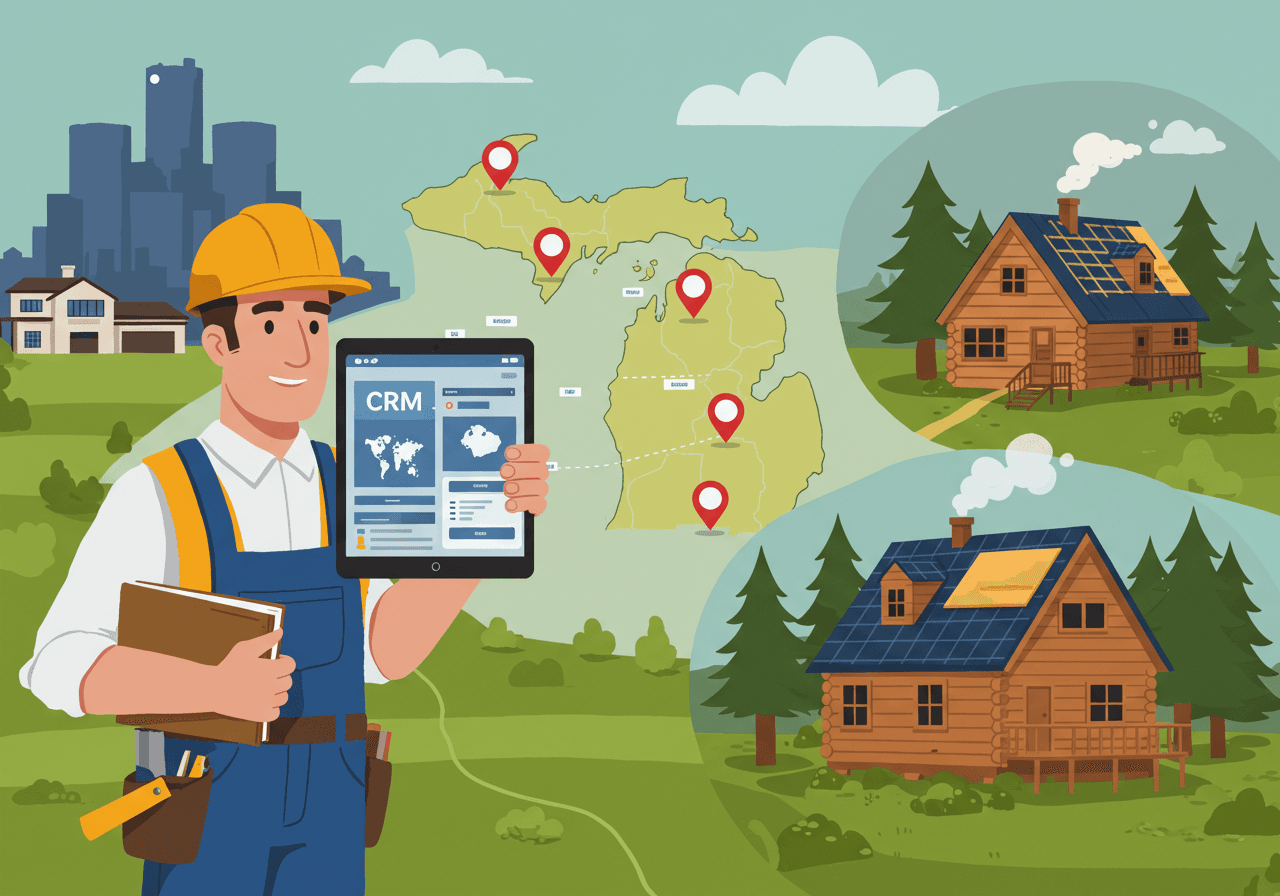
You didn't get into this business to stay small. You've mastered the art of roofing under the relentless Michigan sky. You can estimate a job in Grand Rapids with your eyes closed and you know exactly how much ice and water shield a lakeside home in Traverse City really needs—well beyond what the codebook says. But the ambition that got you this far is now pushing you toward a new horizon: scaling.
Scaling a roofing business in Michigan isn't just about buying more trucks and hiring more crews. It's about building an operational machine robust enough to handle the volatile demands from the U.P.'s lake-effect snow dumps to the summer storm cells that hammer the suburbs of Detroit. It's about transforming your local reputation into a statewide legacy.
This is your blueprint for moving beyond being the best roofer on your block to becoming the most trusted name from Sault Ste. Marie to Southfield.
The Great Lakes Gauntlet: Why Scaling Here is Different
Anyone can scale a business in a state with predictable weather. Here in Michigan, we're playing a different game. To build a true roofing empire, you must first master the unique challenges our state throws at you.
The Geographic and Demographic Divide
Servicing a steep-slope historic home in Ann Arbor is a world away from a metal roof installation on a sprawling barn in the Thumb. As you expand, your logistics, material sourcing, and even your sales pitch must adapt. A crew based in Lansing can't efficiently handle a warranty call in Marquette. Scaling successfully means creating strategic operational hubs or a finely tuned remote management system that doesn't buckle under the weight of a 300-mile drive.
The Four-Season Fury: Our weather isn't a talking point; it's the ultimate stress test for your business model. The brutal freeze-thaw cycle we experience from November through April is a silent killer of subpar installations. Humid summers test ventilation systems, and heavy, wet snow loads challenge structural integrity. A scalable Michigan roofing company doesn't just react to this—it builds its entire service model around it. This means offering proactive services like winter roof inspections, attic ventilation upgrades in the spring, and having a storm-response protocol that can be activated in multiple regions simultaneously.
The Talent Chasm
The skilled labor shortage is a national crisis, but it feels particularly acute here. Building a scalable business means you can no longer be the sole source of expertise. You must build a system to attract, train, and retain top-tier talent. This means creating an in-house training program that codifies your "Michigan-Proof" standards, offering competitive benefits that keep your best people from getting poached, and establishing a clear career ladder from laborer to crew lead to regional manager.
Building Your "Assembly Line": Systemizing for Statewide Success
Michigan's automotive legacy taught the world about the power of the assembly line. It's time to apply that same thinking to your roofing operations. Scaling is impossible without rock-solid, repeatable systems.
Your Scaling Roadmap: From Local to Statewide
Standardize Your "Michigan-Proof" Playbook
Your installation quality is your brand. As you grow, you can't be on every job site. Create a digital playbook—complete with photos and videos—that details your company's non-negotiable standards. This goes beyond the Michigan Residential Code. Specify your requirements: mandate ice & water shield installation to 36 inches (instead of the 24-inch minimum) in high-snowfall zones, create a standardized formula for calculating intake and exhaust ventilation needs, define a 6-nail pattern for all architectural shingles to meet high-wind warranty requirements, and standardize on specific brands of synthetic underlayment or impact-resistant shingles that perform best in our climate.
Deploy a Tech Stack That Crosses the Mackinac
Technology is the glue that will hold your expanding empire together. Your tech stack should provide a single source of truth for your entire operation. A robust CRM like AccuLynx, Jobber, or JobNimbus is essential—it allows you to manage leads, track project progress, and handle invoicing seamlessly, whether the job is in Kalamazoo or Alpena. A drone program dramatically increases estimating efficiency and safety, allowing you to survey large, complex roofs in a fraction of the time and generate precise measurements without putting a salesperson on a treacherous roof. Use fleet and crew management software to track vehicles, optimize routes for fuel efficiency, and dispatch the nearest qualified crew for emergency repairs.
Marketing Beyond Your Home County
As you scale, your marketing must evolve from a local bullhorn to a strategic, multi-regional campaign. You're no longer just targeting "roofers near me." You're building a brand that resonates with the core Michigan values of durability, reliability, and no-nonsense hard work. Focus on digital dominance in key regional markets—West Michigan, Metro Detroit, Up North. Run hyper-targeted ad campaigns in specific zip codes immediately following a hail event. Develop content that showcases your expertise in solving uniquely Michigan problems. Your brand story is no longer "we're the best in town"; it's "we're the best for Michigan."
The Hidden Costs of Scaling: What They Don't Tell You
Scaling isn't just about revenue growth—it's about understanding the true cost of expansion. Many contractors focus on the obvious expenses like new trucks and equipment, but the real costs are often hidden in the operational details.
The Real Cost of Scaling
Fleet Expansion and Maintenance
Each new truck isn't just a purchase—it's ongoing insurance, maintenance, fuel, and the cost of training drivers. Factor in $15,000-$25,000 per vehicle annually beyond the initial purchase.
Management Overhead
You can't scale without managers. Regional managers, project coordinators, and quality control specialists are essential but add $60,000-$100,000 per position annually in salary, benefits, and overhead.
Technology Infrastructure
CRM systems, drone programs, fleet tracking, and digital tools require ongoing subscriptions, training, and IT support. Budget $20,000-$40,000 annually for a comprehensive tech stack.
Material Inventory and Warehousing
As you expand geographically, you'll need regional material storage or pay premium prices for just-in-time delivery. Storage facilities and inventory carrying costs can add $30,000-$50,000 annually per location.
Marketing and Lead Generation
Scaling requires consistent lead flow across multiple markets. Digital marketing, local SEO, and lead generation services scale with your operation. Budget 8-12% of revenue for marketing as you expand.
Scaling Scenarios: The Math Behind the Growth
Understanding the financial implications of scaling is critical. Let's look at two different approaches to expansion and their real-world impact on your bottom line.
Scaling Strategy Comparison
Consider two Michigan roofing contractors, both starting from a $2 million annual revenue base, looking to scale to $5 million over three years.
Reactive Scaling
- Hires crews reactively as jobs come in
- No standardized systems or training
- Relies on word-of-mouth and basic marketing
- Manages operations manually
- Result: 12-15% net margin, high stress, inconsistent quality
Systematic Scaling
- Builds systems before scaling
- Invests in CRM and technology upfront
- Creates standardized training programs
- Implements strategic marketing and lead generation
- Result: 18-22% net margin, scalable operations, consistent quality
The systematic approach requires more upfront investment but creates a business that can scale profitably and sustainably. The reactive approach might get you to $5 million, but you'll be working harder, not smarter, and your margins will suffer.
Alternative Scaling Strategies: Finding Your Path
There's no one-size-fits-all approach to scaling. Different strategies work for different contractors based on their strengths, market position, and resources. Here are the most effective paths to statewide expansion.
Hub-and-Spoke Model
Establish regional hubs in key markets (Metro Detroit, Grand Rapids, Traverse City) with satellite crews. Each hub has its own warehouse, local manager, and dedicated crews. This model provides local presence while maintaining centralized operations and purchasing power. Best for contractors with strong operational systems and capital to invest in infrastructure.
Technology-First Expansion
Use technology to extend your reach without heavy infrastructure investment. Drones for remote inspections, CRM for centralized management, and strategic partnerships with local crews for installation. This model allows rapid expansion with lower capital requirements but requires strong systems and quality control. Ideal for tech-savvy contractors who excel at process management.
Strategic Partnership Model
Partner with established contractors in target markets, providing them with your systems, marketing, and operational expertise in exchange for a revenue share or equity stake. This accelerates expansion while sharing risk and leveraging local knowledge. Works well for contractors with proven systems and strong brand reputation who want to scale faster than organic growth allows.
Storm Response Specialization
Build a scalable storm response operation that can rapidly deploy crews across the state when severe weather hits. This requires flexible crews, mobile operations, and strong logistics. While seasonal, this model can generate significant revenue during peak periods and establish your brand statewide. Best for contractors with strong logistics capabilities and flexible workforce.
Each strategy has its place, and many successful contractors combine elements from multiple approaches. The key is choosing the path that aligns with your strengths, resources, and long-term vision.
Your Scaling Action Plan
- Document Your Systems: Create a comprehensive digital playbook covering installation standards, quality control, customer communication, and operational procedures before you scale.
- Invest in Technology: Implement a robust CRM system and supporting tech stack (drones, fleet management, digital proposals) that can scale with your operations.
- Build Your Talent Pipeline: Develop training programs, create clear career paths, and establish competitive compensation packages to attract and retain top talent.
- Plan Your Geographic Strategy: Identify target markets, assess competition, and determine whether hub-and-spoke, technology-first, partnership, or storm-response models fit your goals.
- Calculate True Scaling Costs: Factor in fleet, management overhead, technology, inventory, and marketing costs when planning your expansion budget.
- Evolve Your Marketing: Shift from local to multi-regional campaigns, focusing on Michigan-specific challenges and building a brand that resonates statewide.
Scaling is the ultimate test of your vision. It's about building a business that's as resilient and enduring as the Peninsulas themselves. Stop thinking about the next job and start architecting your dynasty. The path from local hero to statewide leader isn't easy, but with the right systems, technology, and strategy, it's absolutely achievable.
As you scale your operations, consistent lead generation becomes critical. You need a reliable flow of qualified leads across all your markets, not just your home base. Learn how LeadZik generates exclusive roofing leads that can fuel your expansion, providing you with pre-qualified homeowners ready to work with a professional contractor. Our system integrates seamlessly with modern CRM platforms, helping you manage leads efficiently as you scale from the Soo to Southfield.
Ready to Scale Your Michigan Roofing Empire?
Scaling requires consistent, high-quality leads across all your markets. LeadZik delivers exclusive roofing leads directly to your phone, helping you fuel your expansion with qualified homeowners ready to work with a professional contractor.
Exclusive Leads Only
Every lead is yours alone—no competition, no shared leads, just qualified homeowners ready to work with you.
Statewide Coverage
Get leads across Michigan—from Metro Detroit to the U.P., helping you expand your reach as you scale.
Instant Notifications
Receive leads directly on your phone the moment a qualified homeowner requests a quote, so you can respond first.
CRM Integration Ready
Our leads work seamlessly with your existing CRM, making it easy to manage leads as you scale your operations.
Stop chasing leads. Start building your dynasty.
Get Your Exclusive Leads Today