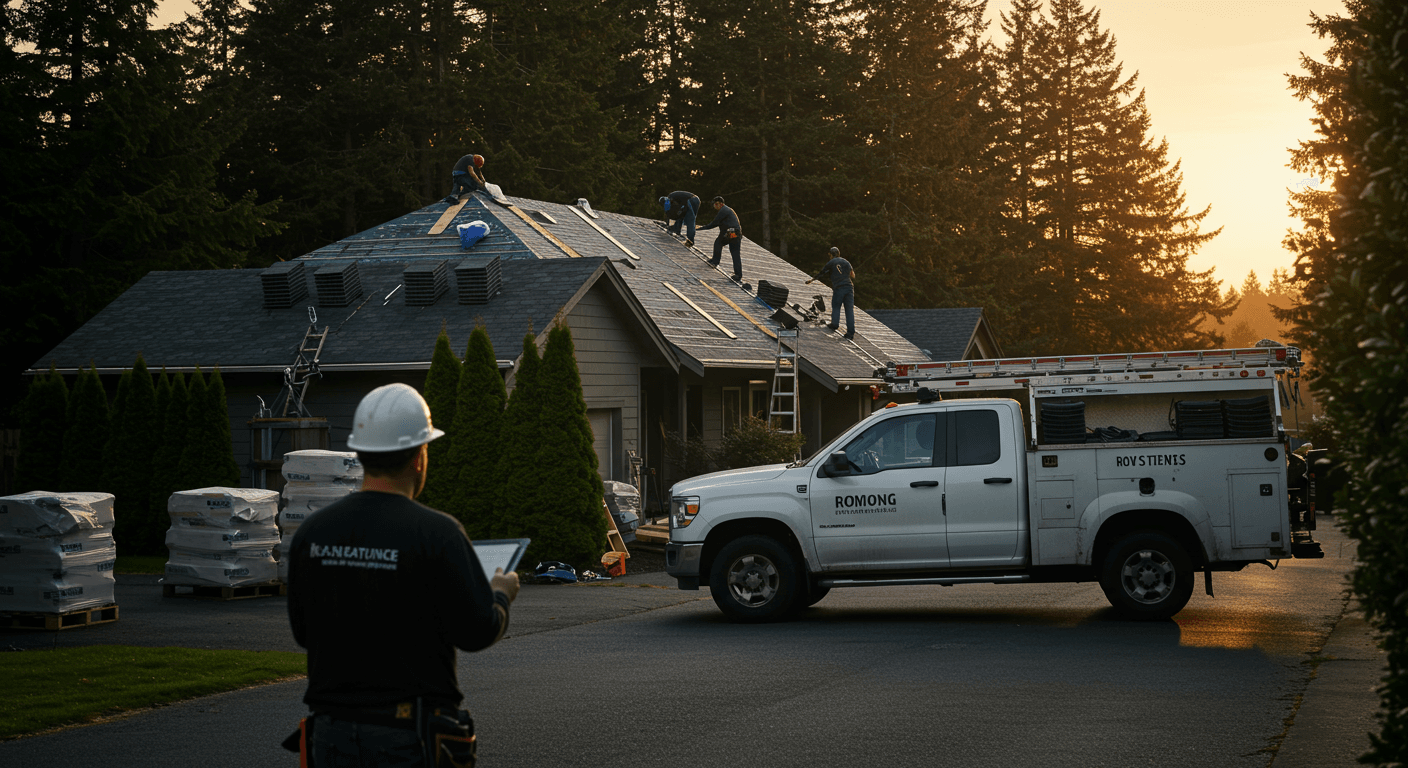
Running a legacy shop as a lifestyle business pays emotional dividends. Rebuilding it as a durable asset asks for different wiring. Many family outfits plateau near $1.25M in annual revenue because the owner is still the primary sales engine. Shops in places like Salem or Eugene that push past roughly $4.8M usually treat the owner as the architect of systems, not the lead estimator who touches every file.
For a second-generation owner, that fork is blunt. You either keep stacking hats until the calendar snaps, or you install guardrails that let other people carry weight without lowering the standard.
From hands-on to hands-off: a Central Oregon shift
Four years ago Wesley inherited a Bend shop that was respected locally and still structurally dependent on him.
Wesley stepped into his father's roofing company after 24 years of steady neighborhood work. Revenue sat near $987,500. He was logging about 72 hours a week, personally inspecting steep-slope tear-offs and negotiating every insurance adjustment. He could read a deck better than anyone on the crew, which also made him the bottleneck.
The constraint was not demand. According to the IBISWorld roofing contractors industry snapshot, the trade stays fragmented, which rewards operators who professionalize faster than the contractor parked next to them at the supply house. Wesley did not need more noise. He needed facts inside his P&L, his pipeline, and his production rhythm.
We spent six months dismantling habits that felt like loyalty but behaved like risk. In their place we built the five systems below. By the end of year two, revenue reached about $2.34M and net margin improved 6.4 points even after adding a dedicated sales manager and the overhead that comes with it.
Lifestyle shop versus scalable asset
| Operating lens | Owner-centric shop | System-driven shop |
|---|---|---|
| Lead flow | Referrals plus seasonal luck | Diversified pipeline you can throttle |
| Sales process | Tribal knowledge and handshake closes | Documented stages with CRM-tracked KPIs |
| Crew management | Owner on-site to bless every detail | SOPs, photos, and clear accountability |
| Financial discipline | Bank balance as the scoreboard | Unit economics and tight job costing |
Lead flow
Sales process
Crew management
Financial discipline
What changes when the shop becomes an asset
Moving from owner-only sales to a documented pipeline is how buyers justify higher multiples, often near 34% when the rest of the books are clean.
Balancing referrals with channels you can turn up in a wet week stabilizes cash when Oregon weather erases a week of production.
Photo-backed quality checks and closed-loop callbacks routinely shave double-digit callback pressure once volume adds crews.
Job costing is the margin firewall in competitive corridors like Portland where a soft bid shows up two weeks later as a net loss.
System 1: granular financial visibility
If you only watch the checking account, cedar shake can look heroic while it quietly bleeds you.
Most family shops I see across the Willamette Valley treat the month-end bank balance as the report card. Pay the supply house, pay the crews, see what is left, call it a win. Wesley was doing honest work on that model and still missing the leaks.
His first real wake-up was job-level math. Cedar shake "specialty" work was losing about 4.2% per project once labor stretch and debris handling were priced honestly. We reweighted the mix toward architectural shingles and metal systems that fit high-desert sun and wind without the hidden labor tax.
Once owners replace gut bids with loaded labor, burden, and waste assumptions, they stop subsidizing pretty portfolios with invisible subsidies.
System 2: predictable lead acquisition
Referrals are gold. They are also not a dial you can turn when a crew has a hole next Tuesday.
Word of mouth keeps reputation high and volume capped. In Oregon, a rainy stretch can hollow a production calendar in a couple of days. You need a backlog of scoped work that fits your crews, not just warm introductions that arrive whenever neighbors talk.
Wesley was burning hours on shared lead lists where he was rarely first in line. We narrowed acquisition around exclusive, verified jobs with clear previews so his team could judge fit before committing time and miles. Customer acquisition cost settled near $412 per closed contract because spend tracked real intent instead of random speed-dial races.
System 3: the standardized sales playbook
If only Dad knows how to close, the company never outgrows Dad.
Family businesses often inherit process as folklore. Wesley documented his sales motion into seven repeatable beats so a new rep could execute without copying his voice.
- The 15-minute pre-arrival call.
- The perimeter photo walk.
- The attic and ventilation audit.
- The digital roof report presentation.
- The good-better-best pricing matrix.
- The financing bridge.
- The immediate follow-up sequence.
On paper, the playbook felt rigid. In practice it freed him to hire. Within 90 days the new rep closed near 31% compared with Wesley's 45%, but appointment volume doubled total monthly revenue because the calendar was no longer single-threaded.
Scope before you schedule
"Give estimators a locked view of project details and verified contact data before the appointment hits the calendar. If the homeowner will not share basics, the meeting is usually a charity consult, not a pipeline event."
System 4: production and quality guardrails
More crews without standards is how callbacks become a second payroll line.
Scaling from two crews toward five invites variance. ConsumerAffairs roofing statistics underscore how much homeowners invest in the category, which raises the emotional stakes when a detail fails. In Oregon, one missed flashing on a November night can turn into thousands in interior repairs and a reputation hit that outlasts the dry season.
Wesley rolled out a "Final 50" checklist: fifty photo-backed checkpoints the lead installer uploads through a mobile field workflow before the crew signs off. Callback pressure fell about 22.4%, and he reclaimed weekends because every ridge cap no longer needed his personal stamp.
Action Plan
The four-step crew accountability loop
Quality at scale is less about hovering and more about forcing evidence before the trucks leave.
Digital onboarding: every crew member acknowledges the job-specific SOP on a phone or tablet before tear-off starts.
Mid-day photo check: ice and water shield plus valley metal documented by noon so corrections happen in daylight.
Customer sign-off: homeowner walk-through or a recorded video tour before final cleanup and invoice talk.
Automated review ask: only trigger the review request after the quality checklist reads complete, not when someone feels lucky.
System 5: cultivating a high-performance culture
Legacy tenure is not the same as legacy standards.
Hiring inside a family brand is sensitive. You inherit people who remember the old trucks and the old rules. Wesley had to make a hard call when a long-time foreman refused the digital tools the new quality loop required. Keeping peace would have quietly vetoed the entire system.
We shifted incentives to three measurable outcomes: safety with zero incidents, quality with zero callbacks inside 30 days, and efficiency inside estimated labor hours. Bonuses followed the scoreboard, not tenure stories.
The informal hire trap
Bringing on relatives or friends without a written role, metrics, and a real consequence path is how scaling stalls near $2M. If performance conversations are impossible, payroll is not the right place for the relationship.
Final thoughts on the Oregon market
Licensing, climate bands, and buyer expectations do not forgive generalists.
Between CCB expectations and the swing from coastal salt air to Cascades snow loads, Oregon punishes roofers who improvise without local proof. Wesley's win was not hustle for its own sake. It was breathing room created by systems that let estimators estimate, crews execute, and the owner steer capital instead of chasing missing bundles.
That is the difference between owning a job and owning something someone else could run if life changes tomorrow.