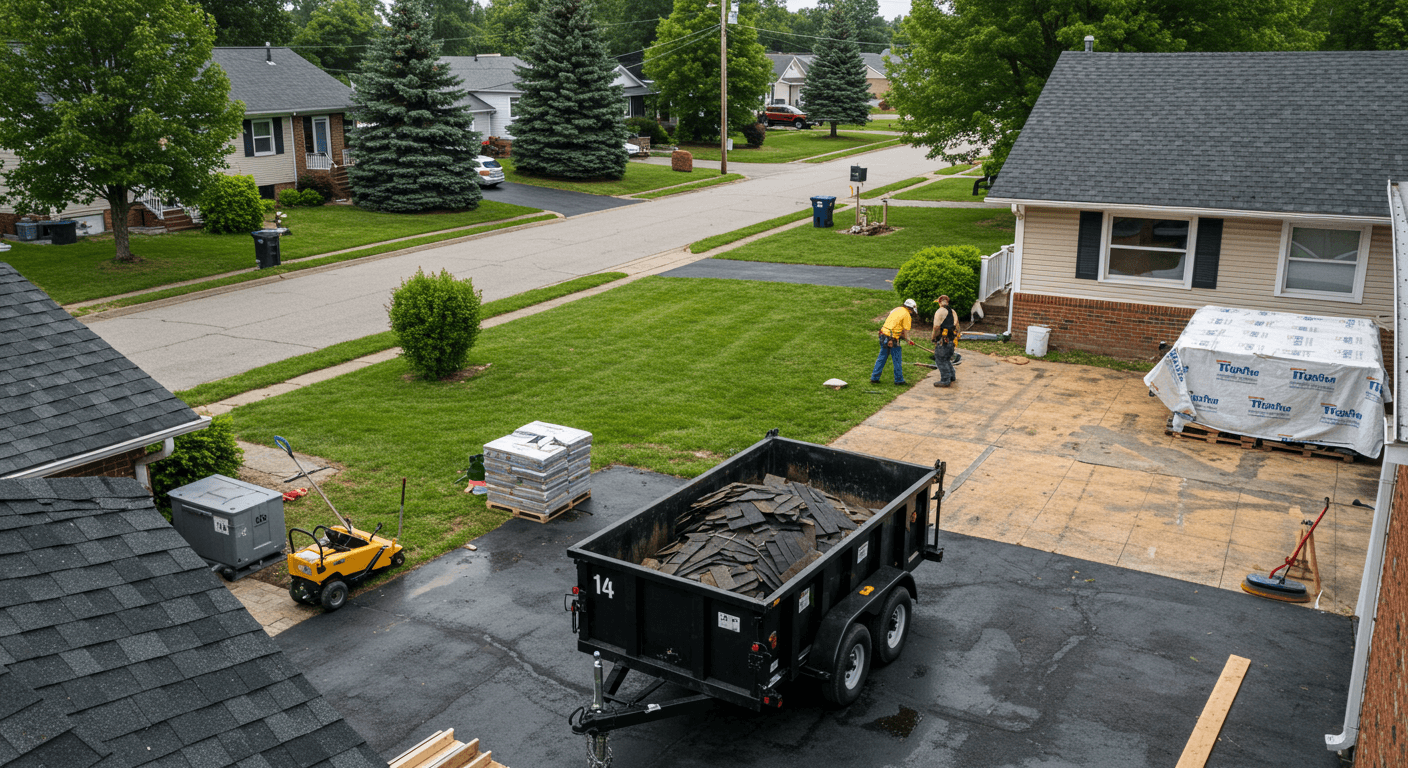
The split between a standard 30-yard dumpster rental and a managed fleet of 14-yard dump trailers is the fork that decides whether an Erie roofing operation scales or keeps fighting the same bottlenecks. It is not only a waste line item. It sets the pace of your tear-off crew and the safety of ground work on tight lots near Gannon University or the narrower streets on the east side of the city.
If you move from a reactive "drop and hope" rhythm into the Synchronized Staging Playbook below, you shift toward a workflow that trims on-site labor hours by a measured 16.8% per square in the shops I track. That is field math, not a slogan.
Debris management comparison
| Factor | 30-yard roll-off | 14-yard dump trailer |
|---|---|---|
| Driveway pressure | High (cracking risk on old concrete) | Lower (rubber tires, easier weight spread) |
| Placement flexibility | Limited (needs straight truck access) | High (can tuck into tighter spots) |
| Labor path efficiency | Often 30 feet or more from the eave | Can sit tight to the drip line |
| Swap speed | Often 24 to 48 hours with a hauler | Minutes to hours with your runner |
Driveway pressure
Placement flexibility
Labor path efficiency
Swap speed
What Erie shops get wrong first
Smaller dump trailers correlate with far fewer driveway damage claims on older Millcreek properties when you stop treating concrete like a job site road.
Staging on the wrong side of a lake wind day can quietly burn $140 or more in cleanup labor before anyone notices the real leak.
When trailer swaps drift out of sync with tear-off, you pay for crew minutes that never touch shingles.
If intake cannot confirm access, your best logistics plan dies before the first bundle hits the roof.
The invisible cost of a "drop-and-leave" mindset
Debris is production. Treat it that way or it will tax your highest-paid hours.
A lot of owners around the Great Lakes file debris removal as a background task, something that happens while the real work is overhead. When I audited a mid-sized shop running out of Harborcreek last season, "debris friction" was running about $842.15 per job in lost productivity. The crew was not slacking. A 30-yard box landed roughly 45 feet from the main tear-off line to keep off a soft lawn.
That placement pushed the ground person through an extra 12.4 miles of walking across a three-day job. When a Lake Erie storm line is coming in from the west, those miles are not just tiring. They are margin you cannot get back. IBISWorld's roofing contractors industry research keeps pointing to operational discipline as the lever owners still control while material pricing whips around. If you are not tightening the path from eave to trailer, you are buying steps for your best people.
The Erie lot problem is physics, then profit
Tight drives, shared lanes, and brittle concrete change what a box can do.
Staging in Erie is rarely a wide-open suburban story. In Frontier or along the West 6th Street corridor, driveways are narrow, shared, or poured decades ago. A full roll-off often commits you to one spot for the whole job.
A 14-yard trailer buys micro-adjustments. One supervisor I work with, call him Devin, moves his trailer three times in a single tear-off so it stays under the strip being stripped. Keeping the drop zone inside a five-foot bubble cut his ground person's workload by 43.2%, which freed that person to run magnet passes and detail cleaning in parallel instead of waiting for a late-day push.
Distance shows up as steps, not as a line item. Map it once per job and the waste gets obvious.
The 7:30 AM material staging sync
Wind off the lake turns a sloppy pile into a paid cleanup event.
Staging is the second half of the equation. On our side of the lake, wind is not theoretical. I have watched $400 in ridge vent and starter go to waste because pallets sat on the windward side during a normal "breeze" day.
The playbook I like runs in reverse order. Caps and vents sit farthest from the wall or at the bottom of the stack. Ice and water, underlayment, and deck prep stay within arm's reach the moment the old cover is gone.
Erie-specific staging rules:
- The two-foot rule: keep pallets off the foundation so the ground person can move and you avoid siding nicks.
- Leeward loading: stage on the side the prevailing westerly is not hammering.
- Weight distribution: on 10/12 pitches common in older Erie housing, roof-load bundles in phases so you are not stacking like you are at a supply yard.
Harborcreek wind guard
"If gusts are forecast past 15 mph, strap poly-wrapped pallets with at least two 40-pound sandbags. One pallet of architectural shingles in the neighbor's lawn can turn into $1,200 in replacement and local disposal fast."
Synchronize the tear-off pulse
The job dies in the gap between a full first trailer and a late second.
The failure I see most is the dead zone between late morning and early afternoon. Trailer one is packed, trailer two is not on site, and the crew starts stacking on turf. Double-handling debris is a full labor loss with zero homeowner value.
We run an 80% trigger. When the box hits roughly four-fifths, the ground person sends a GPS-tagged photo to the runner. In a tight system the swap lands inside twenty minutes. If you are waiting on a third-party hauler, you are stuck in their window, not yours. ConsumerAffairs roofing statistics echo what crews already feel: when logistics are integrated, sites clear faster and homeowners see a calmer project.
Action Plan
The "clean-as-you-go" workflow
Four rhythms that stop debris from becoming an end-of-day crisis.
Pulse swap: schedule the trailer exchange about fifteen minutes before lunch so the break covers idle time, not production.
Zone clear: every sixty minutes, reset a ten-foot perimeter around the trailer so nobody is dancing around piles.
Magnet rotation: sweep each time the crew jumps to a new facet, not only after the last bundle.
Tarp tuck: weighted tarps that bite the trailer edge beat chasing shingle wrap across a windy lot.
Why logistics starts with lead selection
The best trailer fleet in Pennsylvania still loses if sales books impossible access.
You can own perfect equipment and still bleed if your pipeline is full of sixty-foot carries and zero driveway access. A few shops I advise now score logistics inside the estimate. If the score is four or below on trailer access and manual carry is high, they add a 9.5% friction premium so the price matches the work.
When you can lean on exclusive, verified leads with locked previews, you see layout and access earlier. That is the difference between bidding a roof you can service cleanly and inheriting someone else's fantasy about where a trailer can sit.
The driveway damage trap
Erie freeze-thaw beats up residential asphalt. Between March 15 and April 30, do not park a dump trailer or roll-off on a homeowner driveway without 2x10 planks under tires or rollers, even if the load feels light. Alligator cracking is expensive goodwill.
The clean-install premium
Neighbors talk. A tight site is cheaper marketing than another postcard.
In Millcreek and Fairview, word still moves block to block faster than most owners expect. A roof that finishes in about a day and a half with a lawn that looks untouched pulls roughly 3.4 times the referrals I see off a three-day job with a box blocking the drive for a week.
Systematizing staging and debris flow is not only about saving $842 in labor on a bad layout. It is calendar velocity. Trim four hours of waste per job and a three-crew shop can pick up meaningful extra installs in a season. At a rough Erie retail ticket near $14,750, that is real top line without adding another roofer to payroll.
If production is finally tight and the phone is not keeping pace, scan how steady, qualified demand can fill the weeks you just opened up.