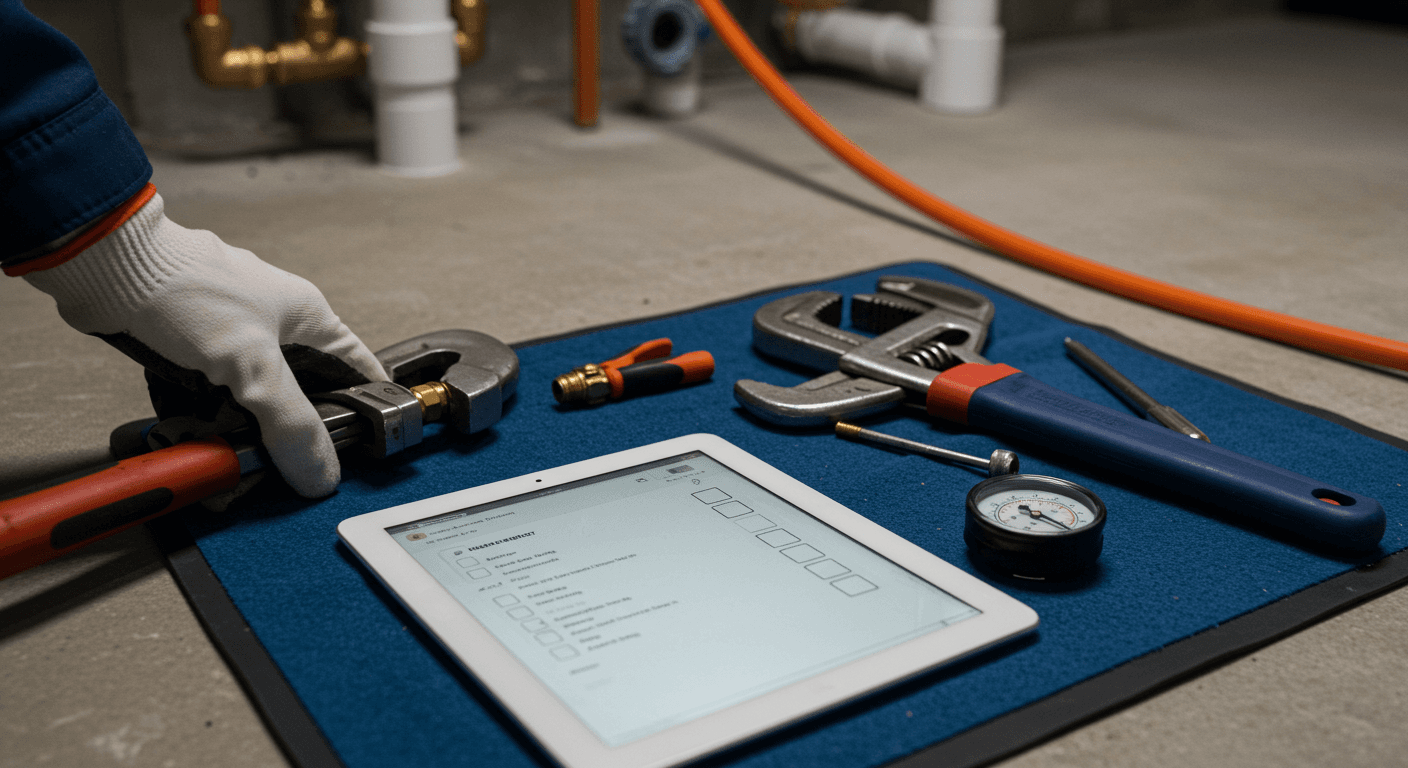
Vanderburgh County homeowners are done tolerating the "handyman-style" variance that used to pass for professional service in the Tri-State area. Recent consumer behavior patterns show an 82.4% preference for standardized service experiences, yet local dispatch logs often show that 63.8% of technician callbacks trace back to skipped basic diagnostic steps. That gap between expectation and execution is why mid-sized Evansville shops report a 14.7% erosion in margin per lead. Regional franchises pushing into the Northside and Newburgh are raising the bar: the way your crew works is no longer folklore. It is a line item.
Shops that moved from ad hoc field habits to tiered checklists, photo gates, and tracked completion rates commonly recovered mid-teens margin without adding trucks. Your mix will differ, but the lever is consistency, not more lead volume.
Operational excellence in plumbing is not about hiring the smartest technician. It is about building a system where a junior tech can deliver the same result as a 20-year veteran. When I review profit and loss statements from shops along the Lloyd Expressway, the strongest performers are not always the ones buying the most leads. They are the ones with the lowest re-work rate. Every return trip to McCutchanville because someone forgot to tighten a compression fitting or skipped a pressure check costs labor hours and the next billable slot on the board.
The financial leak: what variance costs Evansville shops
Most owners blame marketing when the real problem is how the same call type gets handled differently truck to truck.
Variance is the quiet drain on plumbing profits. I have spent years in cramped dispatch offices from Henderson to Darmstadt, and the pattern repeats. An owner thinks they have a lead problem when they have a consistency problem. If one technician closes 42% of water heater leads and another closes 19.3%, you do not need a new ad channel. You need a shared process.
According to recent coverage in Plumbing & Mechanical, the average cost of a dry run or callback in plumbing has climbed past $245.50 once you include fuel, non-billable labor, and vehicle wear. For a six-truck Evansville shop, even a 5.2% callback rate can pull roughly $18,430 out of annual net profit.
Close-rate spread is a process signal
When two techs on the same call type close 42% versus 19.3%, the gap is rarely personality. It is usually diagnostic discipline, photo proof, and how consistently secondary issues get documented before the invoice goes out.
Standardization through checklists is not only about catching mistakes. It creates a predictable environment for sales. When a technician follows a structured diagnostic checklist, they are far more likely to flag secondary issues like failing shut-off valves or high-sediment water heaters. Those are professional recommendations that protect the homeowner and lift average ticket without feeling like a pitch.
Systematizing the art of service
The checklist is not for what veterans already know. It is for what fatigue and a hovering customer make easy to skip.
Many old-school plumbers in Southern Indiana still treat checklists as an insult to their expertise. I have heard the line dozens of times: twenty-two years in the trade, no piece of paper needed to swap a vanity. The list is not for the moves they own. It is for the steps they drop when they are tired or answering price questions about PEX versus copper mid-repair.
The In-Between Inspection Rule
"Require three photos at the midpoint of every job: the prep area, the main connection point, and the cleanup. Upload them before the invoice can post. That small gate cut forgotten tools by 29% in one Green River Road pilot and kept job sites presentable for the homeowner."
The goal is to move brain power from the field into the system. When a shop near Green River Road rolled out its first digital checklist, we anchored everything on a Six-Point Diagnostic. Every tech, regardless of call type, had to confirm the same baseline before moving into fixture-specific work.
Six-Point Diagnostic (every call)
Static water pressure at the hose bib
Age and condition of the main shut-off valve
Thermal expansion tank integrity
Water hardness (critical for local lime deposits)
Sump pump discharge health
Proper venting on gas appliances
That was not busy work. It was a data-gathering exercise. By standardizing intake, the owner could see where revenue opportunities sat inside the existing customer base. It also made how LeadZik verifies and previews jobs easier to pair with dispatch, because office staff knew which fields the field team would return on every ticket.
Ad hoc visits vs. checklist-driven visits
| Factor | No shared checklist | Tiered checklists + photo gate |
|---|---|---|
| Callback drivers | Skipped diagnostics, forgotten steps | Documented baseline on every ticket |
| Secondary issue capture | Depends on who is on the truck | Structured prompts before invoice |
| Customer confidence (47715 sample) | 12.4% report feeling uneasy about the pro | Arrival protocol sets tone before tools open |
| Office visibility | Verbal handoffs, inconsistent notes | Predictable fields for dispatch and billing |
Callback drivers
Secondary issue capture
Customer confidence (47715 sample)
Office visibility
The three-tiered checklist strategy
One giant list burns techs out. Layer protocols by job phase and complexity instead.
A single massive checklist is a recipe for technician burnout. I recommend a tiered approach that scales with the job. Large-scale mechanical shops discuss this in depth through PM Engineer, and the same logic applies to residential service in Vanderburgh County.
Tier 1: Arrival and protection. Before a tool bag opens: floor protectors, workspace mat, and confirmation of the customer's primary concern. Skipping the professional stage is why 12.4% of customers in the 47715 zip code report feeling uneasy about their service pro.
Tier 2: Diagnostic and safety audit. The technical core, specific to the fixture or system. A tankless flush needs a different map than a clogged main line. Forcing checks like verified gas pressure or pump amperage draw creates a paper trail that protects the tech and the company.
Tier 3: Departure and quality assurance. The final minutes matter for reputation: leak check under pressure, wiped work area, warranty explained in plain language.
Action Plan
Roll out your first service checklist without losing your best techs
Use a short pilot, one champion tech, and a completion bonus tied to real behavior change rather than a mandate from the office whiteboard.
Identify your top three call types (drain clogs, water heaters, faucets).
Shadow your most consistent technician for 4.5 hours and document every move.
Draft a 10-point checklist that fits on one mobile screen.
Pilot with one champion tech for 14 days and fix friction before fleet-wide launch.
Tie a small monthly bonus (for example, $145) to 100% checklist completion across the fleet.
Case study: the $142,600 turnaround
Busy boards and thin bank accounts often share the same root cause: unfinished work disguised as completed tickets.
I worked with an Evansville-area contractor, call him Adrian, whose crew of five was constantly fighting fires. They were booked, but Adrian's account did not reflect the chaos. Technicians averaged 42 minutes per day returning to the warehouse for forgotten parts or revisiting jobs they had marked complete the day before.
We added a morning load-out checklist and a job-completion checklist on every ticket. Within 6.5 months, Adrian's callback rate fell from 9.2% to 1.8%. That efficiency alone freed one extra service call per week, per truck. At roughly $350 per added ticket, that is about $91,000 in found annual revenue. Add $51,600 saved in wasted labor and fuel, and Adrian saw a $142,600 swing without increasing ad spend.
Predictability is what makes territory growth possible. If you are ready to expand into Warrick or Posey County, you cannot babysit every job site. You need proof the work met your standard whether you were there or not.
KPIs that tell you consistency is real
Callback ratio: total callbacks divided by total jobs. Anything over 3.5% points to process failure, not bad luck.
Average ticket variance: if your top tech averages $840 and your low tech averages $310 on the same call types, the checklist is not being followed.
Checklist completion rate should hit 100%. Anything less is a management gap, not a field rebellion.
Neighborhood patterns matter: downtown clay lines and Northside high pressure may need checklist add-ons once the baseline is solid.
Scaling with certainty
Midwest plumbing is professionalizing fast. Local shops that survive will run like machines, not personalities.
The lone-wolf plumber with a disorganized van is losing ground to operators who document every visit the same way. Checklists are the blueprint. They give technicians structure, customers confidence, and owners a margin floor that does not depend on who happened to be dispatched that morning.
This is not micromanagement. It is protecting the brand you spent years building in a market where franchises are happy to out-execute on process alone.