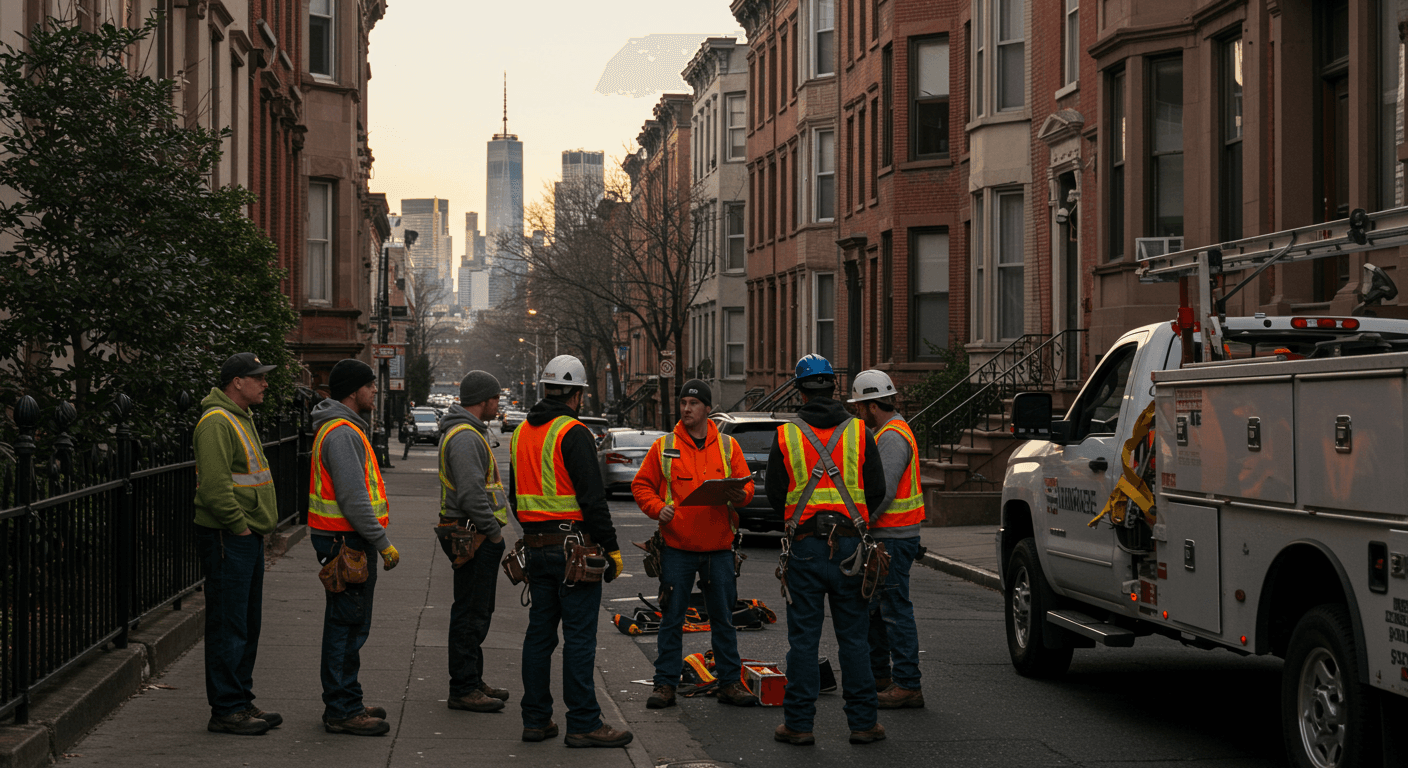
Could your current safety protocol survive a surprise inspection while your crew is tied off on a steep-slope brownstone in Van Vorst Park? It is a question that most owners in the Jersey City market avoid until a compliance officer pulls up to the curb or a workers' comp claim spikes their premiums by 26% in a single quarter. I recently spent an afternoon with Jaxon, who runs a mid-sized residential and light commercial outfit near Journal Square. He was frustrated because he had just lost a lucrative municipal contract for a library roof. The reason was not his price or his craftsmanship. It was his Experience Modification Rate (EMR). His safety record, which he considered "fine" because nobody had been seriously hurt in three years, was actually a 1.24. In the eyes of the city and high-ticket commercial clients, that number shouted "liability."
In the roofing business, we often treat safety as a checklist or a nagging requirement from the state of New Jersey. However, after analyzing the operations of dozens of shops across the Hudson County area, I have seen that safety is actually a primary driver of profit margins. When you operate in a dense urban environment like Jersey City, the stakes are higher. You are not just dealing with the height of the roof. You are managing narrow staging areas, heavy pedestrian traffic on sidewalks, and the logistical nightmare of tight street parking. One mistake does not just hurt a worker, it shuts down a job site and drains your cash flow.
At a Glance
Reducing your EMR below 1.0 can lower annual workers' comp premiums by $12,450 to $18,900 for a typical ten-person crew.
High-value commercial and municipal contracts in Jersey City often require a safety manual and a proven track record of compliance.
Indirect costs of a single safety incident, such as equipment damage and lost productivity, are typically 4.2 times the direct medical costs.
Implementing a "Plan, Provide, Train" framework reduces crew turnover and increases daily shingle-count efficiency.
The Hidden Math of Jersey City Safety Metrics
Most contractors I talk to think about safety in terms of the cost of harnesses and the time spent on morning huddles. That is a narrow way to look at the ledger. To understand the real impact, you have to look at your EMR. This number is a multiplier applied to your workers' compensation premiums. If the industry average is 1.0 and your rate is 1.24, you are paying a 24% "inefficiency tax" on every dollar of payroll. For Jaxon, that amounted to an extra $14,782 per year that his competitors were pocketing as pure profit.
In a market as competitive as Northern New Jersey, where labor costs are already inflated, that $14,782 is the difference between upgrading your fleet and struggling to make payroll during a rainy November. When we dug into Jaxon's numbers, we realized that his "good enough" approach was actually a leak in his bucket. We calculated that by implementing a formal program and staying incident-free for eighteen months, he could drop his EMR to 0.89. That shift alone would represent an 11.4% swing in his net margin on labor-heavy jobs.
Beyond the insurance premiums, there is the reality of the Jersey City job site. Whether you are working in Bergen-Lafayette or the Heights, the lack of space means your "Plan" phase must be more rigorous than a suburban shop in South Jersey. You are often dealing with power lines that are uncomfortably close to your staging area and old structures with unpredictable load-bearing capacities. According to the OSHA Roofing Safety guidelines, fall protection is non-negotiable, but in an urban setting, falling objects are an equally dangerous profit-killer. A dropped bundle of shingles hitting a parked car on a narrow street can result in a $3,400 liability claim before lunch.
The 4:1 Indirect Cost Rule
"Always multiply the direct cost of a job site accident by four to estimate the true impact on your business. If a minor injury costs $2,500 in medical bills, expect to lose $10,000 in total through lost crew momentum, administrative time, and potential liquidated damages for project delays."
Why Urban Density Demands a Different Safety Culture
Jersey City is not just another suburb. The sheer density of the metro area changes the operational math of a roofing job. When you are working on a row of townhomes, your crew is essentially performing on a stage. Neighbors are watching, local inspectors are walking by, and every move is scrutinized. I have seen contractors get flagged for something as simple as improper ladder pitching on a sidewalk because a passerby called the city.
This environment requires a shift from "compliance" to "culture." Aria, a contractor I worked with near Hamilton Park, realized that her crew viewed safety gear as a hindrance to their speed. They felt that putting on a harness for a quick repair was a waste of time. To change this, we stopped talking about "rules" and started talking about "crew utilization." We showed them that an OSHA stoppage, even a temporary one, could cost each man $215 in lost overtime for the week.
Aria began using a systematic approach to lead management that allowed her to schedule jobs with enough lead time to perform site-specific safety audits. Instead of rushing to a site and figuring it out on the fly, her foremen now spend twenty minutes the day before identifying anchor points and pedestrian detours. This level of preparation actually increased their production speed by 8.7% because the crew knew exactly where to stage materials without moving them three times to stay out of the way of foot traffic.
Common Sense Is Not a Safety Plan
Do not rely on "common sense" as a safety plan. OSHA does not recognize common sense during an audit. Without a written, site-specific safety plan for urban environments, you are vulnerable to "Willful Violation" citations that can exceed $15,600 per occurrence.
Implementing the OSHA "Plan, Provide, Train" Framework
If you want to scale your operations without your insurance agent having a heart attack, you need a repeatable system. I always point my clients toward the OSHA Stop Falls Campaign framework because it is simple enough for a busy foreman to follow but detailed enough to satisfy a commercial general contractor.
1. The Plan Phase
In Jersey City, planning starts with the permit. You need to account for street closures if you are using a crane or a high-reach lift. I have seen projects stalled for three days because a contractor forgot to coordinate with the local precinct for a sidewalk permit. Your plan should include a specific fall protection system for every job. Are you using guardrails, personal fall arrest systems, or safety nets? Documenting this choice before the shingles arrive on site is how you protect your business.
2. The Provide Phase
Buying cheap equipment is a false economy. I once saw a crew using weathered ropes that looked like they belonged on a vintage sailing ship. They thought they were saving $450. In reality, they were risking a multi-million dollar lawsuit. Provide the right gear for the specific roof pitch and material. If you are doing a flat roof on a commercial building near Exchange Place, your needs are vastly different than a steep-slope asphalt job in the suburbs.
3. The Train Phase
Training is where most Jersey City shops fail. They do a "toolbox talk" once a year and call it a day. Real training happens in the language your crew speaks and on the equipment they actually use. I recommend monthly hands-on sessions. Have your most experienced lead demonstrate how to properly inspect a harness. When the crew sees that the "old pro" takes safety seriously, they will too.
Action Plan
How to Lower Your EMR and Insurance Costs
A systematic approach to reducing your Experience Modification Rate and insurance costs over an 18-month cycle.
Audit Your Current EMR: Contact your insurance broker to get your "Mod" worksheet and identify which specific claims are driving your rates up.
Draft a Written Safety Manual: Create a document that outlines your specific protocols for fall protection, ladder safety, and urban staging.
Appoint a Safety Officer: Designate one person (even if it is a part-time duty) to conduct unannounced site visits once a week.
Incentivize Zero-Incident Months: Offer a small, tangible reward (like a catered crew lunch or a $55 gas card) for every month with no reported injuries or equipment damage.
Document Everything: Keep a digital log of every toolbox talk and site inspection to prove a "good faith" effort to compliance officers.
Want to skip the manual work and get exclusive, verified leads instead?
Get $150 in Free CreditsThe Competitive Edge of Verified Operations
One of the biggest shifts in the roofing industry over the last 6.4 years is the demand for transparency. Clients, especially those in the high-end residential and commercial sectors of Jersey City, are doing their homework. They want to know they are hiring a professional organization, not just a guy with a truck and a ladder. When you can present a formal safety program as part of your bid package, you instantly separate yourself from 72% of the local competition.
This professionalism extends to how you acquire and handle your business opportunities. I have found that the most successful contractors in the North Jersey region are those who treat every part of their operation as a verifiable process. For instance, the way our founders at LeadZik built our platform was rooted in the frustration of non-verified, messy data. We saw that contractors needed exclusive, locked previews of jobs so they could focus on work they are actually equipped to handle safely.
When you use advanced platform features to filter for the types of jobs that fit your crew's specific safety training, your efficiency skyrocketed. If your crew is expert at steep-slope safety but less experienced with high-rise commercial flat roofs, you should be targeting leads that match that expertise. Buying the wrong leads is not just a waste of marketing spend. It is a safety risk if you are pushing your team into environments they are not prepared for.
Measuring the ROI of a Safety First Approach
Let's look at the numbers one more time. Suppose you invest $9,250 in new equipment and training over the next year. At first glance, that looks like a pure expense. However, if that investment prevents just one minor fall that would have cost $22,400 in direct and indirect costs, your ROI is already 142%. If it also allows you to bid on that municipal contract Jaxon missed, which had a profit margin of $38,600, your ROI jumps to over 550%.
In my experience, the shops that prioritize safety are the ones that actually stay in business for the long haul. They have lower crew turnover because workers feel respected and protected. They have better reputations with local inspectors, which means fewer "red tags" and delays. And they have predictable insurance costs that allow them to price their jobs with precision.
Jersey City is a demanding market. The buildings are old, the streets are tight, and the regulations are thick. But for the roofing owner who sees safety as an operational strategy rather than a chore, these challenges are actually opportunities. By tightening your protocols, you are not just preventing accidents. You are building a more resilient, more profitable, and more professional business.
For a typical ten-person crew, this translates to $12,450-$18,900 in extra annual premiums