Last October, I audited a mid-sized operation near Ottawa Hills and found that for every $10,000 in revenue they booked, exactly $842 was evaporating into the friction between their measuring tool and their invoicing software. That is an 8.4% "complexity tax" that most owners just accept as the cost of doing business. It isn't.
When I sat down with the owner, a guy named Soren who had three crews running between Perrysburg and Oregon, he was toggling between five different browser tabs just to send one accurate estimate. His office manager was spending 9.4 hours every week re-entering data that should have flowed automatically. At $25 an hour, that's $12,220 a year spent on "data janitor" work—money that could have been invested in better equipment or marketing.
The Toledo market is competitive, especially in neighborhoods like Old Orchard and West Toledo where homeowners expect quick turnarounds. If your software isn't actively reducing administrative overhead, it's just another monthly bill eating your margins. The difference between profitable shops and struggling ones often comes down to operational efficiency, not the quality of shingles you install.
At a Glance
Centralizing data can reduce administrative overhead by up to 17.6% per project.
Integrated measurement tools prevent the $300 to $500 'mis-measurement' errors common in manual entry.
Choosing between an 'all-in-one' platform and a 'best-of-breed' stack depends on your 3-year growth targets.
Local Toledo permitting requirements can be automated within specific CRM workflows to avoid project delays.
The "Franken-stack" Problem in Lucas County
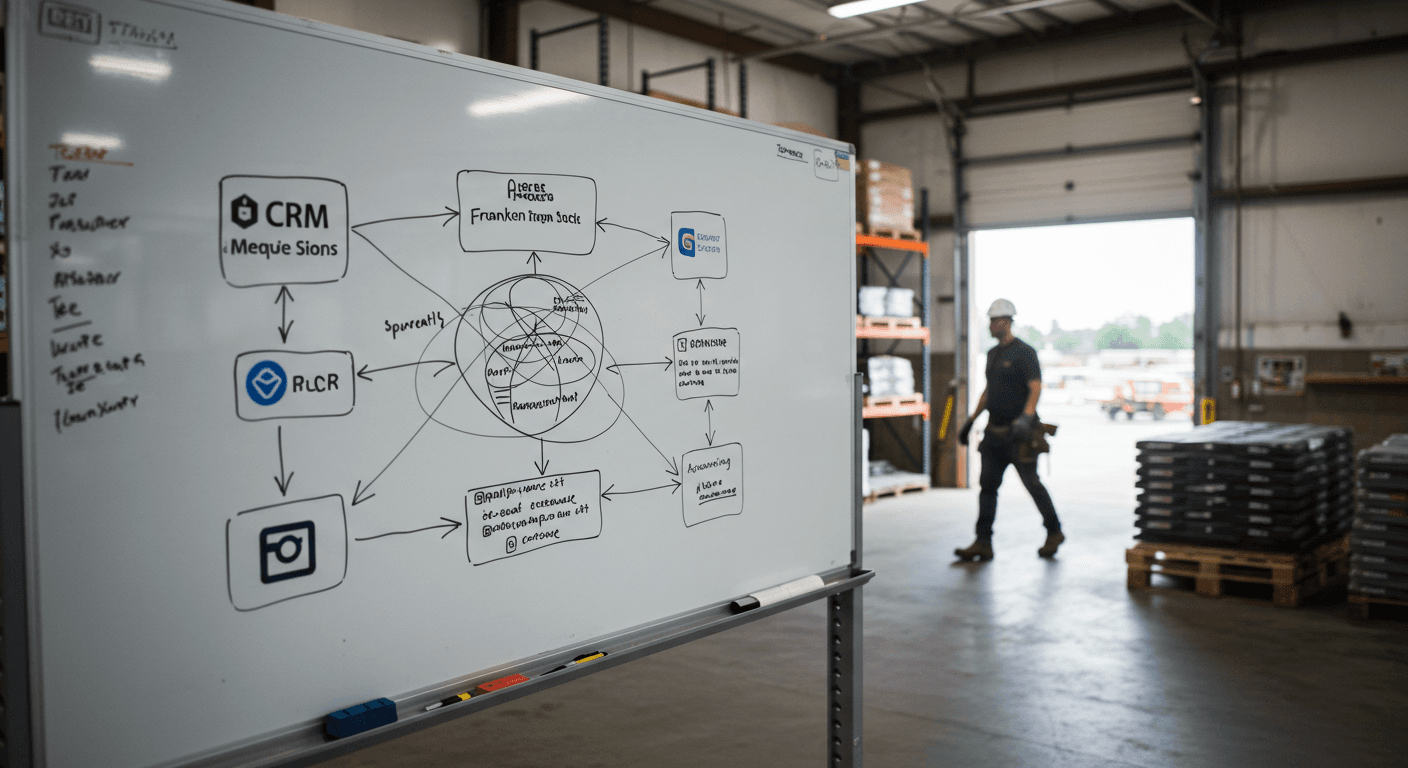
Most Toledo roofing shops do not start with a plan for their technology. They buy a lead, use a separate drone service for measurements, scratch out an estimate on a template they found years ago, and then try to force all that data into QuickBooks. This fragmented approach is what I call a "Franken-stack."
According to the National Roofing Contractors Association (NRCA), administrative inefficiencies are one of the primary reasons small to mid-sized roofing contractors fail to scale past the $2M mark. In Soren's case, his team was spending 9.4 hours every week just re-entering data. If you are paying an office manager $25 an hour, that is $12,220 a year spent on "data janitor" work.
Toledo contractors using fragmented software systems lose an average of 8.4% of revenue to operational friction and data duplication.
The problem isn't that these tools are bad individually—it's that they don't talk to each other. Every time someone has to copy a customer's address from one system to another, you're creating a point of failure. And in a business where margins are already tight, those failures add up fast.
Comparing the Heavyweights: AccuLynx vs. JobNimbus
When we look at operational efficiency, the debate usually settles between AccuLynx and JobNimbus. I have implemented both in shops across the Midwest, and the choice comes down to how much control you want over your workflow.
AccuLynx: The All-In-One Powerhouse
AccuLynx is the "Easy Button" for roofing operations. It is built specifically for roofers, meaning the workflows for Lucas County building permits and material orders are already baked in.
- Pros: Everything is under one roof. You don't have to worry about Zapier or API connections.
- Cons: It is expensive and less flexible. If you have a very specific way of tracking your Maumee sales team's commissions, you might find it restrictive.
JobNimbus: The Customizable Lego Set
JobNimbus is built on the idea that every roofing company is different. It relies heavily on "Boards" to track jobs.
- Pros: Highly visual and cheaper entry point. It excels if you want to integrate specific third-party tools for things like hail mapping or specialized financing.
- Cons: It requires more "setup brain." If you don't have someone on your team who enjoys building processes, you will end up with a messy system that no one uses.
Fragmented vs. Integrated Software Comparison
| Factor | Fragmented Tools (Spreadsheets + Email) | Integrated CRM (AccuLynx/JobNimbus) |
|---|---|---|
| Estimate Speed | 45-60 Minutes | 10-15 Minutes |
| Data Accuracy | High Risk of Entry Errors | Automated Syncing |
| Crew Communication | Scattered Texts/Calls | Centralized Job Folders |
| Avg. Admin Cost/Job | $185.00 | $42.00 |
Estimate Speed
Data Accuracy
Crew Communication
Avg. Admin Cost/Job
The Speed Players: Roofr and RoofSnap
Sometimes, you don't need a massive CRM. If you are a smaller outfit in West Toledo focusing on high-volume residential replacements, your bottleneck is likely the estimation phase. This is where tools like Roofr and RoofSnap come in.
I worked with a contractor who switched to Roofr specifically for their "instant estimates." In the competitive Toledo market, being the first one to get a professional PDF into a homeowner's inbox often determines who gets the job. By using satellite imagery to generate measurements, they cut their lead-to-proposal time by 64%.
The key advantage here is speed. When a homeowner in Sylvania calls three contractors after a storm, the one who can deliver a detailed estimate within hours has a massive advantage. Tools like Roofr eliminate the need for a site visit just to measure, which means your sales team can focus on closing deals instead of climbing ladders.
Toledo Tactical Tip
"Set up your CRM to auto-populate the Lucas County Building Regulations link based on the job's zip code. It saves your production manager 15 minutes of searching per project."
Calculating the ROI of Digital Transformation
Transitioning to a new software system feels like a headache, but the math is undeniable. Let's look at a typical $12,000 roof replacement in the Old Orchard neighborhood.
Without a system, you likely have 5.5 hours of total "invisible" labor:
- Driving to the site for a manual measurement (1.5 hours)
- Drafting the estimate at the office (1 hour)
- Chasing the signature via email (1 hour)
- Manual material ordering (1 hour)
- Invoicing and follow-up (1 hour)
With an integrated system, those 5.5 hours drop to about 1.8 hours. If your internal labor rate is $40 per hour (inclusive of taxes and overhead), you are saving $148 per job. If you do 100 jobs a year, that is $14,800 back in your pocket. That covers the cost of the software three times over.
Beyond the labor, you have the "speed to lead" factor. Using our mobile app to claim and contact leads the second they hit your phone ensures that the data you've paid for doesn't go cold while you're stuck in traffic on I-475.
Action Plan
4-Step Software Migration Plan
A systematic approach to transitioning your Toledo roofing operation to an integrated software platform.
Audit Your Current Gaps: Track every time a team member has to type the same customer name twice. That is a point of failure.
Clean Your Data: Don't move 'garbage' data into a new system. Spend one weekend purging old, dead leads.
The 'Super User' Approach: Pick one person (your best foreman or office lead) to learn the software first. Let them break it before the whole crew starts using it.
Phased Rollout: Start with digital signatures and measurements. Move to production scheduling only after the sales team is comfortable.
Want to skip the manual work and get exclusive, verified leads instead?
Get $150 in Free CreditsAvoiding the "Shelfware" Trap
The biggest mistake I see Toledo roofers make is buying the most expensive software and then only using 10% of the features. It becomes "shelfware"—expensive tech that just sits there. To avoid this, you need to ensure your lead flow is high-quality and consistent. There is no point in having a Ferrari of a CRM if you have no fuel in the tank.
Contractors who focus on verified, exclusive opportunities find that their software ROI increases because the data entering the system is already vetted. You aren't wasting CRM seats on tire-kickers or fake phone numbers.
According to Roofing Contractor Magazine, contractors who integrate their lead generation with their CRM see 23% faster close rates because the sales team isn't wasting time qualifying leads that should have been filtered out upstream.
The Integration Myth
Don't believe a salesperson who says 'it integrates with everything.' Always ask for a live demo of the specific integration you need, especially between your CRM and your accounting software. If it requires a complex third-party connector, it will eventually break.
Final Thoughts on Operational Maturity
Choosing software isn't about the "coolest" features; it is about building a repeatable system that doesn't depend on you being in the office 14 hours a day. Whether you are working in Sylvania or Point Place, your goal should be a "zero-entry" workflow where data moves from the initial lead to the final warranty without being re-typed.
When your operations are tight, every lead becomes more valuable because your margins are protected. If you're ready to stop the profit leaks, start by looking at where your team is doing "double work." That is usually where the biggest ROI is hiding.
The Toledo market rewards efficiency. Contractors who can turn leads into completed jobs faster, with less administrative overhead, will always outcompete those who are still managing projects with spreadsheets and sticky notes. The question isn't whether you need better software—it's whether you can afford to keep losing $842 per job to operational friction.