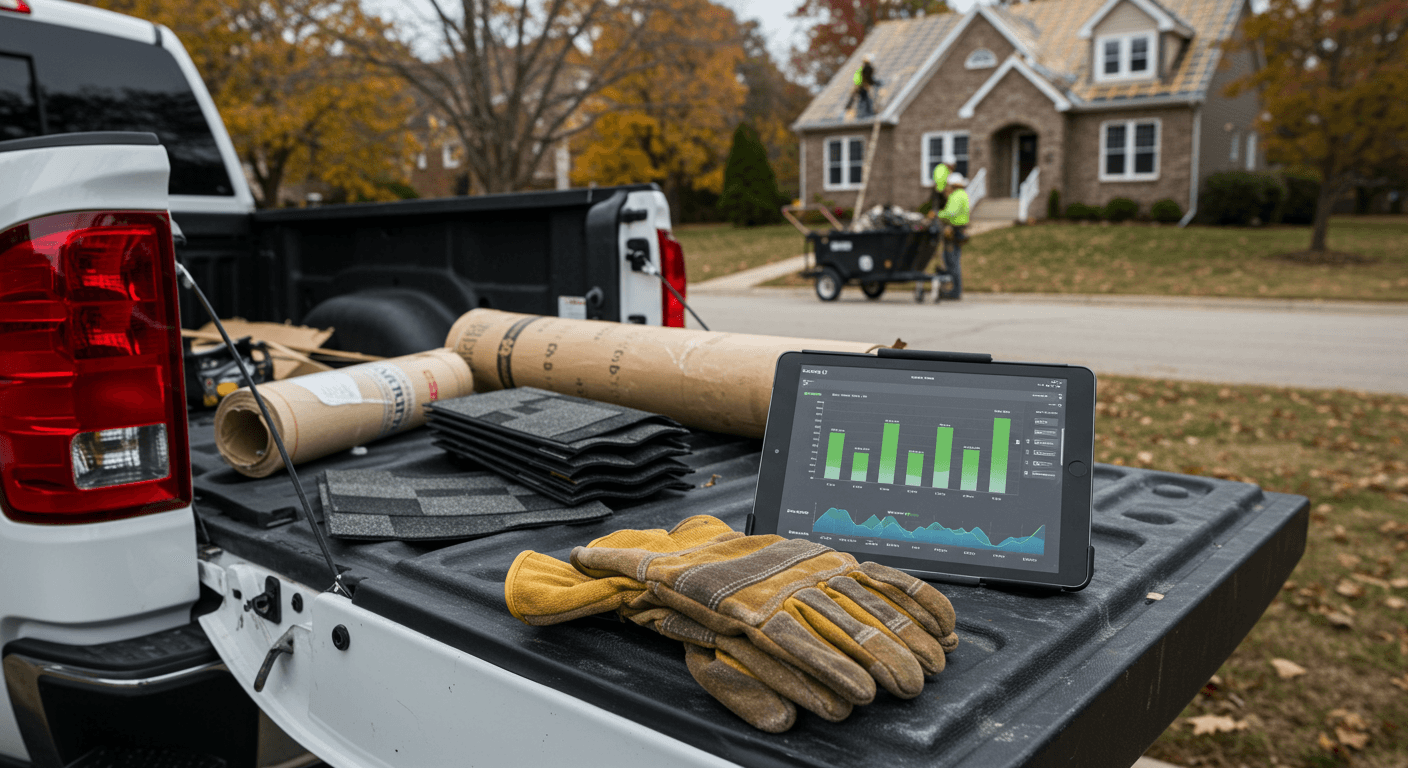
Last October, I sat in a gravel parking lot off I-75 near Sharonville, watching a frustrated owner named Elias stare at three different iPads. On one screen, he had a satellite measurement that didn't match his field tech's notes. On another, a CRM that hadn't synced since Tuesday. On the third, a spreadsheet showing a $22,480 job that was currently $3,200 over budget because of a simple ordering lag.
Contrast that with a shop I visited in Blue Ash two weeks later. Their owner, Gabe, spent exactly six minutes on his phone to move a project from "lead" to "permitted and staged," with every cent of margin accounted for in real time. The difference wasn't the size of their crews or the quality of their shingles. It was a 16.2% gap in operational efficiency dictated entirely by their software architecture.
In the Cincinnati market, where competition for high-end residential work in Indian Hill or commercial tear-offs in Over-the-Rhine is cutthroat, you can't afford "data friction." If your software isn't actively clawing back hours for your production manager, it's just another monthly bill eating your bottom line.
At a Glance
Why 'Frankenstein' tech stacks cost Cincinnati contractors an average of $14,640 in annual labor leaks.
ROI comparison between standard estimation tools and integrated project management platforms.
How to calculate your software payback period using a specific 9.4-month framework.
The impact of local Hamilton County permitting speeds on your software's scheduling efficiency.
The High Price of the "Frankenstein" Tech Stack
Most roofing businesses in Ohio don't start with a plan for their technology. They buy a CRM because they're losing track of paper folders. Then they buy a separate measurement tool. Then a different app for crew scheduling. Before long, they have a "Frankenstein" stack where nothing communicates.
I recently audited a firm in Kenwood that was using four different subscriptions. We tracked their data entry and found that their office manager was re-typing the same customer address 14 times throughout the lifecycle of a single job. When we crunched the numbers, that "hidden" labor cost was totaling $843 per month.
Contractors using disconnected software systems waste significant revenue on redundant data entry and manual synchronization tasks.
The goal of a software comparison shouldn't be "which app has the coolest interface?" It should be "which system reduces my cost per lead and increases my throughput?" According to the National Roofing Contractors Association (NRCA), operational inefficiencies are often the primary reason mid-sized contractors fail to scale past the $2.5M mark.
Comparing ROI: Estimating vs. Project Management
When analyzing software, you have to distinguish between point solutions (tools that do one thing) and platform solutions (tools that run the business). In Cincinnati, weather windows are tight. If your estimating software takes 48 hours to return a report during a storm surge, you've already lost the job to the guy who used an instant AI-measurement tool.
Accuracy vs. Speed in Measurements
I ran an A/B test with a client last spring. We compared manual ladder measurements against a high-end satellite measurement service. On a complex 42-square Victorian roof in Northside, the manual measurement took two hours of travel and climbing time, costing roughly $145 in fully burdened labor. The software report cost $35 and was delivered in 90 minutes.
However, the ROI isn't just the $110 saved. It's the fact that the salesperson could visit three more prospects in that same afternoon. If your closing rate is 22%, those extra stops represent an additional $9,400 in potential weekly revenue.
Software Architecture Comparison
| Factor | Manual Entry / Point Solutions | Integrated Platform Solutions |
|---|---|---|
| Data Entry | High double-entry risk | Single-point data entry |
| Lead-to-Contract Time | 4-6 hour lag | <30 min lead-to-contract |
| Material Ordering | Manual material ordering | Automated vendor PO generation |
Data Entry
Lead-to-Contract Time
Material Ordering
The CRM Engine: Where Margins Are Won or Lost
If you're operating in the Cincinnati metro, your CRM needs to do more than hold phone numbers. It needs to handle the local nuances of Hamilton County and Clermont County permitting. I've seen contractors lose 4.3% of their margin simply because their software didn't alert them that a permit was expiring, leading to a stop-work order and two days of idle crew pay.
I prefer systems that include a robust mobile interface for field crews. When a foreman can upload photos of rotted decking the moment they tear off the old shingles, and the office can send a change order to the homeowner's phone instantly, you eliminate the "I'll pay you when I see the proof" delay.
Pro Tip
"The 5-Minute Rule: In today's market, speed is a premium. Set up an automation in your CRM that triggers a text message to a lead within 300 seconds of the inquiry hitting your system. Data shows that response times under 5 minutes increase conversion rates by over 380% compared to a 30-minute response."
Calculating Your Payback Period
Don't look at the $350 or $600 monthly subscription fee. Look at the payback period. To calculate this, I use a simple formula with my clients:
Payback Period Formula
Total Software Cost / (Monthly Labor Hours Saved × Hourly Rate) = Months to Break Even
If a $485/month software saves your production manager 12 hours a week (valued at $35/hr), you're saving $1,680 in labor value every month. Your payback period is less than 9 days of operation. Everything after that is pure profit injection.
Action Plan
How to Audit Your Tech ROI
A systematic approach to evaluating whether your current software stack is generating returns or draining profits.
Trace the Lead Path: Document every time a piece of data (name, address, roof size) is typed manually.
Identify the Bottleneck: Is it the measurement speed, the contract signing, or the material ordering?
Calculate the 'Missed Opportunity' Cost: How many leads did you fail to follow up on last month because you were 'too busy' with paperwork?
Consolidate or Integrate: Choose one 'Source of Truth' (usually the CRM) and ensure every other tool feeds into it via API.
Want to skip the manual work and get exclusive, verified leads instead?
Get $150 in Free CreditsWhy Local Data Integrity Matters
One thing I see Cincinnati roofers overlook is the quality of the data going into the software. You can have the most expensive CRM on the market, but if it's filled with "tire kickers" or fake numbers from generic lead aggregators, your ROI will stay in the gutter.
I've spent the last 13 years analyzing lead flow, and the most successful shops are those that prioritize verified homeowner data over raw volume. When your software is processing exclusive, pre-screened opportunities, your sales team stays motivated because they aren't chasing ghosts in Mason or Fairfield.
The 'Cheap' Software Trap
Avoid legacy software that doesn't offer an open API. If you can't connect your leads, your accounting, and your measurements, you are building a digital silo that will eventually require a painful and expensive data migration.
Final Thoughts on the Cincinnati Market
We are seeing a massive shift in the Ohio roofing landscape. The "old guard" who relies on yellow pads and hand-shakes is being out-paced by younger, tech-forward firms that treat their software as a profit center, not an expense. Whether you're working a repair in Hyde Park or a full replacement in Covington, the goal is the same: minimize touches, maximize accuracy.
According to research from Construction Dive, contractors who invest in integrated technology platforms see average productivity gains of 23% compared to those using disconnected point solutions. The difference isn't just in the tools—it's in how those tools communicate with each other.
When you're evaluating your next software purchase, remember that the best system is the one that eliminates friction between your sales team, your production manager, and your accounting department. If it doesn't integrate seamlessly, it's costing you more than the monthly subscription fee.