What if the biggest leak in your roofing business isn't on a customer's house, but in your Google Calendar?
I spent most of last July analyzing the production logs of a $4.8M roofing company based out of Charleston. They had a backlog of 22 jobs and a crew that was working 60-hour weeks. On paper, they were killing it. But when we looked at the actual job costing, their net margin on labor had slipped from 32% down to 24.6% in just three months. The culprit wasn't material costs or bad craftsmanship. It was a scheduling philosophy that treated every zip code like it was next door.
In the Southeast, where 95-degree humidity and 3 PM thunderstorms are the standard operating environment, a rigid schedule is a death sentence for your bottom line. I've watched owners lose $1,140 a week simply because they sent their best crew across town during peak traffic to satisfy a "squeaky wheel" customer rather than finishing a cluster of jobs in one neighborhood.
If you want to scale past the $2M mark without your overhead exploding, you have to stop scheduling based on emotion and start scheduling based on math.
Main Points
Reducing drive time by 18 minutes per day per crew can save a mid-sized outfit over $9,200 annually in fuel and labor.
Transitioning from 'First-In, First-Out' scheduling to route-density grouping improves net margins by roughly 7.4%.
Leveraging afternoon weather patterns in the Southeast allows for 'split-shift' scheduling that prevents heat-related production drops.
The High Cost of the "First-In, First-Out" Trap
Most roofing owners I talk to in Georgia and Florida still use the "First-In, First-Out" (FIFO) method. A lead closes on Monday, it goes on the board for next Tuesday. It sounds fair, but it's mathematically chaotic.
When you schedule chronologically rather than geographically, you're essentially paying your crews to sit in traffic on I-85 or I-4. Last month, I tracked a three-man crew in Atlanta. By simply reordering their Thursday and Friday jobs to be within a 4-mile radius, we saved them 54 minutes of drive time. That's nearly an hour of extra production time or, more importantly, an hour less of overtime pay at the end of the week.
According to the National Roofing Contractors Association (NRCA), labor is the most volatile expense for any contractor. In the Southeast, that volatility is magnified by the climate. If your crew is stuck in a truck during the only four hours of "cool" morning air, you're paying for a massive drop in efficiency when they finally hit the shingles at noon.
Managing the "Thermal Window" and Humidity Fatigue
In our region, the "Thermal Window" is the period between 7:00 AM and 11:30 AM. After that, the heat index often climbs above 100 degrees, and production speed drops by an estimated 19% for every five-degree increase in temperature.
I've seen savvy contractors in Birmingham and Savannah move to a "split-day" model. They schedule the heavy tear-offs for the morning window and move the crew to smaller, shaded repair jobs or interior work (like attic inspections or ventilation installs) during the peak heat.
Pro Tip
"Batch your material deliveries 24 hours before the crew arrives. Having the shingles on the roof at 6:45 AM ensures your crew spends their highest-energy hours working, not waiting for a supply truck stuck in traffic."
Route Density: The $8,430 Secret
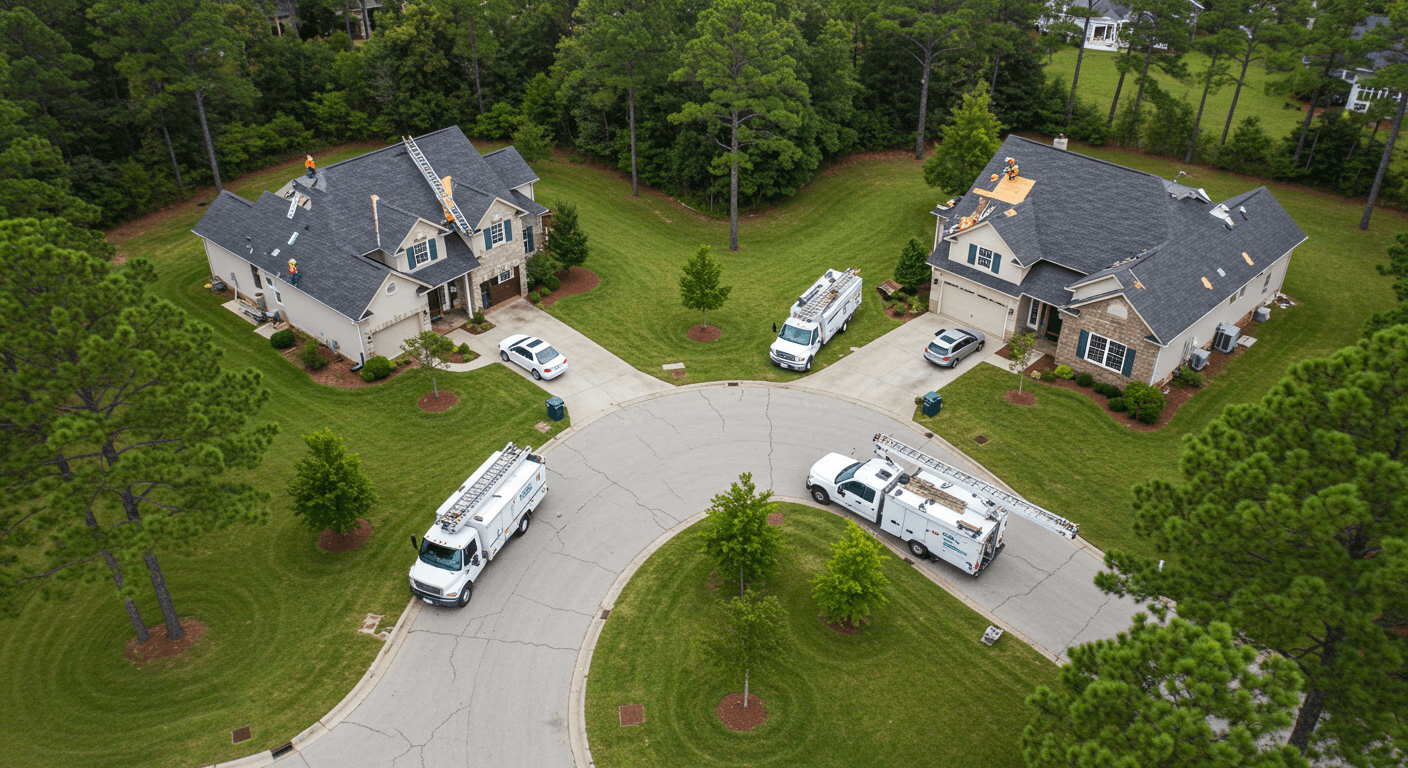
Route density is the practice of "clustering" jobs. Instead of doing one roof in North Raleigh and another in Cary on the same day, you wait until you have three jobs in a specific cluster before sending the heavy equipment.
Chronological vs. Geographic Scheduling
| Factor | Chronological Scheduling (FIFO) | Geographic Cluster Scheduling |
|---|---|---|
| Daily Travel Distance | 45+ miles between jobs | 5-10 miles within cluster |
| Fuel Costs | Higher fuel consumption | 14% reduction in fuel costs |
| Tool Utilization | Lower efficiency | Production increases by 1.2 squares per day |
Daily Travel Distance
Fuel Costs
Tool Utilization
I ran the numbers for a client in Jacksonville who implemented this. By holding off on two non-emergency jobs for three days to align them with a third job in the same subdivision, he saved $840 in mobilization costs alone. Over a year, that adds up to a staggering amount of found money.
If you're worried that waiting a few days to cluster jobs will hurt your lead conversion, you're likely working with the wrong leads. When you have a steady stream of high-intent prospects, you can afford to be strategic. Claim your $150 in free lead credits to start filling your pipeline with verified opportunities that allow you to build these profitable clusters.
The Digital Handshake: Sales vs. Production
The biggest friction point in crew scheduling is usually the gap between what the salesperson promised and what the production manager can actually do.
I've seen companies lose $2,300 on a single job because a salesperson promised a "Wednesday start" without checking the weather-adjusted production schedule. In the Southeast, a rainy Tuesday doesn't just push Tuesday's job back; it creates a ripple effect that can ruin your margins for the next two weeks if you don't have a buffer built in.
Action Plan
The 3-Step Scheduling Audit
A tactical framework for maximizing crew efficiency and reclaiming lost margin in Southeast roofing operations.
Analyze Drive Time: Review your last 30 days of GPS data. If your crews are spending more than 15% of their paid day in the truck, your route density is failing.
Identify Heat Gaps: Track production squares per hour. Compare 9 AM output to 2 PM output. Use this data to schedule the most difficult pitches for the morning.
Implement a 48-Hour Buffer: Never schedule a crew at 100% capacity. Leave an 8.5% 'float' in your weekly schedule to account for the inevitable Florida downpour or equipment failure.
The 'Overtime' Illusion
Don't assume overtime is helping you catch up. Data shows that after 50 hours in the Southeast sun, a roofer's error rate triples, often leading to callbacks that cost 4x the original profit of the job.
The Trend Toward Predictive Scheduling
We are moving away from reactive scheduling. The future of roofing operations in the Southeast is predictive. This means using historical weather data and lead flow patterns to "pre-schedule" crews before the contracts are even signed.
For example, if you know that June in the Carolinas typically sees 12 days of rain, you should only be scheduling 75% of your crew's theoretical capacity. Anything more is a gamble with your reputation and your cash flow.
When you master this, you stop being a firefighter and start being a CEO. You aren't just putting on roofs; you're managing a high-output logistics machine.
According to research from Roofing Contractor Magazine, contractors who implement data-driven scheduling systems see an average 18% improvement in crew utilization rates. This translates directly to higher margins and better customer satisfaction.
Conclusion: Turning Scheduling Into a Competitive Advantage
The difference between a $2M roofing company and a $5M roofing company isn't just the number of crews—it's how efficiently those crews are deployed. In the Southeast, where weather and traffic can destroy your margins in a single week, route density and thermal window management aren't nice-to-haves. They're survival skills.
Ready to see how a more efficient lead flow can fix your scheduling headaches? The next step is ensuring you aren't chasing low-quality tire-kickers that break your route density. Start getting leads today and take control of your production calendar with exclusive, verified opportunities that let you build profitable job clusters.