The split is sharper than most owners admit. One path is a calendar padded so hard that your best installers stew in the yard. The other is a tight production loop where dates follow facts, not hopes. Around Milwaukee, that choice often lands between shops that punch toward roughly $6.8M in organized output and ones that stall near a noisy $2.1M ceiling.
Research tied to Upper Midwest field ops keeps pointing at inventory ghosting, meaning materials are ordered but the office never gets a clean, real-time signal that a job is truly ready for install. The waste shows up as roughly nineteen points of labor drift in some datasets. This walkthrough lays out a three-tier tracking frame that ties supplier lead times, crew deployment, and warranty follow-through to one ledger so you are not guessing from three different screens.
If you want a directional target while you build it, shops that commit to the habit pattern here often see production overhead fall on the order of twelve points and weekly job slots open up because fewer days die to rework and reschedule noise.
What production tracking pays back first
Stop funding trips when the warehouse has not actually released a full kit, so you quit eating roughly $384 per crew on those empty mornings.
Tighten the lag from final walk to invoice with automation so cash can move about 8.5 days faster when billing is tied to verified completion.
Treat warranty touchpoints as scheduled production tasks at 45 days and 11 months so referrals do not quietly rot after the siding looks great in photos.
Give crews fourteen days of visible scheduling so last-second moves drop and the trade crew you trained sticks around.
Why padding the calendar trains chaos
Defensive scheduling feels safe until you count what it steals from margin and morale.
Many Milwaukee-area window and siding owners still build production around guesses from the sales desk. Custom double-hungs might show Tuesday, so you lock Friday and hope. The cushion buys peace of mind until you realize you have baked delay into the standard. A typical four-crew exterior outfit can leak something like $9,400 a month in revenue that could have landed with tighter triggers.
When you pad every line, you are not only hedging supply chain drama. You are teaching the shop that slowdown is normal. Pull scheduling is the counterweight: the install date moves only after product is staged or a delivery is confirmed, not when a salesperson wishes it into existence. Lake Michigan humidity and fast snow bursts already steal windows of good weather. Adding internal slack on top shrinks margin you will not get back on the change order.
You see it when jobs look booked on paper while coil, flashing, or trim is still scattered across POs. The crew still shows, the clock still runs, and gross still bleeds.
The lead time ledger
Custom line items are not the problem. Silent drift while nobody owns the update is.
Labor is tight, yes, but the wider pain in our region is still the four-to-twelve-week swing on custom exterior packages. Treat the gap from PO to dock like a live feed, not a footnote. Teams in Waukesha and West Allis that I have worked beside rely on a simple lead time ledger: manufacturer promise, revised ETA, staging yes or no, and a client ping when material is about ten days out.
Ordering James Hardie fiber cement is a good illustration. Your system should fire a standing reminder every two weeks until the supplier answers with a fresh ship date. That kills the classic late-week surprise where Monday's install was never real.
- Manufacturer commitment date: the original promise tied to the PO.
- Revised ETA: refreshed every Tuesday by whoever owns production planning.
- Staging status: a binary flag that flashing, coil stock, and fasteners are physically in your building.
- Homeowner transparency: an automatic text when product crosses the ten-day window so expectations stay aligned.
Lake Michigan weather and a ranked backlog
Wind off the water is an operations input, not an excuse to wing the schedule.
Milwaukee work is not only about dates. Dew points, gusts, and lake-effect bursts decide whether a plank crew can work safely. A Victorian on the East Side three stories up is a different risk profile than a tight lot buffered by neighbors.
Build a weather-adjusted queue instead of a static whiteboard. Think in three bands: interior or shielded window swaps first, high exposure new construction or lakefront second, warranty or small service thirds you can tuck into a half day when radar shifts. A solid production lead (call him Xavier if you need a name) can reroute within minutes when radar changes, but only when every card in the backlog is actually ready to execute. That readiness is easier when your verification process keeps homeowner intent and access details honest before jobs hit the board.
- Priority 1 (shielded): replacements tucked into lower wind exposure pockets.
- Priority 2 (high exposure): lakefront or open-field jobs that need calm air.
- Priority 3 (service): short warranty touches you can slide between fronts.
Manual boards versus integrated production tracking
| Control point | Spreadsheets or whiteboards | Integrated tracking |
|---|---|---|
| Data freshness | Status goes stale after a day or two in the rush | Field and office see the same live staging flags |
| Homeowner comms | Ad hoc texts when someone remembers | Triggers fire off ledger dates without a manager babysitting each thread |
| Supplier history | No clean record of who hits dates and who does not | Lead time variance is visible by vendor and SKU class |
| Five-plus crews | Admin time balloons as chat threads multiply | Scales with less daily noise because ownership is clear |
Data freshness
Homeowner comms
Supplier history
Five-plus crews
Staging and kitting as margin insurance
Most margin walks do not start with labor rate. They start with a missing corner post.
Missing trim syndrome is expensive in Brookfield and everywhere else: the crew pushes most of a wall, then discovers color-matched caulk or a custom corner piece never left the warehouse. Minutes turn into hours, fuel burns, and your bid guardrails evaporate.
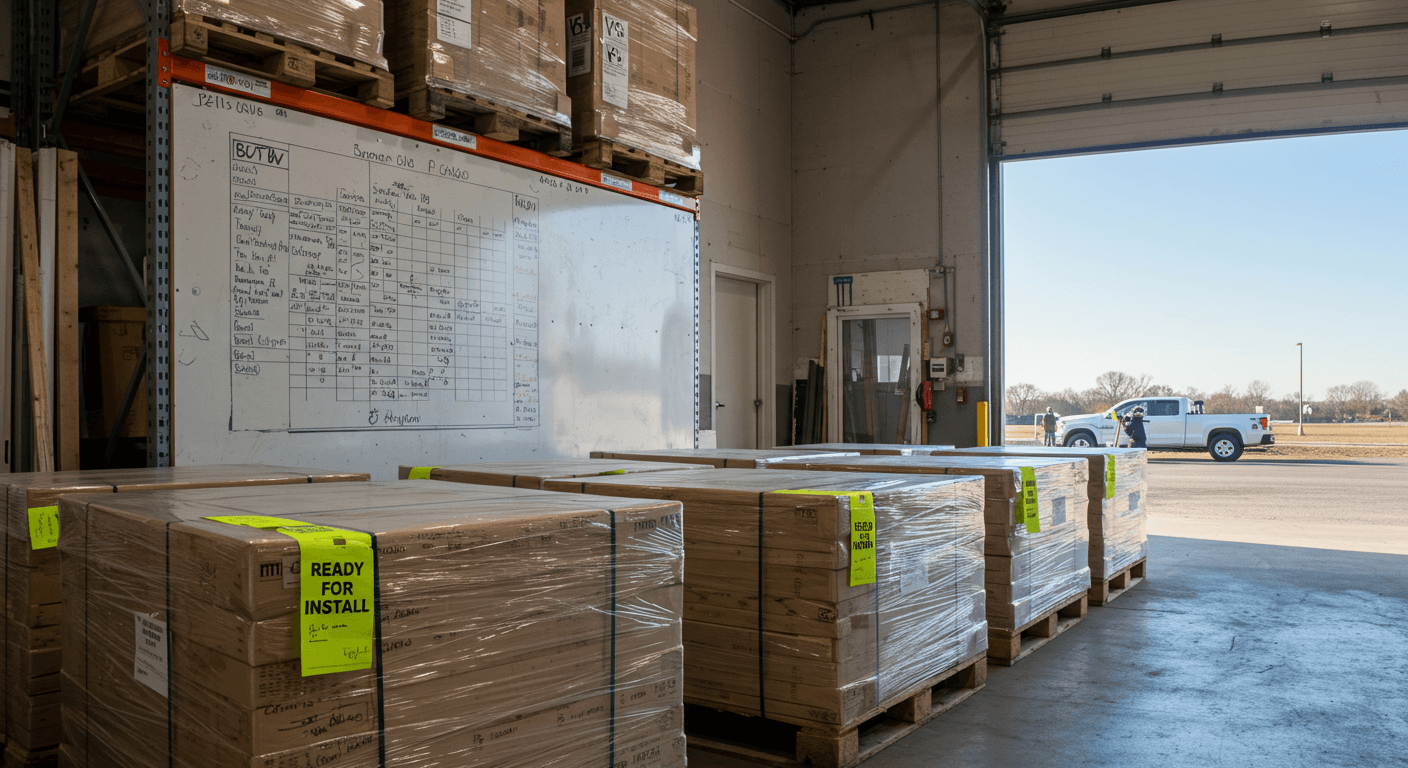
A real production system forces a kitting checklist before anything hits "ready for schedule.” That includes the hero cladding from sources like LP Building Solutions siding resources plus every accessory required to call the job finished, not almost finished.
The 72-hour hard lock
"No job advances from staged to active unless the warehouse lead physically confirms the kit at least seventy-two hours ahead. That kills the dawn scramble that makes foremen hate the office."
Warranty and service as production, not punishment
How you close the loop decides whether reviews age well.
It is easy to treat warranty runs as a tax on new revenue. That mindset shows up in slow callbacks, thin documentation, and homeowners who felt great at close but sour six months later. A disciplined shop tracks service like any other phase.
Build two recurring tasks into the same system you use for installs: a forty-five day quality drive-by for popped trim or early settlement quirks, and an eleven-month anniversary audit before the one-year labor window closes. The second visit is a natural moment to ask for a referral or short testimonial because the house still feels new.
When those jobs stay labeled as production work, they get crew time and materials like anything else. If you never seem to have bandwidth for that work, look upstream. Messy intake often means your team chases the wrong prospects instead of protecting past clients. A straight question to LeadZik support can clear account settings fast so your field leaders are not fighting the CRM while follow-ups slip.
Action Plan
Four weeks to a cleaner production loop
You can stand this up without halting the company. The goal is to replace folklore with one ledger everyone trusts.
Week 1, audit the last fourteen window and siding jobs and tag every delay with a dollar cost tied to labor, fuel, and financing drag.
Week 2, pick your tool and build the lead time ledger with columns for commitment, revised ETA, staging, and homeowner comms. Assign one person to refresh supplier ETAs on Tuesday and Thursday only.
Week 3, define a full kit for each service line, build a physical staging lane, and require tags seventy-two hours before any install date locks.
Week 4, train the production lead on the weather-adjusted queue and run a tabletop drill where high exposure work pauses while shielded and service work absorbs the hours.
Measuring the cost of chaos
If you are not timing from first arrival to signed walkthrough, you are guessing.
Milwaukee labor is not cheap. When a lead installer burns an hour at a yard instead of on a ladder, you can model that as something like $84 of gross left on the table depending on your burdened rate and average ticket.
Shops that move to systematic tracking often lift first-time completion by about sixteen points. That is fewer punch trips, lower fuel, and crews who trust the schedule you publish.
The "one-person" trap
If only your production manager knows whether the Mequon windows cleared receiving, you do not have a system. You have a single point of failure. Keep the ledger cloud-based, readable for ownership, and boringly up to date.
Scaling into 2026 without adding noise
Capacity becomes math once triggers are honest.
Production tracking is not filing for its own sake. It is how you plug in another crew or project manager without the wheels coming off. Owners sometimes freeze on buying demand because they are scared of overload. Fair fear. The fix is not more padding. It is a ready-for-install gate plus a kitting lock so you know what you can actually run next week.
Reclaiming admin friction alone has landed shops with something like twenty-four percent more throughput without hiring a parallel office. You are not chasing heroics, just fewer invisible leaks.