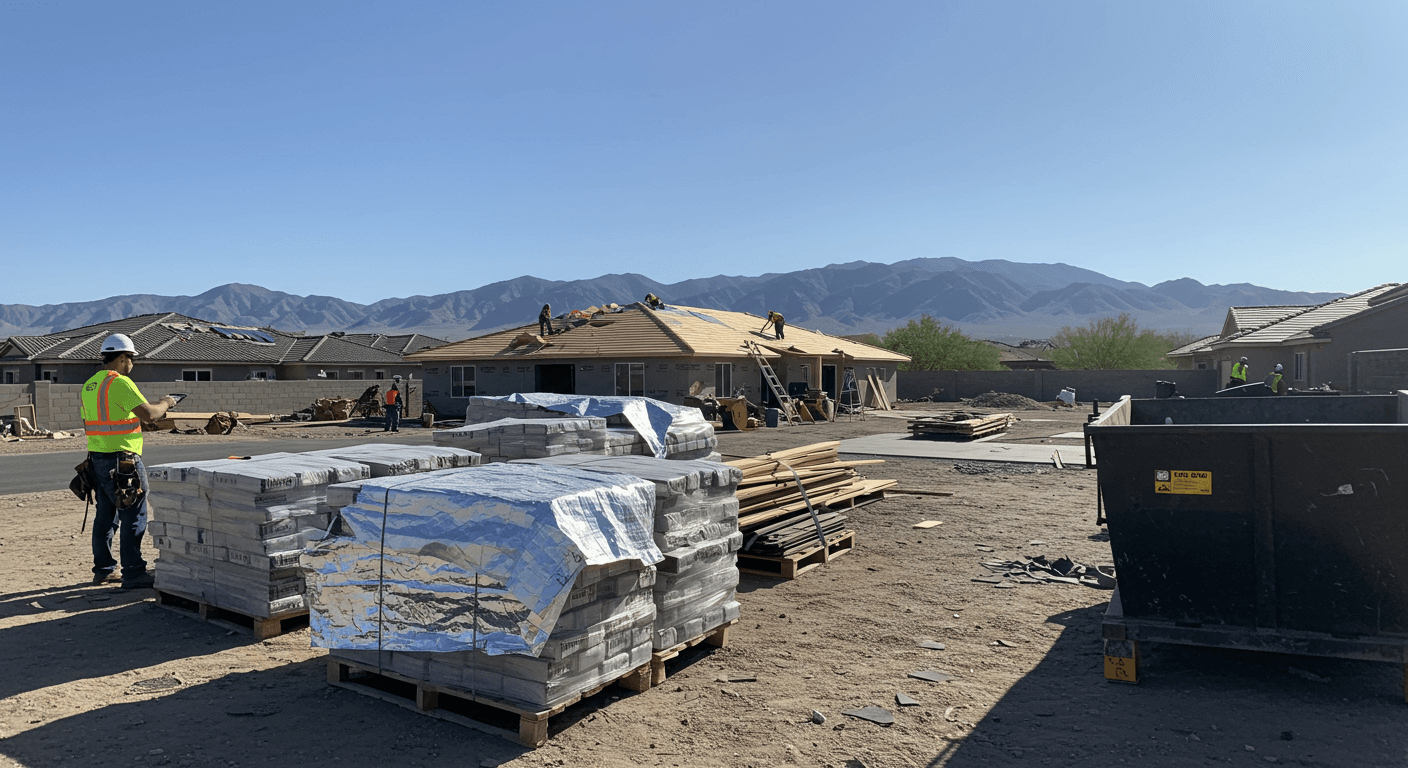
Walking through a job site in the Inspirada community of Henderson last Tuesday, I noticed something that immediately made my stomach churn (and not just because of the 104-degree heat). I was visiting a long-term client, a sharp operator named Preston, who has been trying to scale his residential tear-off business. As we stood near the staging area, I looked into the 40-yard roll-off dumpster and saw three unopened bundles of architectural shingles buried under a heap of OSB scraps and old underlayment. Those bundles represented about $135 of pure profit literally being thrown away, and that was just one house on a street where he had four more starts scheduled.
When I pointed it out to Preston, he sighed and admitted that he usually just builds a 15% waste factor into his estimates to cover the "chaos" of the field. This is a trap many contractors in the Clark County area fall into. They treat material waste as an inevitable cost of doing business rather than a controllable variable. In a market like Henderson, where competition for high-end re-roofs in neighborhoods like Seven Hills or Anthem is fierce, a 13.4% leak in your material budget is often the difference between a healthy year and just breaking even.
At a Glance
Auditing dumpster contents can reveal systemic over-ordering patterns that traditional spreadsheets miss.
Shifting from a flat 15% waste factor to a precision-measured 7.2% can save a medium-sized Henderson shop over $84,000 annually.
Implementing a "Return to Stock" incentive for crews reduces the tendency to bury unused materials in the debris pile.
Comparing software-driven measurements against manual field takes is essential for identifying ridge and valley estimation errors.
The Cost of the "Buffer" Mentality
Most of the companies I have consulted with start their journey with a "buffer" mentality. They order 10% to 15% extra because the last thing they want is a crew sitting idle on a roof in the middle of a July afternoon while waiting for a hot-shot delivery of two squares. While that logic seems sound for production speed, it creates a massive financial leak. I recently audited a shop near Boulder Highway that was averaging $9,642 in monthly material overages. When we dug into the data, we found that their "just in case" ordering was actually incentivizing crews to be sloppy with their cuts because they knew they had an endless supply of shingles on the ground.
This problem is compounded by the disposal costs at local facilities. Every extra pound of wasted shingle you toss into the bin increases your tipping fees. In Henderson, where logistics costs are climbing, you are essentially paying for the material twice (once to buy it and once to throw it away). By tightening these processes, you can redirect those funds toward more aggressive lead generation strategies that actually grow your top line.
Comparing Three Waste Reduction Strategies
To fix this, you have to decide which operational lever you want to pull. Not every shop has the same culture or crew structure, so the solution needs to fit your specific workflow.
Option 1: The Precision Digital Takeoff
This involves using high-resolution aerial imagery and 3D modeling to get measurements down to the inch.
- Pros: Eliminates human error in measuring complex hips and valleys.
- Cons: High per-report cost and doesn't account for crew-specific cutting habits.
- ROI: Typically pays for itself on roofs over 35 squares by reducing waste to under 6%.
Option 2: The Material Audit & Incentive Program
You track exactly what goes onto the roof and what stays in the dumpster. Crews get a small bonus for every unopened bundle returned to the warehouse in good condition.
- Pros: Changes crew culture and puts "eyes on the pile."
- Cons: Requires a dedicated production manager to verify returns.
- ROI: I have seen this cut waste by 38% within the first 90 days of implementation.
Option 3: Lean Staging and Kitting
Instead of delivering a bulk load, materials are kitted by the specific facet of the roof and delivered in stages.
- Pros: Massive reduction in damaged materials and theft.
- Cons: Requires sophisticated logistics and a very reliable supplier partner.
Action Plan
A Systematic Approach to Reducing Job Site Waste
A systematic approach to reducing job site waste through auditing and incentive structures.
Conduct a "Dumpster Dive" audit on three consecutive jobs to identify the percentage of unused vs. scrap material.
Establish a baseline waste percentage for different roof complexities (e.g., 6% for simple gables, 11% for complex multi-level).
Implement a "Clean Returns" policy where suppliers pick up unopened bundles at the end of a project.
Review the "Lead-to-Material" ratio to ensure that high-quality leads aren't being offset by poor production efficiency.
Monthly P&L review to track the decrease in "Miscellaneous Material" spend.
Want to skip the manual work and get exclusive, verified leads instead?
Get $150 in Free CreditsThe Impact of Henderson's Climate on Material Handling
We cannot talk about waste in Southern Nevada without talking about the sun. I have watched crews in Cadence leave bundles sitting in the direct sun for hours, causing the sealant strips to activate prematurely. Once those shingles bond in the bundle, they are essentially garbage. This is "environmental waste," and it is rampant in our region.
Training your crews to stage materials in the shade or under reflective tarps isn't just about comfort, it is about protecting your inventory. I worked with one contractor who lost $4,320 in a single week because his team left 12 squares of premium shingles in the back of a black trailer over a record-breaking weekend. These are the operational "paper cuts" that bleed a business dry. If you want to see how we started as a small shop dealing with these same issues, you can see our story of moving from field chaos to systematic growth.
The 'End-of-Day' Bundle Count
"Require your foremen to text a photo of all remaining unopened bundles at 3:00 PM every day. This simple act of accountability prevents "accidental" disposal and ensures you know exactly what inventory is left for the next morning's start."
Beyond the Shingles: Accessories and Underlayment
While shingles are the most visible waste, the real margin killers are often the accessories. Rolls of synthetic underlayment, starter strips, and ridge vents are frequently over-ordered and under-utilized. I once saw a crew use a 4-foot piece of ridge vent as a shim because they didn't want to walk back to the truck for a scrap of wood. That is a $12 mistake made out of laziness.
Integrating these costs into your broader lead acquisition strategy is vital. If you know your production cost per square is $312 because your waste is dialed in, you can outbid the guy who has to guess $345 just to be safe. That $33 per square advantage is how you dominate the Henderson market. When you combine precise material management with advanced lead scoring and territory optimization, you create a competitive moat that most contractors can't match.
Final Thoughts on Operational Leanness
Efficiency is not about being cheap, it is about being precise. When you look at your P&L at the end of the quarter, you shouldn't see a giant "Miscellaneous" or "Overhead" bucket that hides your material losses. Every shingle should be accounted for, either on a customer's roof or back in your warehouse.
Preston, the contractor I mentioned earlier, eventually implemented the "Clean Returns" program. Last I checked, he had reduced his average waste factor from 15.2% down to 7.8%. On his volume, that move alone added roughly $6,400 to his net profit every single month. That is more than enough to fund a new marketing campaign or upgrade his fleet. Stop letting your profits end up in a Henderson landfill. For more strategies on optimizing your roofing operations, check out our expert articles covering everything from crew management to lead generation.