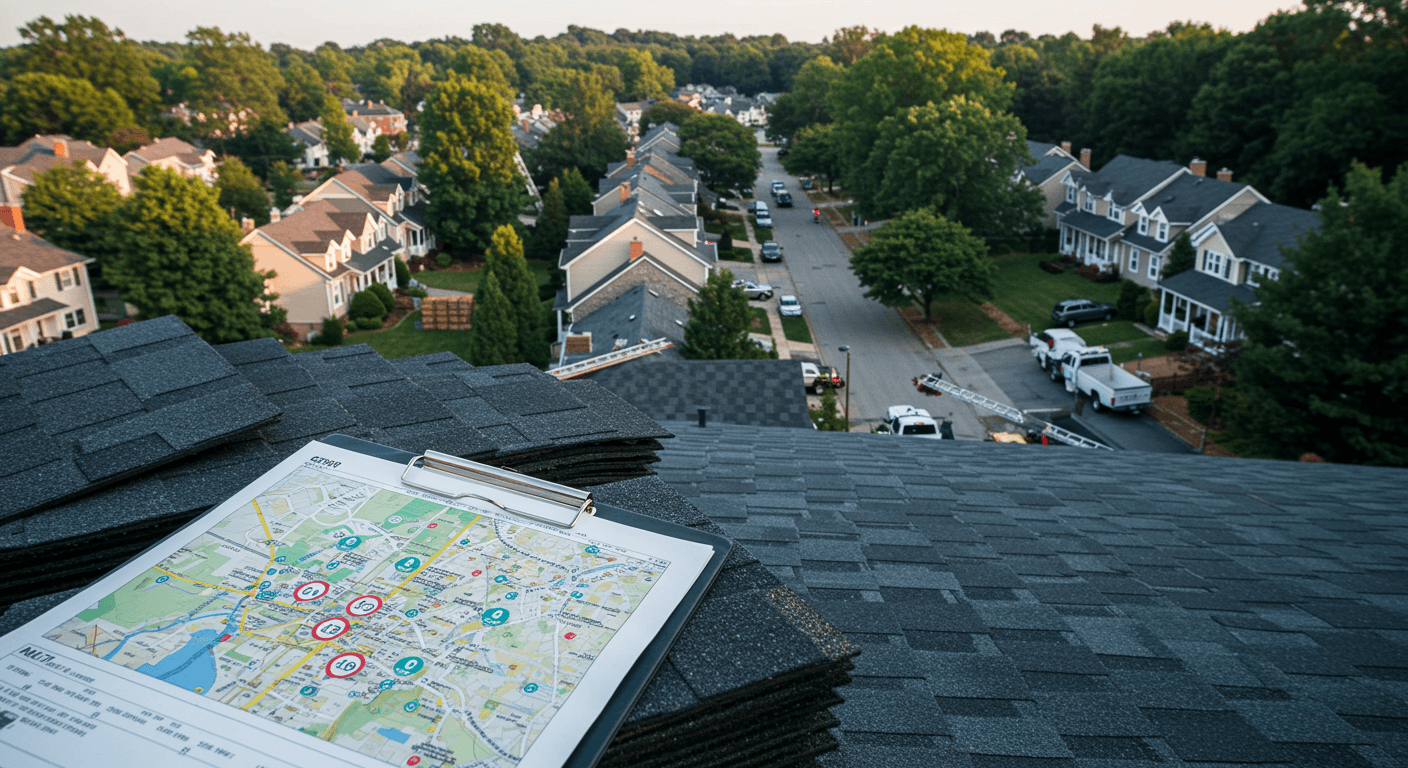
Standing on a wind-whipped ridge in Montclair, Kieran pointed toward the skyline and admitted his biggest fear wasn't the 47-foot drop, but the fact that three of his competitors had yard signs on this same street. He had a crew of 12, a fleet of four shiny Rams, and a bank account that looked healthy on the surface, but his net margins were thinning like an old 3-tab shingle. We spent the afternoon digging into his job costs and realized he was burning $1,842 in fuel and idle time every week just crossing the Driscoll Bridge to chase "maybe" leads.
New Jersey is one of the most densely populated states in the country, yet I see so many contractors treating it like a vast, empty wilderness. They spread their marketing budget from Sussex down to Cape May, wondering why their customer acquisition cost (CAC) is hovering around $540 while their local competitors are feasting on referrals. Market domination in the Garden State isn't about having the biggest billboard on I-95, it is about owning specific zip codes until your brand becomes the default choice for every homeowner on the block.
At a Glance
Prioritize zip code density over geographic expansion to reduce labor burden and fuel costs.
Leverage NJ Home Improvement Contractor (HIC) registration as a trust-building asset in sales presentations.
Use localized data to identify neighborhoods with aging roof stock (typically 17-22 years old).
Optimize the lead intake process to ensure crews are only dispatched to high-probability appointments.
The Math of Garden State Density
If you are trying to scale a roofing business in New Jersey, you are fighting against some of the highest operational costs in the nation. Between insurance premiums and the logistical nightmare of the Garden State Parkway during rush hour, every minute your crew spends in the truck is profit bleeding out of the business. According to ConsumerAffairs, the roofing industry is a $56B behemoth, but that national number masks the local reality: New Jersey is a "battle of the boroughs" market.
Dominating market share requires a shift from a "territory" mindset to a "density" mindset. I worked with a shop in Cherry Hill that slashed its marketing spend by 19% while increasing its total revenue by $1.2M in a single year. How? They stopped taking jobs more than 25 minutes away from their warehouse. By tightening their radius, they turned their trucks into mobile billboards that neighbors saw every single day. This creates a psychological "halo effect" where homeowners assume you are the local expert simply because they see your ladders more often than the mailman.
Navigating the NJ Regulatory Moat
One of the biggest mistakes I see New Jersey contractors make is viewing the state's strict licensing and permit requirements as a nuisance. In reality, these regulations are your greatest competitive advantage. The New Jersey Home Improvement Contractor (HIC) registration and the specific township permit processes in places like Princeton or Ridgewood act as a barrier to entry for "storm chasers" and fly-by-night operations.
When Kieran and I looked at his sales process, we realized his team was glossing over their credentials. We revamped their pitch to focus on their mastery of local NJ building codes and their $2M liability policy. In a state where homeowners are naturally skeptical, proving you have a verified track record of compliance can be the difference between a 22% close rate and a 38% close rate. According to Construction Dive, regulatory compliance and safety standards are becoming primary drivers for enterprise value in the construction sector. If you want to sell your business one day, those paper trails are worth more than your equipment.
NJ Growth Models: Density vs. Wide-Net
| Metrics | Statewide Wide-Net | Hyper-Local Density (NJ) |
|---|---|---|
| Avg. Travel Time per Job | 55-85 Minutes | 14-22 Minutes |
| Customer Acquisition Cost | $580 - $750 | $310 - $420 |
| Referral Rate (Organic) | 1 in 11 Jobs | 1 in 4 Jobs |
| Net Profit Margin | 11.2% | 18.4% |
Avg. Travel Time per Job
Customer Acquisition Cost
Referral Rate (Organic)
Net Profit Margin
The "Zip Code Siege" Strategy
To truly dominate, you need to implement what I call the "Zip Code Siege." This isn't about door knocking until your shoes wear out, it is about data-backed saturation. We started by pulling permit data in Edison and identifying neighborhoods where the average home age was 24 years. We then aligned our digital presence, local SEO, and physical signage to hit those specific streets.
The Parkway Pivot
"If your crews are losing more than 7.5 hours per week to traffic on major NJ arteries (GSP, Turnpike, Rt. 18), it is time to implement a 'Zone Bonus.' Incentivize your sales team to book 3+ jobs in the same municipality to maximize crew production hours and eliminate the 'windshield time' profit drain."
When you own a zip code, your production efficiency skyrockets. You can stage materials at one central location, your project managers can hit four sites in a single morning, and your crews stay fresh because they aren't battling Newark traffic at 6:00 AM. This operational efficiency allows you to maintain higher margins even if material costs fluctuate. If you ever have questions about how we vet the homeowners in these specific high-value zones, our FAQ page breaks down how we ensure you're only walking into "ready-to-buy" situations.
Action Plan
The 4-Step NJ Market Capture Plan
A tactical framework for scaling your roofing footprint in high-competition zones.
Identify 'Power Zips': Use local permit data to find NJ municipalities with aging roof stock and high median household income.
Saturation Phase: Deploy localized social media ads and physical mailers to those specific 5-10 mile radii.
Efficiency Audit: Review your current route logs. If a job is more than 35 minutes away, apply a 15% 'Distance Premium' to protect your margins.
Referral Engine: Implement a 'Neighbor Discount' where homeowners get a $250 credit if a neighbor on their street signs a contract within 30 days.
Want to skip the manual work and get exclusive, verified leads instead?
Get $150 in Free CreditsProtecting Your Margins Against "The Race to the Bottom"
The biggest threat to market share isn't the guy working out of his garage, it is the mid-sized firm that doesn't understand their own overhead. They underbid jobs because they don't account for the 14.3% "hidden cost" of operating in New Jersey, from toll expenses to higher disposal fees at regional landfills.
I told Kieran that we weren't going to compete on price. We were going to compete on "Enterprise Value." This meant building a business that worked without him on the roof. By focusing on market share in specific NJ hubs like Morristown and Westfield, he was able to build a brand that had real equity. If you find yourself struggling to find the right jobs to fuel this kind of growth, you can always reach out to us to talk about targeting specific NJ territories that fit your crew's capacity.
The 'Subcontractor Trap' in NJ
While scaling quickly with subs is tempting in high-demand areas like Jersey City, NJ's strict worker classification laws and insurance requirements make this a high-risk move. One misclassified crew can result in a Department of Labor audit that wipes out three years of profit. Always verify your sub's workers' comp and HIC status before they step on a ladder.
Transitioning from Contractor to CEO
Dominating a market requires you to stop thinking like a roofer and start thinking like a hedge fund manager. You are deploying capital (marketing/labor) into specific assets (neighborhoods) to generate a return. When you see a 42% return on your marketing spend in a specific town, you double down. You don't take that profit and try to open a second location in a different state, you buy another truck and hire another estimator to squeeze every ounce of value out of your home turf.
Kieran eventually stopped chasing every lead that pinged his phone and started focusing on the "Golden Circle" of towns within 15 miles of his office. His stress levels dropped, his crews were home for dinner by 6:00 PM, and his net profit jumped from 9% to a staggering 21.4% in just over two seasons. That is what market domination looks like in practice.