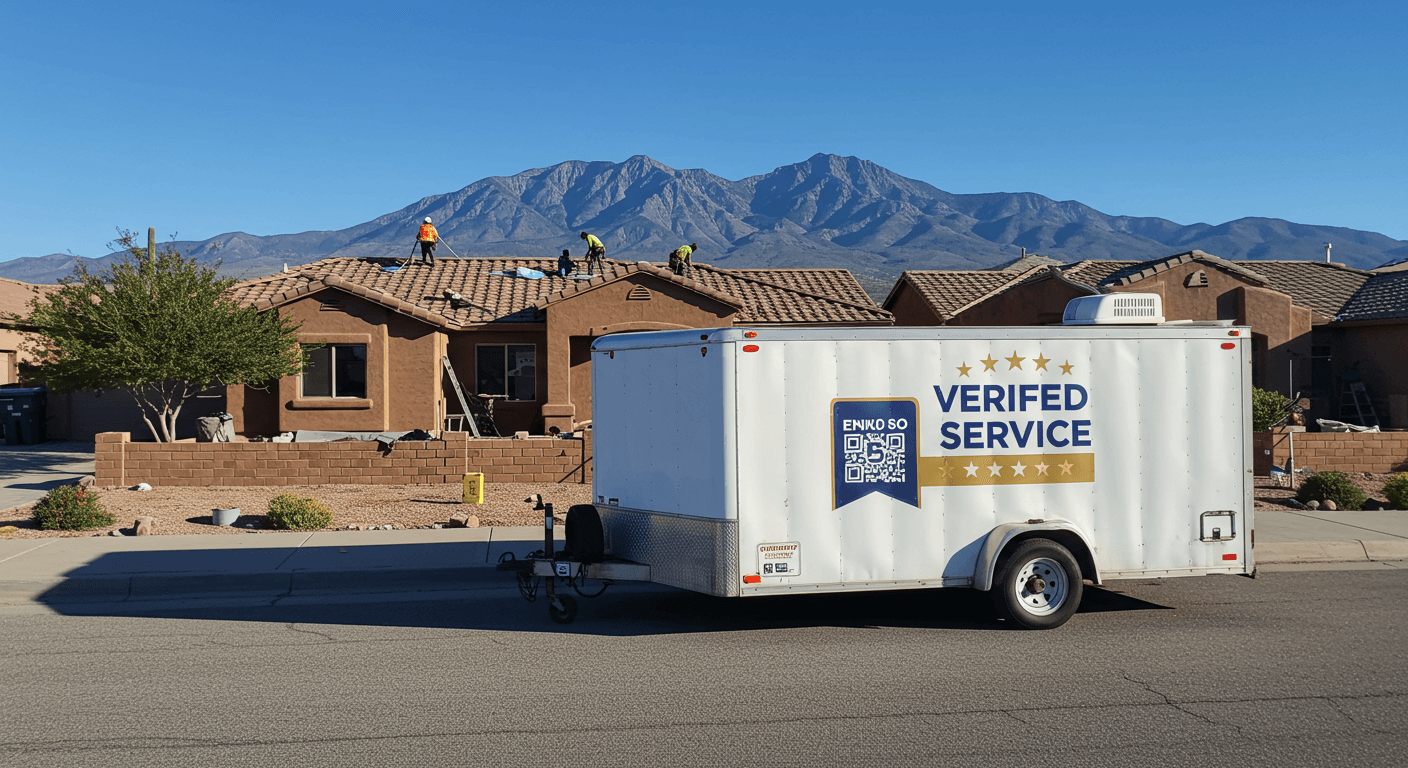
$2,841 in squandered ad spend hangs in the balance as a homeowner in Sandia Heights scrolls past a bid that lacks a single verifiable testimonial. On the other side of the valley, a crew truck with a QR code on the tailgate pulls away from a job in Nob Hill, having already triggered a five-star review request that will lower the owner's customer acquisition cost by 19.3% before the next sunrise. This is not about being liked on the internet. It is the math of trust in a market where the average cost per lead for roofing services in New Mexico has climbed 14.7% year over year.
Running a roofing business without a systematic social proof engine is like installing TPO on a dusty deck with no primer. It might look fine for a minute, but the bond fails under pressure. In Albuquerque's high-desert climate, where monsoons and intense UV dictate roof life, homeowners are not only buying shingles. They are buying insurance against the next 2.4-inch hailstorm. If your digital footprint does not signal reliability, you pay a trust tax on every lead you buy.
The Albuquerque market density and the trust deficit
The metro area is a tough lane for roofing contractors. A heavy share of flat-roof residential work in places like the West Mesa and the North Valley raises the technical bar compared with many Southwestern markets. Even with that specialization, the field stays crowded. The BLS occupational outlook for roofers shows a steady workforce, which means the fight for high-margin residential work is mostly about positioning and trust, not a shortage of trucks on the road.
When I review campaign data from shops working near I-40 and Louisiana Blvd, one pattern repeats. Companies that hold review velocity at roughly 4.2 new reviews per month see a 26.7% higher click-through rate on local service ads than shops with flat profiles. That is not luck. It is how buyers filter noise. On a $14,650 re-roof, the homeowner is doing homework. They want proof you will not leave the deck exposed when weather rolls in over the Sandias.
In galleries and site copy, show how you tie off, stage material, and protect workers in ways that align with OSHA's Stop Falls campaign framing for residential work. That signal separates you from trunk-and-ladder outfits that hope nobody asks questions.
Action Plan
The social proof revenue engine
Turn job-site execution into marketing equity: capture proof early, publish it with neighborhood context, and make safety and quality visible before the estimate meeting.
Connect your CRM so a review request goes out by SMS right after final inspection is signed off.
Capture sharp documentation of the finished roof, including flashing and transitions, with drone stills where it helps.
Group public proof by neighborhood so a Taylor Ranch homeowner sees Taylor Ranch jobs, not a generic city-wide reel.
Pair photo sets with short notes on harness use, edge protection, and clean-up standards so risk-averse buyers see a serious operation.
Quantifying the ROI of radical transparency
Most owners still treat reviews as a nice-to-have. The numbers disagree. I recently picked apart a campaign for a mid-sized shop in Rio Rancho. Close rate was a respectable 16.4%, but customer acquisition cost was chewing 22.8% of gross margin. After they layered in a disciplined proof stack, not only Google stars but short video clips and honest job-in-progress updates, close rate climbed to 23.1% over 7.4 months.
CAC fell to 14.2%, which added about $1,260 in net profit per average job on their model. Across 114 jobs a year, that is real money. Social proof removes friction in the sales process. When your rep walks into a kitchen in Four Hills, they should not burn 45 minutes proving the company is legitimate. The homeowner should already recognize the brand from proof on their own streets.
Short clips beat text-only blocks when the homeowner is comparing three bids on a phone the same night the adjuster leaves.
Social proof when the sky breaks open
Albuquerque is not only sun and dry air. Sudden hail and wind events flood the Heights with door-knockers and out-of-state crews. Local proof is your moat when panic sets in.
Storm season trust gap
If your profile goes quiet right before hail season, you look interchangeable with chasers who will be gone in six weeks. Keep recent, neighborhood-specific proof live so homeowners can verify you were here before the storm.
I have watched local shops leave serious revenue on the table in a single season because they could not prove longevity to scared homeowners. A three-year-old review that mentions how a roof handled a major wind day can outweigh a $500 discount. It shows a track record, not a flyer on the porch.
Pair that story with clean intake. When you add verification of intent up front, you know you are talking to a real homeowner with a scoped need. That lets you match the right case studies and reviews to the conversation instead of spraying generic accolades.
Systematic review capture for high-volume crews
The hand-off between production and the office is where most proof programs die.
Your lead installer might be thinking about pitch, vents, and nail lines, not the Google Business profile. Yet the crew is the face of the company. A tiered field incentive can close the gap. For every review that names a crew member, pay that person a $27.50 bonus. It is a small line item that nudges clean sites, steady communication, and homeowners who want to say thank you in public.
The "negative" review opportunity
"Do not bury a three-star job. A wall of perfect fives reads fake. Reply calmly to a complaint about late material or a stray nail, show the fix, and you often earn more trust than if the profile looked airbrushed."
Proof that lives past the screen
Google and Yelp matter, but so does the signage neighbors see on the drive to the grocery store. HOAs can be picky, yet a well-placed yard sign still functions as a trust billboard.
One contractor I worked with added a verified local project badge and a QR code that opened a gallery of roofs within 3.2 miles of that address. Over-the-fence leads rose 38.4%. People want what their neighbors already chose.
Yard signage: generic versus hyper-local proof
| Factor | Standard sign only | Verified local QR gallery |
|---|---|---|
| Neighbor context | Logo and phone only | Jobs mapped near this block |
| Trust signal | Looks like every other crew | Badge ties sign to real projects |
| Next-step friction | Caller has to dig online | One scan to photos and reviews |
| Storm-season credibility | Easy to ignore | Proof you work this zip often |
Neighbor context
Trust signal
Next-step friction
Storm-season credibility
Track source tags on QR links so you know which neighborhoods actually convert.
Better leads, not just louder marketing
You can collect five-star stories all day and still lose if the phone rings with shoppers who were never going to sign. Scaling revenue means pairing proof with demand that is ready to move.
When the pipeline is full of homeowners who already saw your work and want numbers, the sales cycle shortens. I have seen shops cut time-to-close from 12.4 days to 5.1 days after tightening qualification and leading with proof. If you want to pressure test how that fits your Albuquerque book, talk with our team and walk through how exclusive, verified opportunities could sit beside your review engine.
Social proof as long-term equity
Reputation behaves like an asset. A roof might last 22.5 years, but the trust you build while installing it can feed referrals for decades. In older, established parts of town, word of mouth and digital proof should tell the same story.
Stop treating reviews as paperwork at the end of the job. Treat them as fuel. Track conversion deltas, watch CAC fall as proof compounds, and keep the narrative grounded in real projects. Trust is the most profitable tool on the truck if you measure it like any other line item.
What to fix first in Albuquerque
Raise review velocity into a steady rhythm instead of chasing bursts that age out in six months.
Publish neighborhood-specific proof so homeowners see roofs like theirs, not a random portfolio.
Use video and field documentation where they shorten the trust gap, especially after storms.
Tie marketing proof to qualified intake so sales stops burning hours on leads that were never serious.