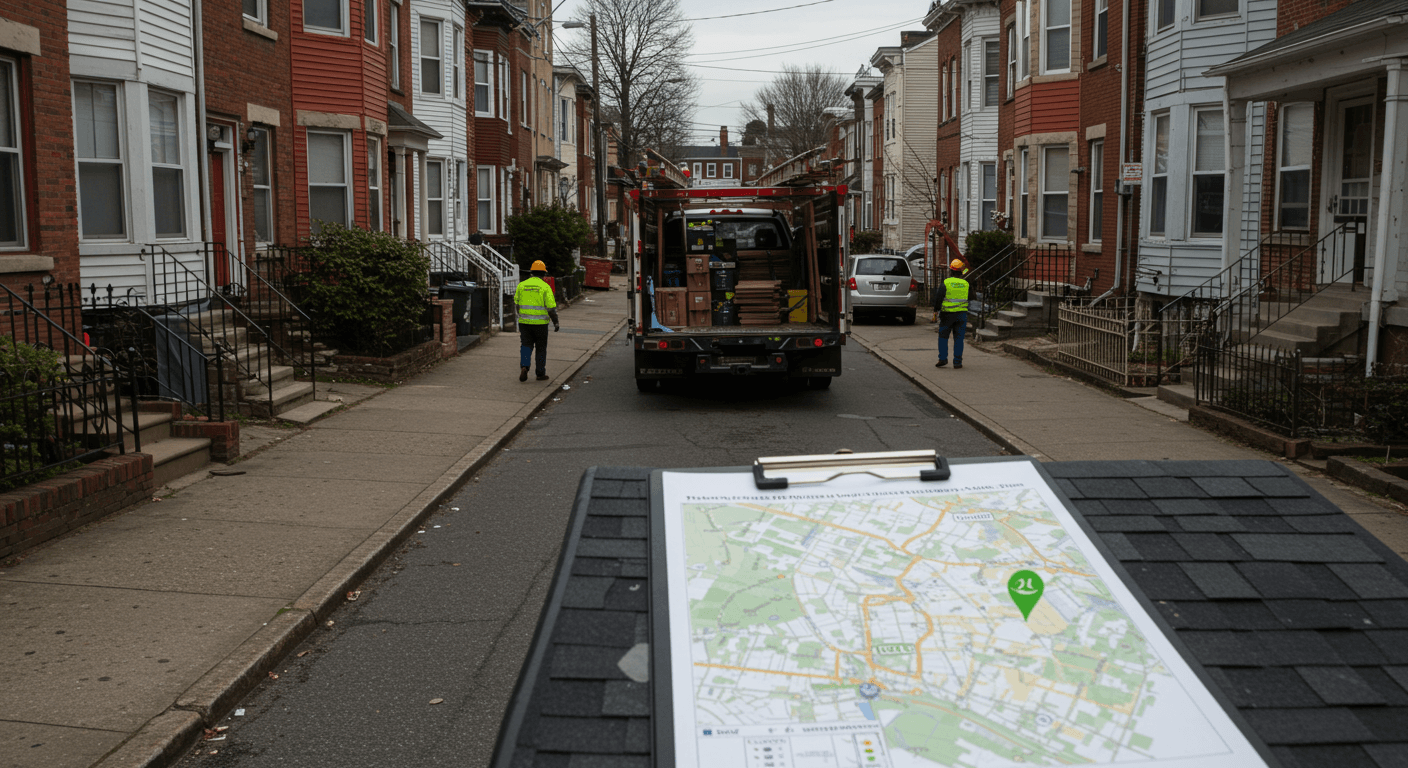
Domination in a market like Paterson isn't about having the loudest radio ad or the shiniest wrap. It is about logistical density. Most owners I talk to think growth means buying another truck and sending it forty miles down the Parkway to Edison. That is the fastest way to bleed your fuel budget dry and burn out your best foreman. Real regional control happens when you own a three-mile radius around the Great Falls so tightly that your competitors feel like outsiders in their own zip code.
I spent three days last October in a cramped warehouse office off 21st Ave with a contractor named Jaxon. He was frustrated. His crews were spending 94 minutes a day stuck in traffic between Paterson, Clifton, and Wayne. We sat down and looked at his job map. It looked like someone had sneezed red dots across the entire map of Northern New Jersey. There was no pattern, no strategy, and most importantly, no profit margin left after the windshield time was tallied. We decided to stop the "scatter-gun" approach and focus on high-density neighborhood clusters. By narrowing his focus to specific neighborhoods like Hillcrest and South Paterson, Jaxon didn't just save on gas; he became the "neighborhood roofer" that every homeowner saw three times a week.
Clustering vs. Scatter-Gun Operations
| Factor | Scatter-Gun Approach | Regional Cluster Strategy |
|---|---|---|
| Average travel time | 78 mins/day | 22 mins/day |
| Referral rate | 1 in 12 jobs | 1 in 4.5 jobs |
| Permit familiarity | Low (Multiple towns) | High (Mastered Paterson) |
| Marketing ROI | 2.1x | 4.7x |
Average travel time
Referral rate
Permit familiarity
Marketing ROI
At a Glance
Tighten your service radius to under 8 miles to maximize crew 'wrench time' vs. 'windshield time'.
Master local permitting nuances to avoid the $350-per-day delays common in older municipalities.
Use neighborhood-specific social proof; homeowners trust a roofer they see working at their neighbor's house.
Optimize material drops to account for Paterson's narrow streets and limited staging areas.
The Geography of Profit in the Silk City
Paterson is a unique beast. You have a mix of historic brick structures, tight residential lots, and specific building codes that can trip up a crew coming in from out of town. When you focus your operations geographically, your team develops a "muscle memory" for the local architecture. Jaxon's crews started to realize that the Victorian-style homes near Eastside Park almost always had specific decking issues that the ranch houses in the suburbs didn't.
This expertise translates directly to your bottom line. According to the Bureau of Labor Statistics, roofers typically earn a median pay of $50,970, but that cost to the employer skydives when efficiency peaks. When your crew knows exactly what tools to pull off the truck before they even hop out, because they've done six houses on that same block, you're saving 14.7% in labor hours per square.
Mastering the Paterson Permit Grind
If you've ever tried to pull a permit in Passaic County on a Tuesday morning, you know the frustration. Each municipality has its own quirks. By dominating a single region, you build relationships with the inspectors. They know your work. They know your foreman. That level of trust can be the difference between a 24-hour inspection turnaround and a three-day delay that leaves a roof open to a sudden Jersey rainstorm.
I watched Jaxon transform his relationship with the local building department simply by being a "frequent flier." Because he was doing 14 roofs a month in a single zone rather than three, the inspectors knew his rigs. They knew his underlayment was always up to code. This isn't just about being "buddy-buddy"; it's about operational velocity. Every day a job sits idle because of a paperwork hang-up is a day you aren't collecting a final check.
The Labor Advantage of Local Focus
Scaling a roofing business isn't just about getting leads; it's about keeping the guys on the shingles. The BLS guide on becoming a roofer highlights that physical stamina and balance are critical, but so is morale. Nobody wants to sit in I-80 traffic for two hours after a ten-hour shift in the sun.
When Jaxon shifted his focus to local Paterson jobs, his turnover rate dropped by 19.3%. His guys were home by 4:45 PM because the shop was only ten minutes from the last job site. In an industry where finding reliable labor is the number one bottleneck, being the "local" shop that respects its workers' time is a massive competitive advantage. You aren't just a boss; you're the guy providing a better quality of life.
The Yard Sign Multiplier
"In high-density areas like Paterson, don't just put up one sign. Offer the neighbor a $55 gift card to a local spot like Libby's Lunch if they allow you to put a second 'Work Being Done By' sign on their lawn. Doubling the visual presence on a narrow street creates an illusion of total market takeover."
Turning Proximity Into a Sales Weapon
When you are the local expert, your sales process changes. You stop being a "bid" and start being the "solution." I coached Jaxon to change his pitch. Instead of talking about GAF shingles or warranties first, he started mentioning the house three doors down. "We just finished the Miller place on 17th Street last Tuesday. You probably saw our silver trucks."
That sentence is worth more than a five-star Google review. It's physical proof. It tells the homeowner you aren't a storm chaser who will disappear once the check clears. This localized trust allowed Jaxon to maintain a 31.6% closing rate even when his bids were $1,245 higher than the "tailgate contractors" undercutting the market.
To keep this momentum, Jaxon needed a steady flow of local opportunities. He stopped buying shared leads that were being sold to five other guys in the county. He needed something exclusive. He found that LeadZik's verified leads allowed him to see the job details before committing, ensuring he stayed within his high-profit "power zone" in Paterson.
Implementation: Your 90-Day Domination Roadmap
If you want to own your backyard, you have to be disciplined. You have to be willing to say "no" to a high-ticket job if it's too far outside your density zone. Here is how we did it with Jaxon's shop:
Action Plan
Your 90-Day Domination Roadmap
A step-by-step plan to transform your scattered operations into a high-density regional cluster that maximizes margins and minimizes windshield time.
Analyze the Heat Map: Export your last 12 months of jobs into a map tool. Identify where your 'clusters' already exist.
Draw the Hard Line: Pick a center point (your shop or a high-performing neighborhood) and draw a 7.5-mile circle.
Localize Marketing: Stop broad SEO. Target 'Roofing Paterson NJ' or 'Clifton Roof Repair' specifically.
Optimize Logistics: Negotiate with your supplier for a dedicated delivery window. If they know you're always in the same three zip codes, they can plan their routes better, often saving you on delivery fees.
Refine the Lead Pipeline: Ensure you are only spending money on leads that fit your geographic criteria. Whether you're checking pricing on exclusive leads or looking for a more roofing-centric lead source, the goal is exclusivity and proximity.
Want to skip the manual work and get exclusive, verified leads instead?
Get $150 in Free CreditsWhen refining your lead pipeline, it's crucial to work with sources that understand your geographic focus. Companies like LeadZik, founded by roofers frustrated with shared leads, offer the kind of exclusivity that keeps you within your power zone. For more details on how this works, check out our FAQ section covering pricing, lead quality, and exclusivity guarantees.
The Results: Beyond the Numbers
Six months after Jaxon narrowed his focus, the results weren't just on the spreadsheet. The atmosphere in the warehouse changed. The frantic "where is the crew?" phone calls stopped. The trucks lasted longer between service intervals. But most importantly, Jaxon's net profit jumped by $14,288 per month.
He didn't need more leads to make more money; he needed better leads in a smaller area. Regional domination isn't about size; it's about density. When you own your streets, you own your margins.