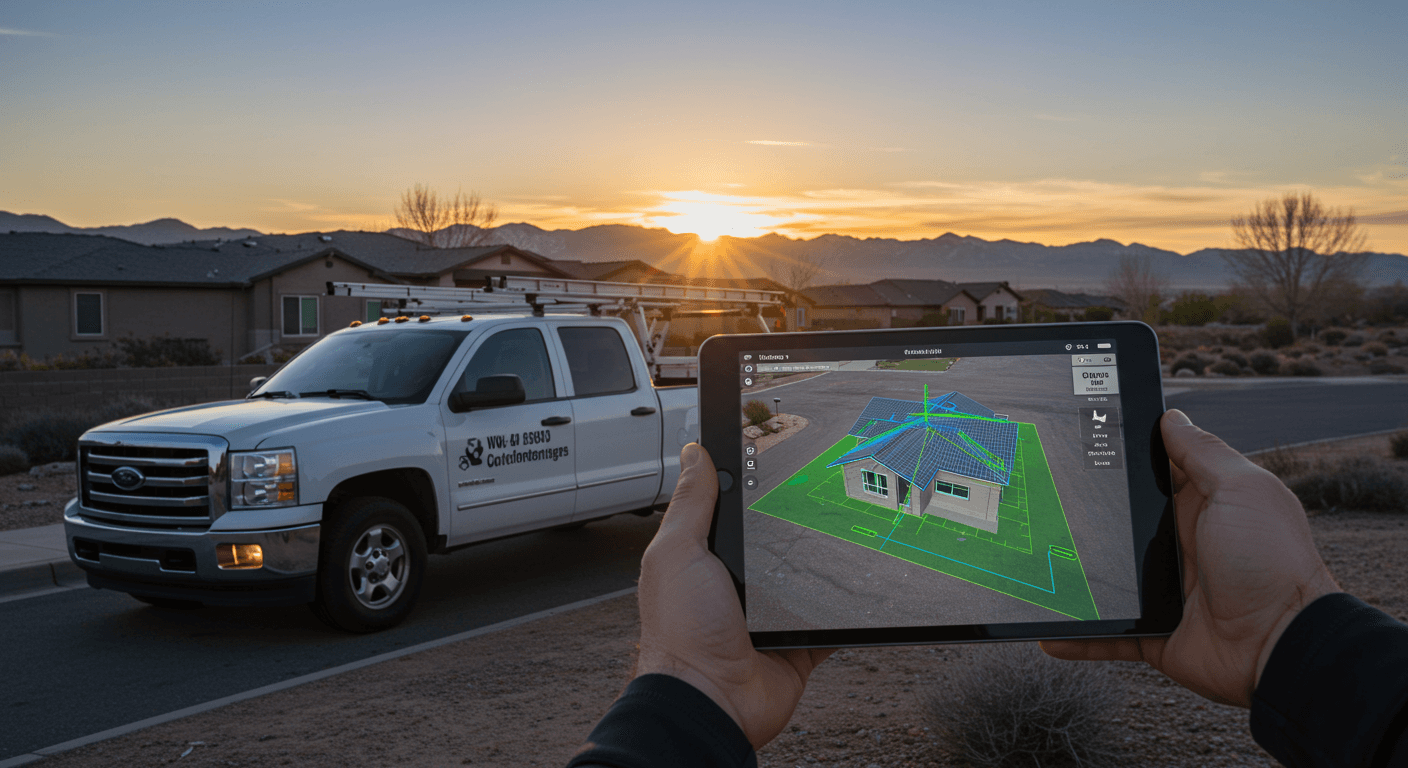
Standing on a steep pitch near Mt. Rose Highway, Finn adjusted his sunglasses against the high-altitude glare while juggling a tape measure and a tattered legal pad. It was his fourth "look-see" of the afternoon, and the sun was already dipping behind the Sierras. He was exhausted, but more importantly, he was behind. While he spent forty-five minutes measuring eaves and checking flashing details by hand, his biggest competitor down in the valley was already emailing a polished PDF quote to the homeowner.
This is the reality for many shops in the Truckee Meadows. We often think of "hard work" as physical presence on every roof, but in a market as competitive as Reno, that traditional approach is becoming a massive financial leak. Finn was burning through roughly $1,140 a week just in his own time and fuel, not even counting the deals he lost because he couldn't get a bid back within 24 hours. When we sat down to look at his books, the numbers were startling. He was spending nearly 14 hours a week just on travel and manual measurements for leads that hadn't even committed yet.
At a Glance
Automated tools reduce site visit requirements by up to 64%, drastically cutting fuel and labor costs.
Speed to lead is the primary driver of modern conversion, with bids delivered under 4 hours seeing a 31.8% higher win rate.
Precision software eliminates the "fudge factor" in ordering, preventing the $400 to $900 waste typical of over-ordered materials.
Integration with verified lead sources ensures your team only spends time estimating high-probability jobs.
The High Cost of Manual Measurement in Washoe County
Reno poses unique challenges for roofing contractors. Between the sprawling growth in Spanish Springs and the aging steep-slope homes in Caughlin Ranch, your "windshield time" is a profit killer. According to Construction Dive, labor shortages continue to squeeze margins, making the efficiency of your existing team the most important lever you can pull for growth.
Finn's old process was a relic of the early 2000s. He would drive from his office near the airport out to a property, spend an hour on a ladder, drive back, and then spend another hour at his desk fighting with an Excel sheet. If he did five of these a week, he was essentially losing two full days of production or sales time. When you factor in the current $56B market size for the roofing industry, the companies capturing the lion's share of that revenue are the ones who have digitized their front-end operations.
By switching to automated estimation tools, Finn stopped guessing. He started using aerial measurement services that provided 99.2% accuracy for roof facets, pitch, and waste factors. Instead of driving to South Reno for a "quick look," he was able to pull a report, verify the details, and have a professional proposal ready before his second cup of coffee.
Shifting from "Estimating" to "Closing"
The biggest psychological hurdle Finn faced was the belief that he had to see the roof to sell the job. I challenged him on this. Was he a measurer or a consultant? The value he provides to a homeowner in Sparks isn't his ability to use a tape measure; it is his expertise in selecting the right shingles for our 100-degree summers and snow-heavy winters.
Action Plan
The Virtual-First Estimation Strategy
How to transition your Reno shop from manual to automated bidding without losing accuracy.
Audit your current "Lead-to-Bid" timeline to identify where the 48-hour gaps are occurring.
Select an aerial measurement partner (like Roofr or EagleView) that integrates with your CRM.
Establish a "Virtual First" policy where every lead gets a remote estimate within 3 hours.
Reserve on-site visits for final contract signings or complex inspections that tech cannot solve (like structural rot).
Train your sales team to present the digital report as a sign of professional transparency and tech-forwardness.
Want to skip the manual work and get exclusive, verified leads instead?
Get $150 in Free CreditsOnce Finn made this shift, his closing rate jumped. Why? Because he was the first person in the homeowner's inbox. In the roofing world, the first professional bid often sets the price anchor for the entire project. By the time his competitors were pulling into the driveway to start their manual measurements, Finn's digital contract was already sitting in the client's email waiting for an e-signature.
Manual vs. Automated Estimation Comparison
| Factor | Manual On-Site Bidding | Automated Digital Estimation |
|---|---|---|
| Time Investment | 3 - 5 Hours per Lead | 15 - 25 Minutes per Lead |
| Average Accuracy | 92% (Human Error Risk) | 99% (Satellite/AI Precision) |
| Fuel/Vehicle Wear | $45 - $80 per Bid | $0 (Remote) |
| Consumer Perception | Traditional / Slow | Modern / Professional |
| Scaling Potential | Limited by physical hours | Nearly Infinite |
Time Investment
Average Accuracy
Fuel/Vehicle Wear
Consumer Perception
Scaling Potential
Managing the "Garbage In, Garbage Out" Problem
Automation only works if the data coming in is high quality. Finn found that he was wasting money running digital reports on "tire kickers" who were just looking for the lowest price to show their insurance adjuster. To fix this, he needed a more reliable way to filter his pipeline.
I've seen shops transform their pipeline by focusing on exclusive, verified opportunities rather than chasing the same shared leads that five other guys are calling. For Finn, this meant he only ran his automated estimates on leads where he could already see the job details and property condition. It allowed him to preview the project specifics before committing any resources, even digital ones.
The 15-Minute Rule
"Never let a lead sit for more than 15 minutes without a response. Use your automated tool to send a "Ballpark Estimate" immediately. This stops the homeowner from calling the next contractor on Google and buys you time to refine the final quote."
The Revenue Impact: A Six-Month Retrospective
Fast forward six months. Finn didn't just save time; he fundamentally changed his profit margins. By reducing his on-site measurement visits by 72%, he was able to reallocate that time to actual production management. He went from running two crews to four without hiring an additional office manager.
His cost per lead decreased because his "success rate" per lead increased. He wasn't burning $200 in labor just to find out a roof in Somersett was too steep for his current crew's comfort level. He knew the pitch before he ever picked up the phone. For contractors looking to replicate this, you can test the platform with $150 in credits to start feeding high-quality data into your new automated system.
Finn's fuel bill alone dropped by $642 a month. His shingles waste factor went from a "safe" 15% to a precise 8.4%, saving him an average of $412 per job in materials. Across 12 jobs a month, that is nearly $5,000 in found money that was previously going into a dumpster.
Navigating the Local Reno Regulatory Climate
It is worth noting that while technology handles the measurements, you still need the "Reno touch" for permitting. The Washoe County Building Department has specific requirements for ice and water shields and snow load ratings that a satellite can't always dictate.
Finn used his saved time to build better relationships with local inspectors and refine his supplemental claim process. Instead of being a "guy with a ladder," he became a business owner who understood his data. Automated estimation isn't about replacing the contractor; it is about freeing the contractor to do the work that actually generates a 35% net margin.
Common Questions
The transition wasn't overnight. Finn had to learn to trust the data. He spent the first month double-checking the software with his tape measure. After 22 consecutive jobs where the software was within 1% of his manual measurements, he threw the tape measure in the back of the truck and never looked back.
If your current process feels like a treadmill of endless driving and paperwork, it is time to look at the numbers. The cost of the software is a drop in the bucket compared to the cost of a missed opportunity in a market that is moving as fast as ours. By the time Finn finished our last consulting session, he wasn't just a roofer; he was a tech-enabled operator with the highest margins in his zip code.