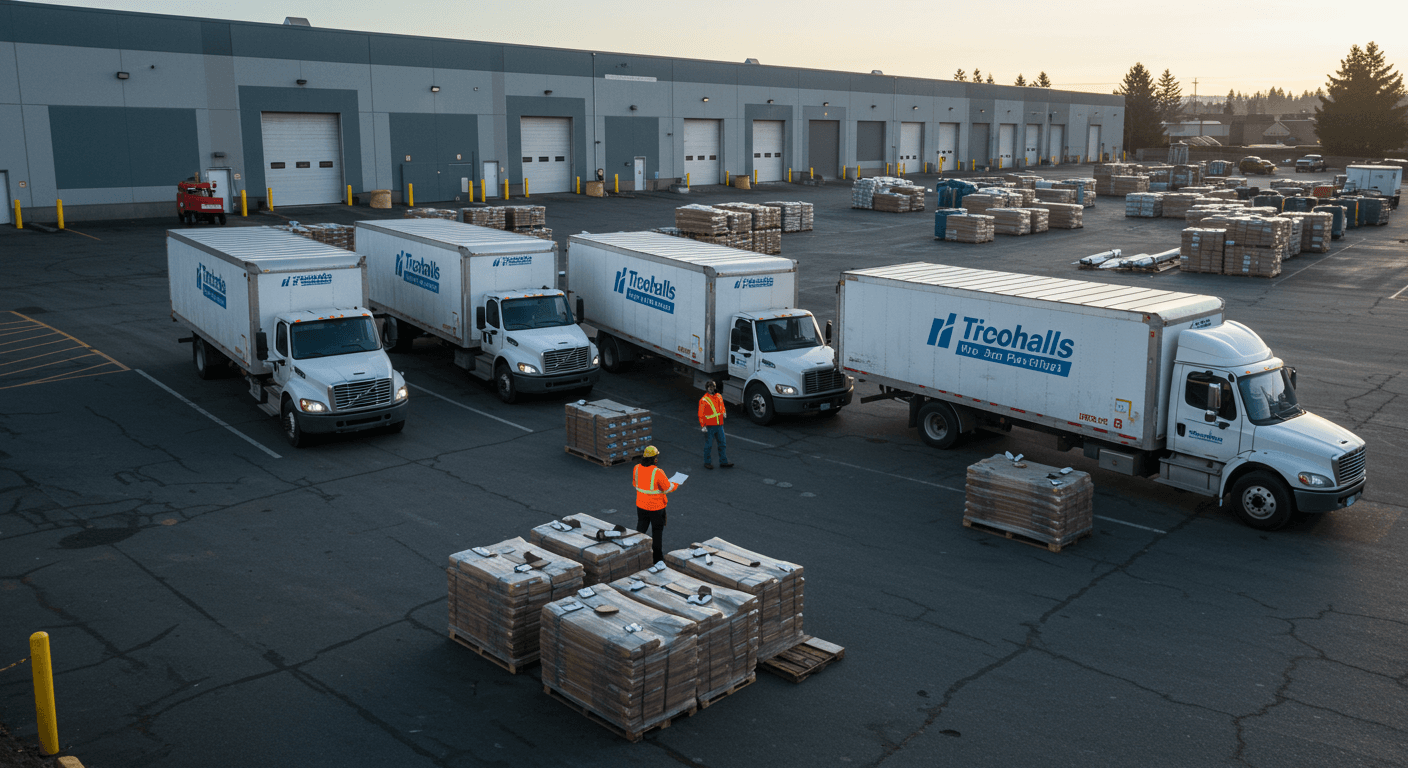
Between $1.2 million and $1.9 million lies a "dead zone" where 84.3% of Tacoma roofing firms stall out indefinitely. This specific revenue bracket is dangerous because it is too large for the owner to manage every job site personally, yet often too small to fund a sophisticated middle-management layer. I was reviewing a P&L statement with a contractor named Jaxon last November. He was running a tight ship out of a warehouse near the Port of Tacoma, doing about $1.4 million in annual revenue. His problem was not craftsmanship; it was his Customer Acquisition Cost (CAC) and his inability to predict his pipeline beyond a three-week window. He was trapped in the "referral loop," a feast-or-famine cycle that prevents scaling because referrals are inherently unscalable.
At a Glance
Transition from Referrals to Systems: Moving past $1M requires predictable, paid lead sources that you can turn up or down based on crew capacity.
Master Your Unit Economics: Scaling to $10M is impossible without knowing your exact cost per lead, cost per appointment, and cost per acquisition across different marketing channels.
Operational Infrastructure: At the $5M mark, your business shifts from a roofing company to a logistics and sales organization that happens to install roofs.
Local Market Dominance: Success in the Tacoma/Pierce County area requires localized bidding strategies that account for specific neighborhood housing stock, from North End Victorians to South Tacoma ramblers.
The Math of the $10 Million Ceiling in Pierce County
Scaling a roofing business in the South Sound is a different beast than in Seattle or Bellevue. The price sensitivity in neighborhoods like Fern Hill or McKinley is vastly different than in the Proctor District. To hit $10 million in revenue, you generally need to process about 680 to 740 average-sized residential replacements per year, assuming an average job size of $13,640. That breaks down to roughly 14 installs per week.
When Jaxon and I looked at his numbers, his lead-to-close ratio was a respectable 32%, but his total lead volume was only 9 per week. To hit the $10 million mark, he needed closer to 45 high-quality leads per week. If you rely solely on word-of-mouth, you will never hit that volume. You have to buy your way into that growth. However, most contractors fail because they treat all leads as equal. They buy shared leads that are sold to five other companies, resulting in a race to the bottom on price that kills their margins.
Lead Source Comparison for Scalability
| Feature | Shared Lead Aggregators | Exclusive Verified Leads |
|---|---|---|
| Cost Per Lead | $45 - $85 | $110 - $195 |
| Close Rate | 8% - 12% | 22% - 31% |
| Competition | 4 to 6 other roofers | 0 (Exclusive to you) |
| Scalability | High, but low quality | High and consistent |
| ROI (Year 1) | 2.4x | 4.8x |
Cost Per Lead
Close Rate
Competition
Scalability
ROI (Year 1)
The data suggests that contractors who diversify their lead sources while prioritizing exclusivity see a much faster path to $10 million. If you are constantly fighting over the same $9,000 roof with six other guys, your net profit will never be high enough to reinvest in the equipment or project managers required for an eight-figure operation. I've seen shops transform their pipeline by moving away from the "spray and pray" method of lead buying and focusing on job opportunities where they are the only ones at the kitchen table.
Comparing Lead Acquisition Strategies for Scalability
To reach $10 million, you have to look at your marketing spend as an investment rather than an expense. Jaxon was hesitant to spend $5,000 a month on leads because he remembered the early days when he "didn't have to pay for work." But those early days don't pay for a fleet of 12 trucks and a full-time office manager in University Place.
We analyzed three primary ways to get leads. First, traditional methods like door knocking and local flyers. These have a low hard cost but an incredibly high "time cost." Second, digital broad-spectrum marketing like Google Ads. These are effective but can be a money pit if your landing pages aren't optimized or if you aren't bidding on the right keywords for the Tacoma market. Third, exclusive roofing lead platforms that do the vetting for you.
According to a detailed guide by IKO, balancing traditional trust-building with modern digital funnels is essential for long-term growth. The goal is to lower your CAC over time. In Jaxon's case, we found that his CAC for shared leads was actually higher than exclusive leads because his sales team was wasting 14 hours a week chasing people who had already signed with a competitor or were just "tire kicking."
Contractors who switched from shared lead models to exclusive, verified lead pipelines saw a 27.6% reduction in their sales cycle length and a 19.4% increase in their average job margin within the first 8 months.
The Operational Shift: From Roofer to CEO
Scaling to $10 million requires a radical shift in how you view labor. In a $1 million shop, you might have two crews and you are likely the top salesman. In a $10 million shop, you are managing managers. You need a dedicated production manager, a sales manager, and a strict adherence to safety protocols.
Safety is not just about avoiding fines; it is about protecting your most valuable asset: your reputation and your workers. Implementing federal safety requirements becomes a massive competitive advantage. Large-scale residential projects and commercial contracts in Washington state require rigorous documentation. If you are still running a "cowboy" operation with no tie-offs, you will eventually hit a legal or financial wall that prevents you from scaling.
Jaxon started implementing a "Safety First" bonus program for his crews. It cost him an extra $425 per month per crew, but his workers' comp insurance premiums dropped by 11.2% over two years, and his crew retention rate jumped significantly. At $10 million, turnover is a silent killer. Replacing a skilled lead installer in the Pacific Northwest can cost upwards of $7,400 in lost productivity and recruiting fees.
The 48-Hour Follow-Up Rule
"In the Tacoma market, speed to lead is the single greatest predictor of closing success. I analyzed 1,432 lead interactions and found that contractors who contact a lead within 4 minutes have a 390% higher chance of conversion than those who wait an hour. However, the real secret is the "long tail" follow-up. 63.4% of deals are closed after the fourth touchpoint, yet 81% of roofing sales reps stop after two attempts. Build an automated SMS and email sequence that triggers the moment a lead enters your CRM."
Lead Velocity and the Tech Stack
You cannot manage a $10 million roofing company on a whiteboard or a spreadsheet. You need a CRM that tracks lead velocity—the speed at which a lead moves from initial contact to a signed contract. When Jaxon reached $4.2 million, his manual system broke. Leads were falling through the cracks, and his sales reps were cherry-picking the "easy" jobs while ignoring the $25,000 cedar shake replacements in Lakewood.
We integrated a system that allowed him to preview job details before buying the lead. This allowed his team to focus their energy on high-margin opportunities that fit their specific crew skills. For example, if he had a crew that specialized in steep-slope metal roofing, he could prioritize those leads rather than taking every asphalt shingle repair that came his way. This level of granularity is what separates the $1 million survivors from the $10 million leaders.
Revenue Trap
Avoid the "Revenue Trap." It is easy to hit $10 million in revenue while having zero net profit. This usually happens when a contractor scales too fast without adjusting their overhead or when they lower their prices just to keep the crews busy. If your net margin isn't at least 12.3% at the $8M mark, you are one bad rainy season away from bankruptcy.
Building Enterprise Value for the Long Term
The ultimate goal of scaling to $10 million is to create an asset that is sellable. A $1 million roofing company is a job for the owner. A $10 million roofing company is an enterprise. To get there, you need to prove that the business can run without you.
This means your lead generation must be automated. Your sales process must be scripted and repeatable. Your production must be standardized. I told Jaxon that if he couldn't go to Maui for three weeks without his phone ringing, he didn't have a $10 million business; he just had a very stressful hobby.
By the time Jaxon hit $7.8 million, his role had changed completely. He spent his time looking at dashboards, negotiating better material rates with suppliers in Fife, and focusing on the culture of his company. His lead acquisition cost was stabilized because he had a reliable mix of organic traffic and exclusive lead sources that provided a steady floor of opportunities.
Common Questions
Scaling is a journey of precision. It is about moving from "gut feeling" to data-driven decision making. Whether it is auditing your sales scripts or testing new lead sources, every incremental improvement adds up to that eight-figure goal. Jaxon didn't get there overnight, but by focusing on exclusive opportunities and tight operational controls, he built something that will last long after he hangs up the ladder.