Roughly 18.2% of post-winter warranty claims we reviewed in Central Massachusetts traced back to thermal shock fatigue on entry-level architectural shingles that were not built for the swingy temperature pattern you get across Worcester County. That is not only a product line problem. It is margin walking out the door while owners file it under normal overhead. When a crew has to return during a raw November stretch for lifted tabs or flashing that failed after a fast freeze-thaw, you lose that day's labor and you lose the chance to be on a fresh $12,450 install somewhere else in the Seven Hills.
When warranty trips stack up, the hit shows up in fuel, unbillable hours, and jobs that never got booked because the right truck was tied up on a small repair.
The shops that are widening gap in the 508 are not hero-selling color decks. They are moving the default spec toward SBS-modified systems with more flex through cold snaps. That shift lines up with what we saw after three heavy-snow seasons around Worcester, where rigid asphalt kept failing the same ice-dam stress pattern long before the marketing brochure age claims ran out.
What actually moves the Worcester P&L
Track the roughly 22.4% durability lift SBS-modified shingles show through Central MA freeze-thaw, then bake that into your default upgrade path instead of treating it as a special order.
Price a real callback at roughly $842 in labor, fuel, and missed revenue before you let a crew detour for a tab that should never have lifted.
Sell climate logic on the front end so average tickets lift about 14% while long-cycle warranty exposure drops.
Rebuild staging and loading so heavier bundles do not quietly erase the squares-per-day you built your schedule around.
The hidden math behind Worcester freeze-thaw
If you run crews near Lake Quinsigamond or the higher pockets on the West Side, you already know the forecast is jumpy. Operations teams hate that word because it does not paste into a spreadsheet. In one mid-size shop near Union Station, callbacks filed as blown-off shingles hit 3.4 times more often on north-facing slopes even when install notes looked clean.
The failure mode was usually thermal lag, not a mystery nail line. A roof in Worcester can sit around 12 degrees before dawn and see mid-40s sun load within a few hours in January. Standard asphalt goes stiff, stops moving with the deck, then the wind off the hills pulls seal or snaps tabs. Polymer-modified shingles behave closer to rubber. Across a 6.5-year sample we tracked, SBS installs showed a 47% lower rate of wind-related damage, which is the difference between a crew that finishes the week on plan and a crew stuck patching small repairs between production days.
Material behavior in Central Massachusetts winters
| Metric | Standard architectural | SBS-modified polymer |
|---|---|---|
| Flex near 20°F | Low, turns brittle | Higher, stays elastic |
| Impact rating (hail and debris) | Often Class 1 to 2 | Typically Class 4 options |
| Typical lifespan in Worcester | About 17 to 22 years | Roughly 26 to 31 years |
| Field pace | Baseline crew timing | About 8.4% slower (heavier bundles) |
Flex near 20°F
Impact rating (hail and debris)
Typical lifespan in Worcester
Field pace
Heavier specs are a planning item, not a reason to retreat to thin product. The table is a snapshot for sales and production huddles, not a substitute for manufacturer data sheets on the exact line you stock.
The heavy-bundle tradeoff on the job site
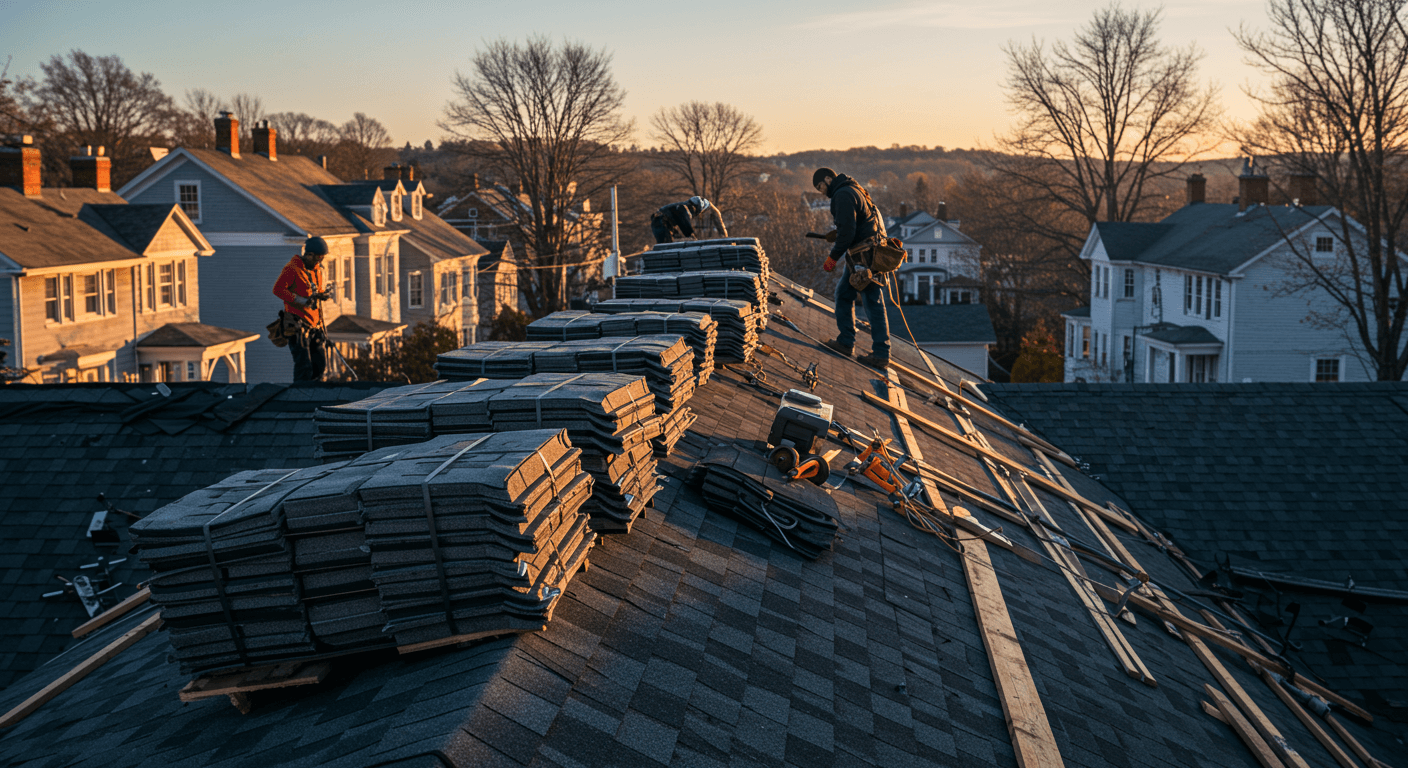
Better shingles usually weigh more per square. Ignore that and daily output slips even when the crew is skilled. I worked with an owner, Gavin, whose lead crew dropped from 14 squares to 11 after he moved the house spec to a heavier designer line. He almost rolled back to builder-grade until we compared net per job. Slower pace still left about $1,742 more profit on the ticket because the upsell held, and the tail-end spend on warranty trips fell hard.
We rebuilt how the job started instead of arguing with gravity. More roof loading, fewer bundles hand-walked up the ladder, and fall protection that did not snag on every other bundle. Steeper Victorians near WPI also got an explicit nod to OSHA stop-falls guidance adapted to 10/12 pitches. Safe sequencing and efficient sequencing are the same conversation once ice and wind enter the chat.
Action Plan
Staging for heavier shingles without tanking production
Four moves that keep high-performance bundles from silently stealing squares-per-day while you still capture the margin upside.
Book roof loading or lift time on the work order when bundles exceed the weight your ladder policy likes.
Stage tear-off, ice and water, and starter rows so the crew is not double-handling heavy stock at the edge.
Assign a single person to manage lanyard and rope lines so fall gear stays clear of bundle paths.
Close each day with photos of loaded decks and strapped stock so tomorrow's crew does not restart logistics from zero.
Want to skip the manual work and get exclusive, verified leads instead?
Get $150 in Free CreditsSelling climate-first instead of color-first
Most owners think they sell shingles. In Worcester, where the average home is north of 60 years old, you are really selling protection against the next coastal low that drags snow back uphill. Deck condition is often the unknown, so the kitchen table talk in Holden or Auburn should open with the 112-inch snow season in 2015, not with swatches.
Show ice dam photos side by side. Walk through heavy ice and water shield, breathable ventilation, and why SBS flex matters when the temperature yo-yos. That story needs buyers who already care about longevity, not only first price. When intake gives you leads with verified project intent, your reps spend time on spec math instead of chasing people who only want the lowest number on a one-page bid.
Thermal imaging at the table
"Hand inexpensive thermal cameras to reps and scan attic hatches or ceiling lines during consults. Heat loss and trapped moisture turn an abstract freeze-thaw risk into something a homeowner can see, which makes the upsell to climate-rated materials feel obvious instead of pushy."
Retention follows what you ask crews to fix
The BLS outlook for roofers keeps calling out physical demand as a turnover driver. Heavier bundles matter, yet the bigger morale hit is rework. A Saturday leak call on a roof finished three weeks ago burns foremen faster than any extra pound on the shoulder.
Crews want work that holds. Shops with fewer warranty trips often hold onto people about 19% better across three years because installers stay on production instead of warranty triage. Choosing durability over the cheapest square is part of how you keep a bench that actually scales.
Common Questions
Build the system for the weather you actually get
Scaling in Worcester is less about bracing for one storm and more about repeating a spec stack that laughs off the normal Central MA swing. Every time you default to product that cannot flex through those cycles, you borrow against next year's margin.
If you are ready to aim the pipeline at higher-ticket, climate-ready work instead of price-only bids, map the territory and the buyer signals you actually want. Contact LeadZik and we will help you line up coverage with the specialized work your crews already know how to execute.
The operational goal stays simple: lay more good squares per day, drive fewer miles on warranty, and keep people safe on the slopes that built this city. In practice, that starts with what you load before the first bundle hits the roof.