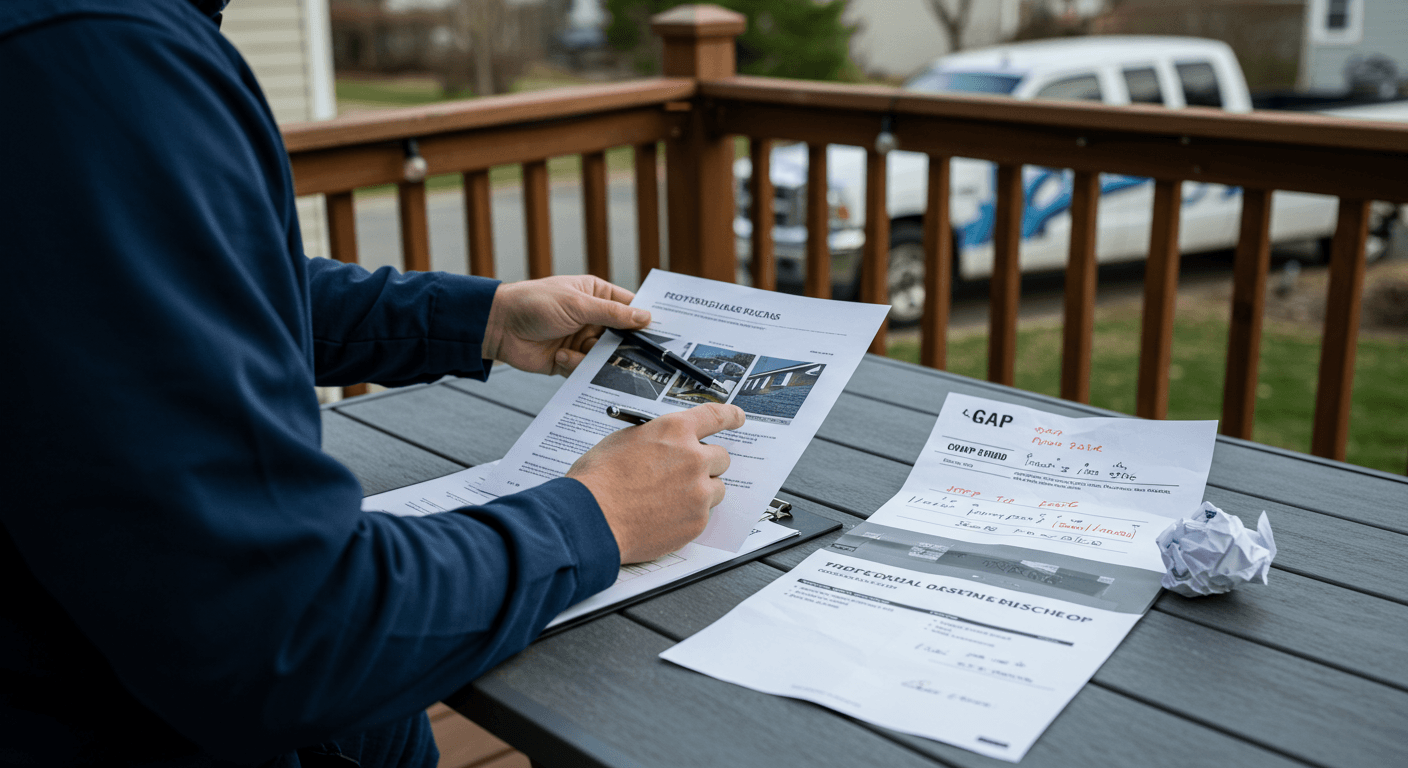
One estimator walks into a kitchen with a folder full of shingle samples, while another enters with a thermal imaging readout and a ventilation write-up. I spent a Tuesday afternoon in an office near Columbus reviewing why the first rep held a 19.4% close rate on retail leads while the second sat at 36.2% in the same zip codes. The gap was not the shingle brand or the warranty footnotes. It was how each person framed the moment the homeowner said the number felt high.
The shift clicked when Jaxon, the stronger producer, quit defending his $18,453 total and started hearing "that's too high" as a request for clarity, not a personal attack. We listened to three calls back-to-back. The reps who lost on price were selling a roof as a SKU. The ones who won were selling an engineered assembly and making the comparison about risk, coverage, and long-term performance before dollars became the only story. Handling objections, done right, is less about clever comebacks and more about resetting the criteria before anyone fixates on the bottom line.
How two roofing sales cultures respond when price gets loud
| Decision focus | Price matcher | System advocate |
|---|---|---|
| Default story | We cost more because of overhead | Here is what protects the structure |
| When a low bid appears | Match or chase with steeper discounts | Ask what was removed to hit that number |
| Proof on the table | Brochures and manufacturer cards | Photos, measurements, and a written scope checklist |
| What the homeowner learns | Wait for the best price drop | Cheaper can mean underbuilt |
Default story
When a low bid appears
Proof on the table
What the homeowner learns
If the only visible difference is dollars, dollars will decide. Give them a better ruler.
The high-cost reality of the commodity trap
When every objection becomes a negotiation, you teach the market that your price is optional.
Most teams stiffen the second a homeowner mentions someone cheaper. If your answer is an instant $500 trim or a vague "let me talk to the office," you already signaled that the first number was a placeholder. That is the commodity trap, and it is where double-digit margins quietly disappear. Compete only on square-foot math and you are claiming every architectural shingle bundle is interchangeable no matter who nails it off.
Delaney, a shop owner I met last quarter, watched 43% of signed-ready bids walk to a competitor with no workers' comp on file. Her reps were spending almost all of their time on product features and almost none on what a bad install costs when flashing fails or a crew member gets hurt. Teams that run a scope-first story still land near a 38.4% gross margin in those same neighborhoods because the homeowner compares risk, not only the final digit. The National Roofing Contractors Association (NRCA) hammers home that technical skill and real safety programs separate professional shops from operators who disappear after the check clears. If your team does not make those standards the headline, the customer falls back to the one thing they can compare without help: the total on the last page.
The jump shows up once estimators anchor risk, ventilation, and water management before they talk about shingles.
Two schools of objection handling
Pressure closes and consultative gap analysis both show up in roofing. Only one protects margin.
The price matcher
This rep treats the roof like a single-line SKU. When price lands, they reach for overhead stories or generic quality lines. Homeowners rarely care about your rent. They care about cash leaving their account. If the first visit does not close, the matcher often follows with a staircase of calls, each with a lower number, which trains the buyer to stall until the steepest cut shows up.
The system advocate
Advocates, including crews I have coached past about $2.4M a year in personal volume, treat the price gap as a scope conversation. They name the delta quickly. If another bid is $3,742 lighter, they ask what came out of the scope to make that work. Ice and water coverage, starter detail, ridge venting, and metal work go on a checklist side by side. By the end, the cheaper bid reads less like a deal and more like skipped protection.
Action Plan
The four-step gap analysis for price objections
Use this when a homeowner has a lower number in hand. The goal is to make the comparison about protection and performance, not emotion.
Acknowledge and validate. Say you expected to land above a few of the bids they will collect. Do not argue.
Define the variance. Write the exact dollar gap on paper so it feels concrete instead of vague.
Isolate the risk. Ask which protective layer they want removed to fund the savings. Name three real items.
Re-anchor value. Tie your total to a future cost they want to avoid, such as interior mold work after a slow leak.
Why psychology beats a perfect script
Fear of overpaying and fear of choosing wrong are not the same thing. Speak to the second one.
I have reviewed hundreds of calls where the rep hit every line on the script and still lost. Usually they misread the homeowner's fear. Most people are less worried about spending another twelve percent than they are about picking the wrong contractor and paying twice. When you speak to the fear of a bad decision, price stops sounding like a moral failure and starts sounding like insurance.
Carter, a rep in last winter's cohort, moved his close rate from 22% to 31.5% after one change at the reveal. Instead of sliding paperwork across the table like he was apologizing, he kept the inspection photos up. He pointed at soft decking near the chimney and at flashing that had maybe six seasons left. The problem stayed center stage, so the contract read like a fix instead of a splurge.
That level of focus needs bandwidth. When reps burn hours on recycled names or vague web forms, they default to fast talk and shortcuts. Shops that pair this consultative style with verified, exclusive homeowner demand can run the same conversation without sounding worn down before they arrive on site.
The future-cost anchor
"When someone pushes back on a $16,800 proposal, ask if they plan to stay in the home more than five years. If yes, sketch the inflation-adjusted cost of replacing a thin install that fails around year ten versus paying once for a properly layered system now."
Material mix and technical specs
If you never explain difficulty and coverage, every bid looks like someone padded labor.
A basic three-tab quote will always photograph better than a steep-slope system with designer laminate or metal accents. Trade media such as Roofing Contractor keeps showing how specialty assemblies need salespeople who can teach, not just quote. On complex valleys and pitch changes, labor and liability are real. If you never spell out degree of difficulty and the insurance that backs the crew, the customer assumes you invented a labor upcharge.
We coach teams to show a clear labor-and-liability line during the review. When homeowners see what it costs to keep a covered crew on a steep deck, the $1,400 to $2,300 swing against a tailgate bid stops feeling imaginary.
The discount death spiral
Do not cut dollars for nothing. If you drop $800, remove a defined item or secure a signature before you leave. A free discount tells the buyer your first price was negotiable fiction.
Build a culture of value, not a folder of rebuttals
Marketing, yard presence, and the first five minutes on site should all point to the same story.
Price training is not a single workshop. It is how the company talks everywhere. Shops I work with add a short value-discovery block to the first five minutes of every appointment. They ask what happened the last time a contractor touched the house. Often there is still anger over a $950 patch that did not stop the stain. That history is the opening to sell a permanent fix instead of another quick patch.
If your week feels like a constant race to undercut the lowest bid in town, audit what is hitting your calendar. Getting estimators in front of homeowners you can confirm are real and tied to the property frees time for the conversations that defend margin instead of chasing $500 on jobs you never wanted.
Before you touch the price again
Treat "too high" as a request for scope clarity, not an attack on your character.
Make NRCA-level safety and technical standards part of the buying criteria, not a footnote after the total.
Run a written gap analysis whenever another bid appears so homeowners see what cheaper bids omit.
Keep the reveal tied to documented roof problems so the contract feels like relief, not a splurge.