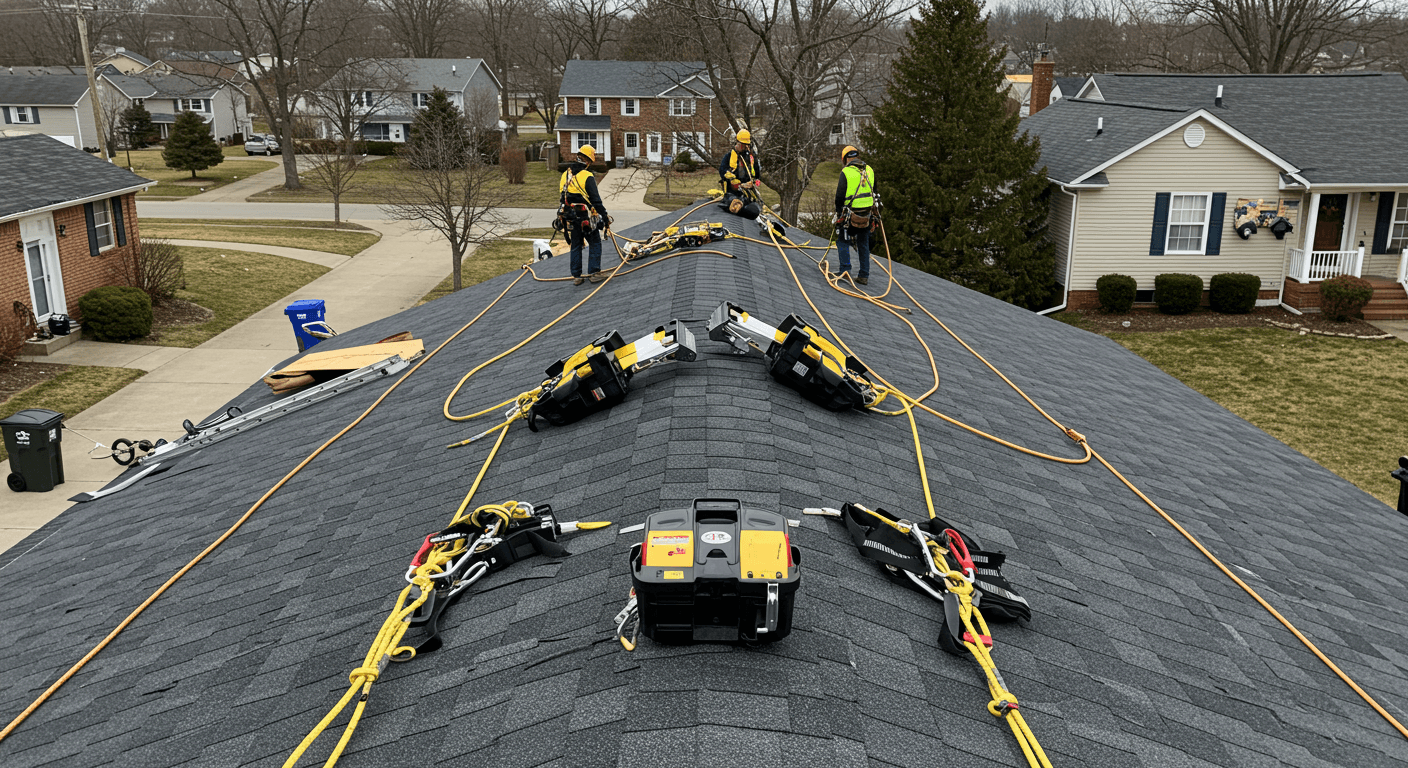
Macomb County insurance carriers have tightened their appetite over the last 18.4 months. They are showing up less like distant billing departments and more like people who actually read your loss runs. For residential shops that still want to hold something near a 22% gross margin, "safe enough" is a weak answer when your Experience Modifier Rate (EMR) is treated like a simple gate. When EMR sits north of 1.0, you are not being poetic about risk. You are paying more for the same coverage your competitors buy at a cleaner number.
Homeowners around Warren and Sterling Heights are also paying attention in ways that show up in real work, not just online drama. A crew on a 10/12 pitch with nothing visible for fall protection is not only a regulatory headache. It becomes a brand problem fast, especially when a nervous homeowner calls a halt mid tear-off. If you want scale, safety has to live where the money lives: in the schedule, the photos, the training log, and the P&L, not in a binder that only comes out after something goes wrong.
Table of Contents
Operational safety ROI
When EMR improves, workers' comp can move enough to matter on bids. In Warren, a shop moving from 1.25 toward 0.88 can see annual premium relief in the mid five figures, depending on payroll mix and class codes.
Injuries are expensive beyond the medical bill. Hiring and retraining after a lost-time event often lands near $6,200 per replacement hire, and that does not count the soft cost of a crew that stops trusting the plan.
Commercial and higher-end residential buyers increasingly ask for proof. A program you can show beats a program you can only talk about.
Documentation is not paperwork for its own sake. It is the trace that helps you respond when a claim does not match reality.
The invisible tax on Warren roofing operations
A real shop, a real EMR, and the moment safety stopped being a lecture.
When I first dug into the books for a residential roofing company near Mound Road, the owner, Wesley, was irritated for the right reason. He was winning work, but net was sagging. Overhead felt inflated in the vague way owners describe when they know something is off but cannot point to a single line item. The culprit was not mysterious once we isolated it. His EMR was 1.42. For every dollar a cleaner competitor paid for workers' comp, Wesley was paying $1.42.
That is not drama. It is arithmetic. Across 14.7 months, the spread drained about $43,812 out of operating capital. His crews were fast, but speed was showing up as skipped steep-slope setup steps and lazy ladder stabilization. Safety lived like a list of threats instead of a production system. Fixing it meant we stopped chasing guilt and started building a repeatable field standard.
The National Roofing Contractors Association (NRCA) frames training as more than compliance theater. It is how you teach crews that an injury is the worst kind of schedule slip. In Warren, weather can flip from clear to slick fast. Protocol is not pessimism. It is how you keep production from becoming a coin flip.
Reactive safety versus systematic safety
| What carriers and crews actually experience | Reactive (traditional) | Systematic (operational) |
|---|---|---|
| Gear checks | Harnesses and ropes get attention when someone is nervous or an inspector is nearby | Daily inspection before the crew leaves the lot, with failed gear pulled immediately |
| Pre-job communication | Toolbox talks drift to once a month, if that | A 15-minute Monday briefing plus a tight daily focus on one hazard class |
| Incentives | Bonuses lean hard on squares and speed | Bonuses include zero-incident milestones tied to real savings |
| Records | Paper piles that never match the job file | Digital logs for training dates, gear age, and setup verification |
| EMR story | EMR stays elevated and premiums act like a slow leak | EMR trends down and premiums stop punishing every payroll dollar |
Gear checks
Pre-job communication
Incentives
Records
EMR story
The left column is what I still see on storm weeks. The right column is what Wesley moved toward, one boring habit at a time.
Step 1 and 2: gear that is real, then a huddle that is not a speech
Wesley started with an inventory audit that embarrassed nobody on purpose, but the numbers did the talking. About 17% of harnesses were expired or showed wear at D-rings and stitching. In roofing, gear ages like tires. You can pretend it is fine, or you can treat it like an asset with a retirement date.
We put a simple red-tag rule in place. Every Friday, crew leads inspected kits. Anything questionable left service immediately. We replaced several rope-grab setups with self-retracting lifelines that cost about $214 more per unit, which stung until we watched crews move on 8/12 and 10/12 pitches without fighting snags all day.
Based on the premium trend after EMR improvement and fewer reportable incidents.
Programs fail when they feel like homework. Wesley replaced the thick manual nobody opened with a 15-minute Warren morning huddle at the shop before routes headed toward 8 Mile or Van Dyke. Each day picked one tactical theme: ladder angle and footing, edge awareness during tear-off when debris hides the perimeter, hydration and heat illness risk in humid July weeks.
We pulled a simple stat from Roofing Contractor to anchor the point: a large share of falls happen between six and ten feet, often in the awkward transition from ladder to eave. When training targets the moments people actually live in, crews stop treating it like a policy written for someone else's job site.
Step 3: digital proof when you cannot be on five roofs
Warren work is decentralized by nature. Wesley could not personally verify every anchor point without turning his week into windshield time. So we added a lightweight check-in. Before the first shingle came off, the lead uploaded three photos: anchor installation, ladder securement, and the crew tied off on the slope.
It took a little under two minutes on a normal job, and it created a trail that mattered when someone asked what happened on a Tuesday in July. It also changed crew psychology. When proof exists, shortcuts feel less like a secret between friends and more like a liability everyone owns.
If your pipeline is thin on the jobs that pay for better gear and better systems, it is worth testing whether your intake is pulling the wrong work. You can sign up on LeadZik and use previews to steer dispatch toward work that actually funds professional standards.
The Warren 10-point perimeter check
"Before the compressor starts on a Macomb County steep job, have your lead tech walk a 10-point perimeter check: overhead lines, ladder base stability, fragile skylights, debris piles that hide the edge, and the small trip hazards that cause stupid falls. Twelve minutes on the ground beats a $10,000 headache that starts with one rushed assumption."
Step 4: put part of the savings back into crew pockets
The culture shift accelerated when Wesley tied money to behavior. We called it a safety dividend. If a crew went 90 days without a reportable incident or a failed spot check, they earned a bonus tied to a slice of the labor savings from cleaner premiums.
Veterans stopped treating harness rules like a favor to the office. A violation became a group problem because it hit wallets. In the first year, Wesley paid about $8,740 in bonuses and still cleared well over $31,000 in direct and indirect savings once injuries, downtime, and premium pressure were included.
Action Plan
Five-phase safety rollout
A practical path for a Warren shop that needs EMR improvement without turning the company into a safety theater company that cannot produce.
Baselines: pull EMR, class codes, and injury costs across the last 3.5 years so you are not guessing about the tax you are paying.
Asset refresh: purge expired and damaged gear, then standardize on equipment crews will actually wear because it helps them move.
Digital proofing: require setup photos on every job, no exceptions, stored where your office can find them in seconds.
Ongoing education: keep the 15-minute rhythm, but anchor each week to real Macomb County conditions, not generic national talking points.
Incentive alignment: return a portion of verified savings to crews so enforcement is peer-driven, not only manager-driven.
Step 5: keep discipline when hail turns the market loud
In Warren, hail season creates a weird kind of social pressure. Everyone is in a hurry, and hurry is where safety dies. Last spring, Wesley watched competitors stack three roofs a day and cut corners on tie-off because the homeowner was screaming about interior leaks. He stayed boring on purpose. One bad fall erases the margin from a long string of quick wins.
The surprise was sales-side. Discerning homeowners noticed the circus elsewhere. Wesley leaned on his documentation and crew behavior as proof of seriousness, not as a flex, just as a fact. When your field rhythm is tight enough to handle surges, you do not need heroics. You need a system that still works when everyone else is sprinting. If you want a cleaner picture of how verification and delivery fit together, read how LeadZik routes demand, then keep your safety stack as the operational backbone that makes surge weeks survivable.
The documentation trap
Buying gear is not the finish line. If something bad happens and you cannot produce training logs, inspection records, and job-specific notes, you will lose the narrative in a hurry. OSHA and carriers do not reward intentions. They reward evidence.
The result: a cleaner EMR and a calmer shop
Two years later, Wesley's EMR moved from 1.42 to 0.94. Workers' comp premiums fell by 28.4%, which put about $12,340 back into cash flow every quarter using his payroll mix. Turnover improved by 19.1%, which is the kind of number that shows up in quality, not only HR spreadsheets.
Safety is not a moral accessory in a competitive Michigan market. It is a financial strategy that reduces waste, protects people you cannot replace quickly, and signals maturity to homeowners who have seen too many temporary crews.