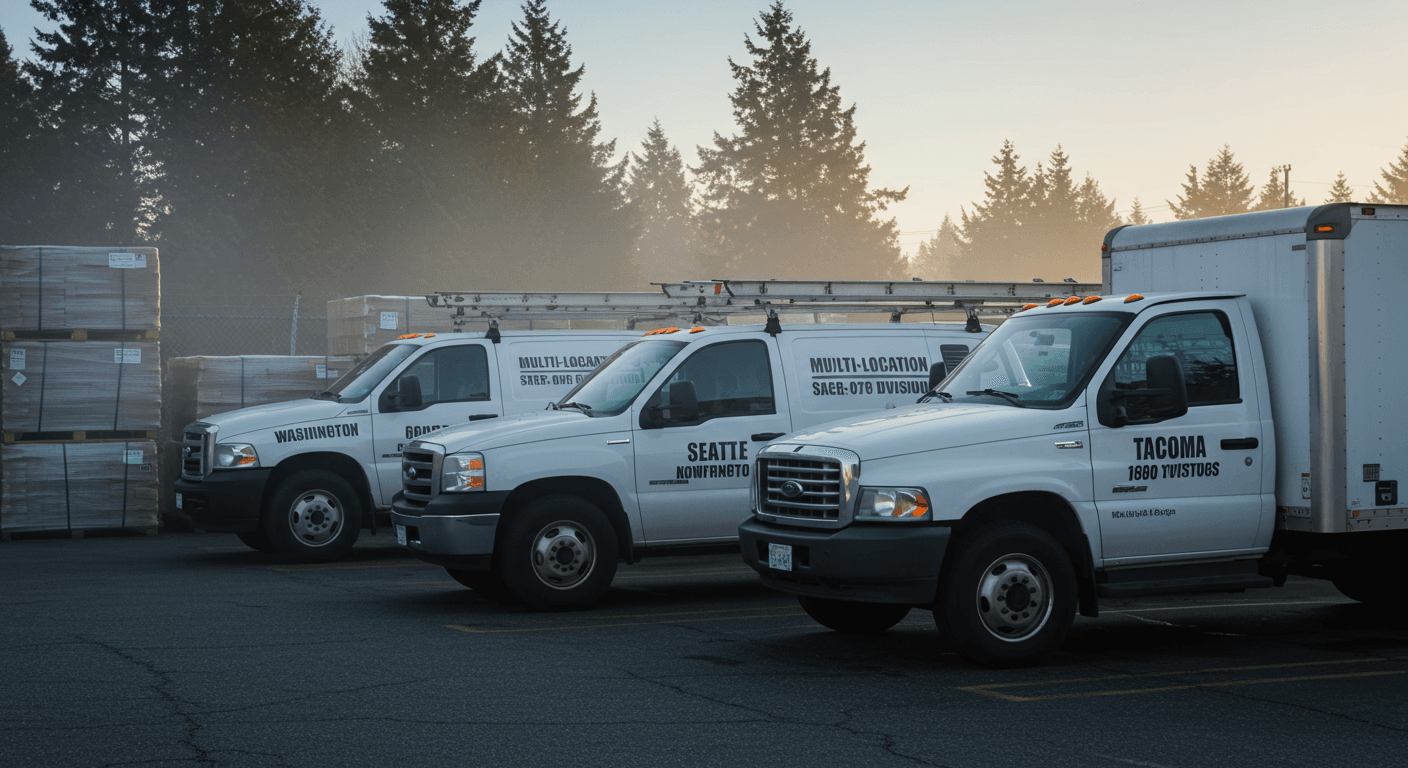
Operating a single-hub roofing shop in Seattle limits your annual revenue ceiling to the radius your crews can cover in about 48 minutes before overtime starts eating the job cost. Opening satellite capacity in Tacoma or Bellevue can lift top line fast, but it also introduces a 14.3% management drag that often cannibalizes the profit you were chasing. That tension between regional density and distance is where a lot of Washington roofers stall.
One path duplicates overhead and hopes the market catches up. The other builds a deliberate hub-and-spoke system so margins do not leak while you grow. I have seen owners burn about $142,500 in six months planting flags without a logistical moat. To scale past roughly $8.4M in the Evergreen State, you have to choose whether you are building separate mini-shops or one coordinated machine. In my regional data, the "copy-paste" expansion approach fails about 38% more often than hub-and-spoke because it ignores how labor and permitting friction differ between King and Pierce counties.
Satellite expansion can still work, but if coordination cost is not modeled up front, margin disappears before revenue catches up.
The geographic reality of the I-5 corridor
Washington expansion is less about adding routes and more about reading each sub-market on its own terms.
Expansion here is not a generic growth play. A roofing lead in Olympia usually carries a different margin profile than one in Redmond, and travel on I-5 can quietly erase production hours. When Carter, a contractor I worked with in Kent, pushed into Everett, he initially treated both zones as interchangeable. Within a few weeks he saw the corridor was costing his crews about 7.4 hours of production time per week, per installer, mostly in predictable bottlenecks.
Washington licensing and municipal expectations also shift city to city. Seattle and Bellevue can feel like different countries on paperwork and inspection cadence. Before you sign a second lease, audit capacity at home. If your primary location is not holding at least a 34% gross margin on steep-slope installs, expansion tends to scale the inefficiency instead of the profit. A second location behaves like a magnifier. If your systems are loose, the new branch will expose it faster, and usually at a higher monthly burn.
The 45-minute efficiency rule
"Do not open a secondary base more than a 45-minute drive from your primary material staging unless you have a dedicated local production manager. Beyond that window, supervision load and non-billable drive time often chew about 11% of net profit."
Satellite offices versus hub-and-spoke
Most owners picture expansion as cloning shop number one. That is rarely the highest-return layout.
In a satellite model you duplicate office staff, sales leadership, and production leadership at every site. In hub-and-spoke, you centralize the expensive coordination work (admin, estimating, marketing) and push only what must be local out to staging yards and crews.
When we modeled a Spokane shop moving into the Tri-Cities, hub-and-spoke trimmed about $9,342 per month in redundant admin salaries. Keeping Aria, their lead coordinator, at the main office to schedule both regions tightened the calendar and cut the miscommunication that creates wasted site visits.
Washington expansion layout comparison
| Decision factor | Satellite model | Hub-and-spoke |
|---|---|---|
| Overhead profile | Duplicated office and admin payroll at each location | Lean admin with centralized scheduling and estimating |
| Culture and control | Strong local autonomy, higher variance in how jobs are run | One operating rhythm with local leads executing the same playbook |
| Typical ROI window (directional) | Often 18 to 24 months before the model stabilizes | Often 9 to 14 months when coordination stays tight |
| Risk posture | Higher silo risk if a satellite manager goes off script | Higher control, with accountability centralized in the hub |
Overhead profile
Culture and control
Typical ROI window (directional)
Risk posture
Swap the middle column with your own payroll and drive-time data. The point is to force an honest comparison before you sign.
Savings came from not re-hiring overlapping roles. The revenue line still has to prove itself, but the fixed cost stack stayed flatter.
Labor, safety, and compliance at two addresses
A second shop turns you into a recruiter whether you planned for it or not.
Washington's labor pool for certified installers stays tight, especially for crews that understand wet-climate details and the documentation insurers expect. Scaling to another location means you are competing for a thin slice of talent against every other shop along the Sound.
Safety compliance also stops being a single-yard conversation. OSHA roofing safety guidance is clear that fall protection and consistent oversight travel with every crew. I have watched multi-location shops take stacked penalties because the culture that worked at the main yard never translated to a crew sixty miles away. You either fund a serious safety lead or invest in digital jobsite tracking that proves the same standard is being followed on both sides of the map.
The ghost office trap
Do not lease a storefront just to win a map pin. If a location is not producing at least about $1.2M a year in revenue, rent and utilities can erase whatever local visibility you thought you bought. Shared yard space or a lean satellite staging setup is often the smarter bridge.
Prove demand before the lease
The expensive mistake is expanding because a competitor opened a yard, not because your pipeline proved the zip.
I like a ninety-day test in the target zip codes with dedicated lead flow before anyone commits to a warehouse. Measure close rate and average contract value on real conversations, not assumptions from a drive through the neighborhood.
If you want homeowner intent you can trust while you run that test, use LeadZik's verification breakdown to see how leads are checked before they hit your reps. It is a cheaper way to learn whether Pierce County pricing fits your model than absorbing a $6,500 monthly lease while your team is still based out of the original shop. If sales cannot hold about a 22% close rate on verified opportunities in that zone, a new building will not fix the underlying offer.
Action Plan
The four-phase expansion roadmap
A practical sequence for entering a new Washington market without destabilizing the shop that pays today's bills.
Phase 1, months 1 to 3: Digital scouting. Allocate budget to the target zip codes, track cost per issued lead, and log average contract value by area.
Phase 2, months 4 to 6: Commuter crew coverage. Service the new territory from your existing bench, pay travel stipends, and accept a temporary margin dip instead of a permanent duplicate staff.
Phase 3, months 7 to 9: Localized sales. Hire a rep who actually lives in the new territory so short-notice site visits do not default to two-hour I-5 sprints.
Phase 4, month 10 onward: Staging yard. When the area reliably hits about $115,000 in monthly revenue, sign a short-term yard lease. Hold off on buying real estate until the trend is boringly consistent.
Operational sync and enterprise value
Buyers and lenders reward systems, not owners who live in their trucks between two cities.
Multi-location roofing only builds enterprise value when estimating, CRM, and intake behave the same everywhere. If Tacoma flashes a chimney one way and Seattle does another, you are not scaling, you are running two brands under one letterhead. Resources from the Western States Roofing Contractors Association can help standardize specs and contract language so crews do not improvise critical details under pressure.
When you are ready to tighten how new markets feed the calendar, talk with LeadZik support about account setup, billing, or partnership questions. The shift you want is from guessing where the next signed job arrives to reading clean data per territory. Growth for its own sake bankrupts shops. Growth tied to profit and repeatable install standards is what actually wins Washington.
What Washington owners should carry into the next market
Model management drag, drive time, and duplicate payroll before you celebrate new revenue.
Treat King versus Pierce (and every adjacent county pair) as different margin cases, not one generic territory.
Run a timed demand test with measurable close rate and ticket size before you lock real estate.
Standardize safety, estimating, and flashing details so a second crew cannot create liability for the first.