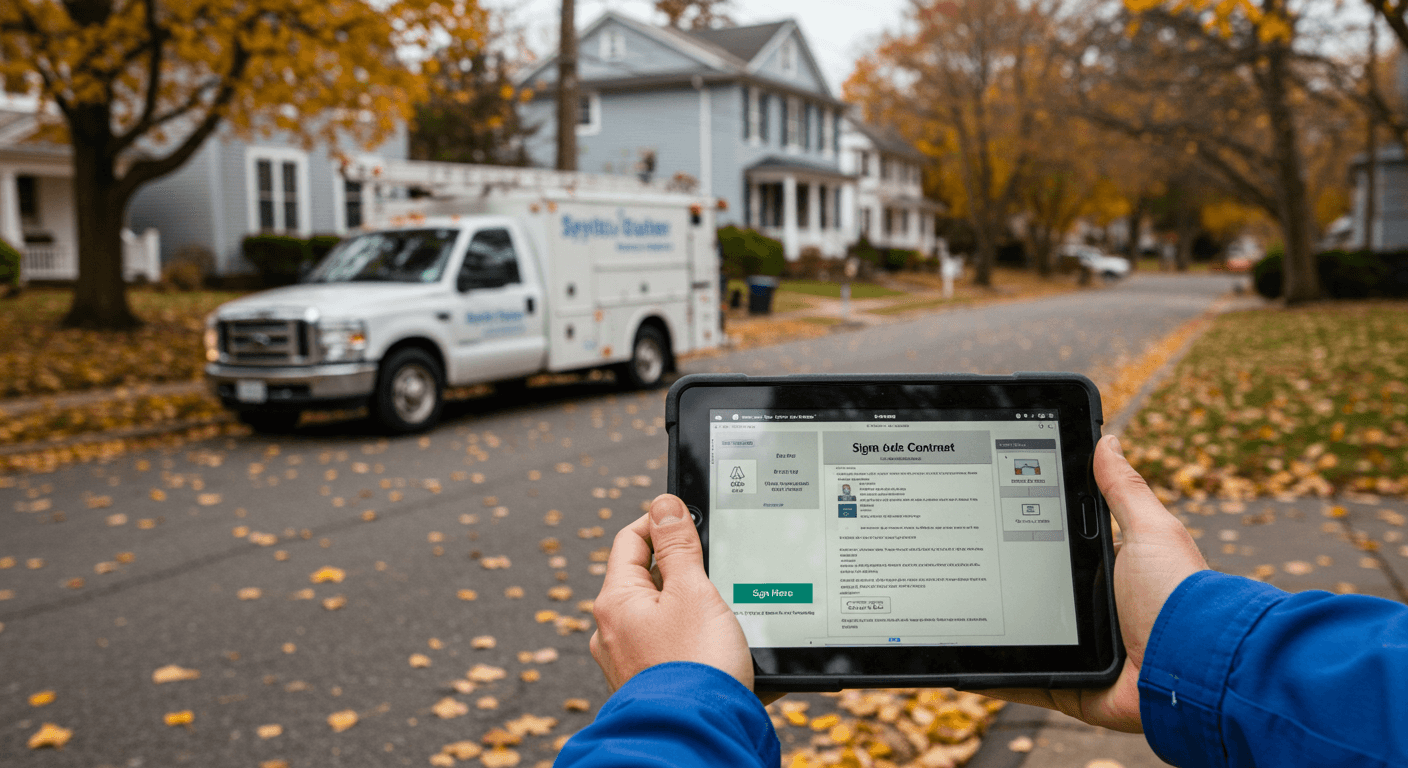
Choosing between the handshake momentum of a kitchen-table close and the slow grind of a thick paper packet is the fork that quietly stalls multi-million-dollar roofing operations across Central New York. Do you push to get a crew on a roof in Liverpool ahead of the next lake-effect stretch, or do you wait days for a signed folder to land on a desk? Most owners split the difference, and in that middle ground they bleed roughly 14.2% in operational efficiency from document lag and preventable mistakes.
The Contract Velocity Playbook below is a practical way to digitize the full project lifecycle. We are past treating e-sign as a novelty. The signed agreement should kick off material orders, crew scheduling, and municipal permitting work in Onondaga County. This is not about stacking unused apps. It is about wiring a workflow so your reps in the field are not circling back to Cicero just to chase a missed initial on a contingency clause.
The price of putting paperwork second
When the forecast finally cooperates, admin lag still does not.
In Syracuse, your construction window answers to the weather. When October gives you four clear days, every hour spent waiting on a scan-and-email loop is an hour crews are not earning. I recently reviewed a Fairmount-area shop running six crews that was burning close to $8,450 a month in idle time. Their PM could not release material orders until she held a wet signature, even when everyone knew the job was sold.
Current market research on roofing contractors still shows growth, but administrative drag is what caps scaling teams. If contracts depend on a printer, a scanner, or someone physically moving paper, you built your own ceiling. A real digital contract stack is not file storage alone. It shortens the jump from sold to production-ready.
Manual routing vs an integrated digital packet
| Workflow step | Paper / emailed PDF | Integrated digital system |
|---|---|---|
| Average turnaround to executed agreement | About 4.2 days | Near 17 minutes when mobile-first |
| Data into CRM / accounting | Manual retyping and attachments | Automated sync with validation rules |
| Missing initials / signatures | Roughly 11% error rate on reviewed packets | Hard stops on required fields before submit |
| Document storage | File cabinets or scattered cloud folders | Searchable vault tied to job IDs |
Average turnaround to executed agreement
Data into CRM / accounting
Missing initials / signatures
Document storage
Figures reflect shops we benchmarked in Upstate New York; your variance will depend on CRM maturity and municipality turnaround.
What Contract Velocity changes first
Shift paperwork from a multi-day lag into a trigger so procurement and scheduling see the job the moment it is fully executed.
Standardize change orders with photo-backed templates so Northeast material swings do not quietly eat margin.
Centralize versions so New York home improvement contract rules are easier to audit without spreadsheet detective work.
Track signatures in real time so storm-season crews can lock production slots before slower competitors clear their inboxes.
Why emailed PDFs still stall schedules
A PDF is often just a photograph of the old problem.
Plenty of Central New York contractors tell themselves they are digital because they email a PDF. That workflow still assumes the homeowner owns a printer, knows how to sign it, and can send it back without friction. I have watched mid-teens-thousand-dollar replacements sit idle because someone in Skaneateles could not get a home scanner to cooperate on a weeknight.
Mobile-first contracting removes that friction. Your rep can walk scope on a tablet, capture initials where they belong, and leave with a time-stamped agreement before heading to the next appointment. Labor stays tight in our market. Roofing labor statistics keep pointing to strong demand for installers, and shops that can quote a firm start date sooner tend to win the crews they need.
Teams paired faster signatures with immediate downstream tasks such as PO drafts and permit prep instead of waiting on overnight scans.
Planning for the Syracuse surprise under the shingles
Change orders deserve the same discipline as the original scope.
You rarely know the full story until tear-off. Rotten plywood from weak attic airflow, chimney-framing issues, or saturated decking shows up without warning. Too often the crew hears about extras through a rushed phone call or a sharpie scribble on scrap stock.
Digital change packets fix that. The field lead photographs damage, attaches it to a template, and routes an approval text so the homeowner signs before labor proceeds. I have seen shops absorb north of a thousand dollars in plywood because they did not want to pause production for a formal approval. Ninety seconds of signed clarity beats eating the cost and arguing later.
The three-minute verification rule
"No tear-off starts until the office confirms the primary digital contract is complete and insurance contingency language is active. That single pause prevents unauthorized-work fights and keeps carriers aligned before the first fastener backs out."
When sales energy meets production reality
Fast intake deserves an equally fast contract lane.
The fracture I see most often sits between aggressive sales and careful production. When you invest in routing that separates verified demand from noise, you are buying speed on the front end. If the packet still dies on a clipboard after that win, you erase the trust you just earned.
Tie submission to automation where it matters: welcome messaging with timeline expectations, an alert that kicks permitting for the City of Syracuse or the relevant town, and an accounting sync that raises the deposit invoice without duplicate entry. That stack replaces headcount you would otherwise hire just to chase paper between departments.
The wet-signature habit with carriers
Insurance-heavy jobs that depend on ink-on-paper packets often stretch payment timelines when supplements need clean documentation. Carriers increasingly expect digital, timestamped files for supplements and depreciation releases. Staying digital keeps cash predictable.
Action Plan
Pick the documentation lane that matches your volume
These three paths cover most shops I help in Upstate New York. Mixing them without a decision usually creates more exceptions, not more speed.
CRM-native documents: Best when your CRM is already the brain for pipeline and job costing; watch for clunky homeowner UX.
Dedicated e-sign tools: Easiest signing experience for homeowners but plan manual bridges back into scheduling and accounting.
Custom workflow automation: Makes sense around six million dollars and up when sales, suppliers, and ERP systems need bespoke triggers.
At LeadZik, we talk about demand quality because operations only pay off when internal systems can absorb it. If signatures eat more manager hours than prospecting, your acquisition cost doubles in practice even when ads look fine on paper.
Common Questions
Win back time before the next weather swing
Speed is operational, not motivational.
Moving to digital contracting is less about novelty than about removing the gap between yes and start date. When paperwork propagates in real time, you run more volume with less chaos in the office.
Syracuse crews live with sudden forecasts. Closing Tuesday with materials staged Wednesday because systems—not couriers—moved the file is how you compound advantage. Trade administrative zigzags for deliberate throughput and the margin shows up where it belongs.