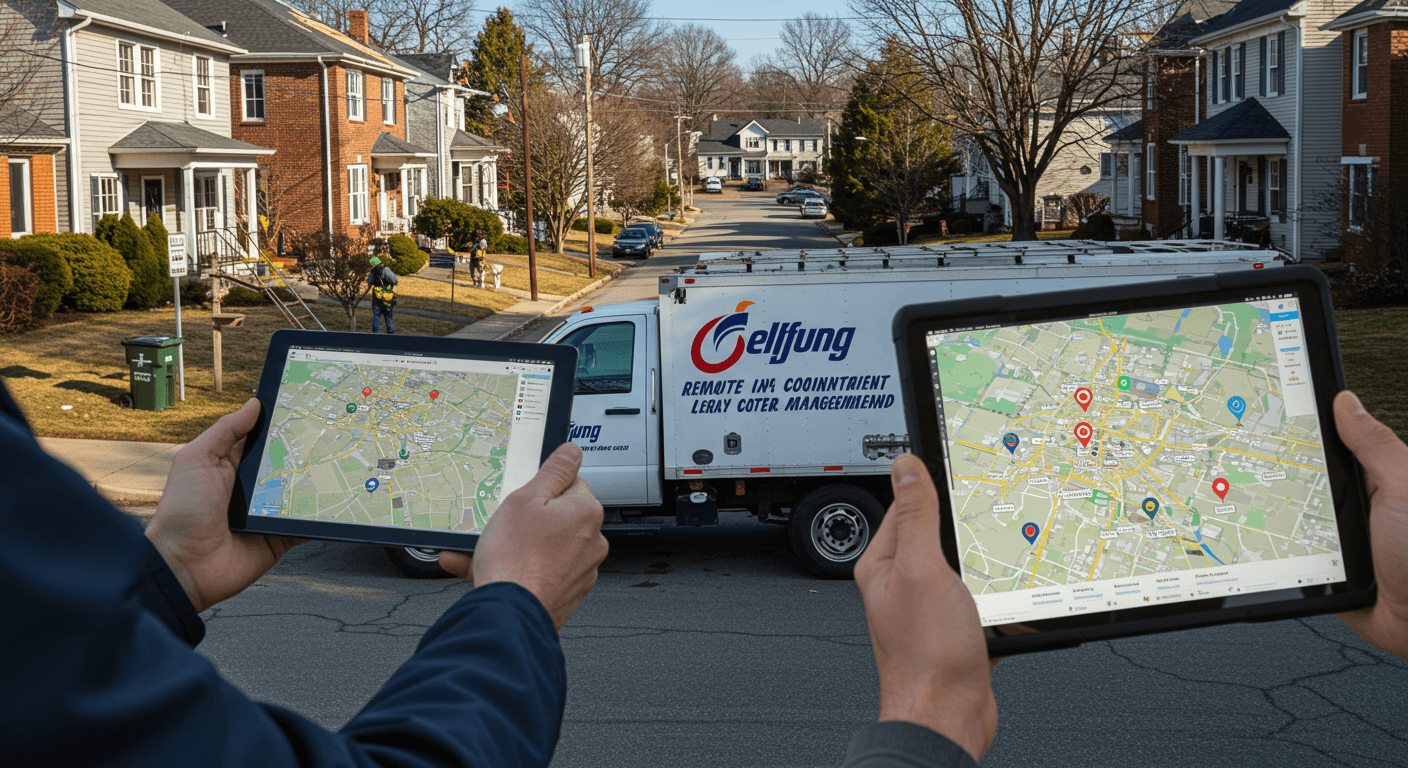
Are you still cutting a $3,850 check every month for that office space near the PPL Center just so your estimators have a place to park their trucks and drink mediocre coffee? I sat down with a contractor named Zane three months ago at a diner on Hamilton Street, and he was frustrated. He had six sales reps, a fleet of wrapped trucks, and a lease that was eating 14% of his gross margin before he even climbed a single ladder in Bethlehem. Zane felt like he had to see his team's faces every morning at 7:00 AM to ensure they were actually working. He was paying an "accountability tax" in the form of expensive square footage, and it was suffocating his ability to scale.
At a Glance
Eliminating $6,010 in monthly office overhead translates to $72,120 annually—money that requires $721,200 in sales at a 10% margin just to break even on the space.
Remote management reduces sales rep turnover from 44% to 12% by eliminating commute stress and giving top producers the freedom to work from home, saving $8,400 per replacement hire.
Transitioning to remote-first operations typically pays back initial setup costs in under three months, then generates $3,910+ in pure monthly profit that can be reinvested in growth capital.
Performance-based management replaces "clocking in" culture with "winning" culture, attracting A-players who want autonomy while naturally filtering out underperformers.
What we discovered over a long breakfast was that his physical office wasn't a hub of productivity; it was a bottleneck. By the time his guys fought the traffic on Route 22 to get to the office, sat through a disorganized huddle, and finally headed out to Macungie or Easton, they had already lost ninety minutes of prime selling time. We ran the numbers, and the "desk cost" per lead was nearly $84. That is money that could have been spent on higher-quality materials or better commissions to keep his top talent from jumping ship to a competitor.
The shift to a remote-first model in the roofing industry isn't just a tech-trend for Silicon Valley. For a high-volume shop in the Lehigh Valley, it is a mathematical necessity for survival in a market where labor costs are rising and competition is stiff. If you can eliminate the fixed cost of a central office, you transform that "dead money" into "growth capital."
The Hard Math of the 'Empty Desk' Tax
Most roofing owners look at their P&L and see "Rent" as a fixed cost they just have to live with. I challenge you to look at it as a variable cost tied to your headcount. When Zane moved his team remote, we didn't just look at the $3,850 lease. we looked at the $420 electricity bill, the $190 high-speed internet, the $310 cleaning service, and the $1,240 in "incidental office supplies" that seemed to disappear every month.
When you total that up, Zane was spending $6,010 a month to maintain a physical presence. Over a year, that is $72,120. In the roofing world, at a 10% net profit margin, you have to sell $721,200 worth of roofs just to pay for the building your sales reps don't want to be in anyway. According to business insights from Harvard Business Review, small businesses that optimize for flexibility often see a direct correlation in reduced operational drag.
By moving remote, Zane reinvested $2,100 of that monthly savings into a robust tech stack, including a high-end CRM and a mobile app for instant lead management that allowed his reps to claim and update jobs from their driveways in Whitehall or their tailgates in Emmaus. The remaining $3,910 went straight to his bottom line. His net profit didn't just go up; his stress went down because he stopped playing "office manager" and started playing "sales coach."
The $8,400 Sales Rep Retention Equation
In the Allentown market, finding a solid sales rep who can actually close a $22,000 architectural shingle job is like finding a parking spot at the Fairgrounds on a Saturday. It is nearly impossible. When you do find them, you have to keep them. The cost to recruit, onboard, and train a new roofing sales rep in Pennsylvania currently hovers around $8,400 when you factor in the "ramp-up" period where they are burning leads but not closing.
Remote management is your secret weapon for retention. Your top producers don't want to sit in traffic on I-78. They want to be in the field, closing deals, and then getting home to their families. When Zane gave his team the freedom to work from home, his turnover rate dropped from 44% to 12% in the first six months.
I remember a specific training session I held with one of Zane's reps, a guy named Jaxon. Jaxon was a killer closer, but he was burnt out. He told me, "Noah, I spend two hours a day in my truck just going to and from the office for meetings that could have been a text message." We transitioned Jaxon to a "digital huddle" model. Now, he starts his day by reviewing his verified homeowner leads on his phone, hits his first appointment by 8:30 AM, and his closing rate has climbed by 7.4% because he isn't starting his day frustrated by a commute.
Action Plan
How to Transition Your Allentown Roofing Team to a Remote-First ROI Model
A step-by-step approach to eliminating office overhead while maintaining accountability and boosting sales rep performance.
Audit the Physical Drag: Total every expense related to your office, from the lease to the water cooler. Calculate how many roofs you must sell annually just to break even on that space.
Digitize the Accountability: Replace the morning "sign-in" sheet with a 15-minute video huddle. Require reps to log "arrival" and "departure" notes in your CRM for every lead.
Reallocate the Savings: Take 30% of your saved rent and put it into a "Lead Acceleration Fund." Use this to buy exclusive, high-intent leads that keep your remote reps busy.
Implement a Performance Dashboard: Shift from "hours worked" to "milestones hit." Track leads claimed, inspections completed, and contracts signed in real-time.
Establish a Local Hub Strategy: If you need a place for materials, rent a small, low-cost warehouse in an industrial zone like Hanover Township instead of high-rent retail or office space.
Want to skip the manual work and get exclusive, verified leads instead?
Get $150 in Free CreditsSales Psychology: Performance Over Presence
One of the biggest hurdles for old-school owners is the fear that "if I can't see them, they aren't working." This is a management fallacy. Just because a rep is sitting at a desk in your office doesn't mean they are selling. They might be checking their fantasy football team or complaining about the new commission structure with the guy at the next desk.
As discussed in the Harvard Business Review: The End of Solution Sales, the market has shifted toward insight-driven selling. Your reps need to be experts who provide value, not just warm bodies in an office. Remote management forces you to manage by the numbers, which is the only way to truly scale a roofing business.
I told Zane, "If Jaxon hits his numbers and his close rate is 38%, do you care if he's doing his paperwork from his couch or a desk in your office?" The answer, obviously, was no. We set up a system where performance was the only metric that mattered. This changed the culture from one of "clocking in" to one of "winning."
Contractors in the Lehigh Valley who transitioned to remote sales management reported a 23.6% reduction in fixed overhead and a 14.8% increase in average contract value due to higher sales rep morale.
Handling the "Communication Gap"
The main risk of a remote team is the "silo effect," where your reps feel disconnected from the company mission. In a place like Allentown, where word-of-mouth is everything, your reps need to feel like they are part of a local powerhouse.
We solved this for Zane by implementing a "Win Wire." Every time a contract was signed, the rep posted a photo of the signed agreement and a quick video of the house to a group chat. It created a virtual sales floor. When Jaxon saw a $28,400 commercial flat roof contract come in from a rep in Easton, it lit a fire under him to close his residential lead in Fogelsville.
If you find that your communication is lagging or your team feels disconnected, it might be time to reach out for a strategy session to tighten up your digital infrastructure. Remote doesn't mean alone; it means efficient.
The Payback Period: What to Expect
When you decide to go remote, there is an initial "friction cost." You might have to pay a fee to break your lease, or you might need to invest in better tablets for your crew. For Zane, the total cost to "go remote" was about $9,200, which included his lease buyout and a few software licenses.
However, his monthly savings were $3,910. His "payback period" was less than three months. From month four onward, he was tucking nearly $4,000 of pure profit into his pocket every single month. That is enough to buy a new dump trailer every year or run a massive localized ad campaign targeting storm-damaged areas in Northampton County.
The 10:00 AM 'Pulse' Check
"Instead of a 7:00 AM meeting that kills the morning drive, hold a 10:00 AM "Pulse" video call. By then, your reps have already seen their first lead or inspected their first roof. They can share real-time objections they are hearing on the ground, allowing you to coach them while they are still in the field and ready to close the next one."
Building a Culture of Autonomy
The most successful roofing companies I coach in Pennsylvania aren't the ones with the flashiest offices. They are the ones with the most disciplined systems. Remote team management is the ultimate test of your systems. If your business falls apart because you aren't standing over your employees' shoulders, you don't have a business; you have a babysitting service.
Transitioning to a remote model forces you to document your processes, clarify your expectations, and trust your team. This autonomy is what attracts the "A-players." The "B" and "C" players need a manager watching them to stay productive. The "A-players" want the freedom to dominate their territory. By going remote, you naturally filter out the slackers and build a team of self-starters who treat their territory like their own mini-business.
Zane's shop is now a leaner, meaner operation. He's no longer worried about the landlord on Hamilton Street. Instead, he's focused on his close rates and his crew's efficiency. He realized that his profit wasn't hiding in the shingles; it was hiding in the overhead he was brave enough to cut. If you are looking at your bank account at the end of the month and wondering where the money went, look at your office. It might be time to trade that "prestige" address for a healthier bottom line.