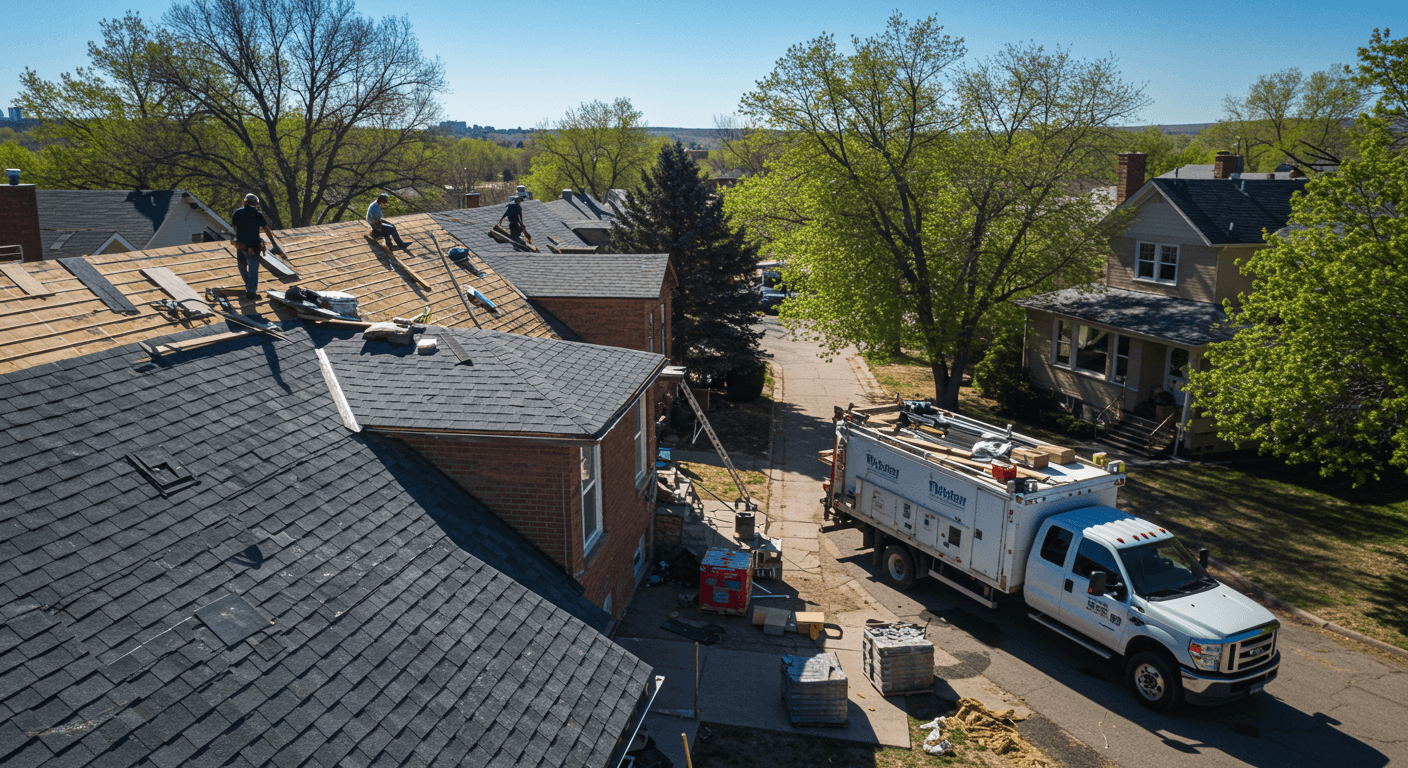
Standing on a steep 10/12 pitch in Centennial last August, I watched a crew struggle with a complex valley flashing that wasn't on the original scope. It wasn't the technical difficulty that bothered me; it was the silence of the spreadsheet back at the office. We were watching roughly $438 in labor and material waste evaporate because the estimator hadn't accounted for the specific structural quirks of these older suburban builds. That moment clicked for me: most Denver roofing shops aren't losing money because they can't nail a shingle; they're losing it because their job costing is a ghost of the actual field reality.
The Front Range market is unforgiving right now. Between the volatile cost of asphalt shingles and the aggressive competition for skilled labor along the I-25 corridor, a "close enough" estimate is a recipe for a slow-motion business collapse. I've spent the last 14 years dissecting the operational guts of roofing companies, and the pattern is always the same. The shops that scale are the ones that treat a job cost like a surgical instrument, not a rough guess.
At a Glance
Implement unit-based labor costing rather than flat-rate day pay to account for roof complexity.
Factor in location-specific logistics buffers for high-density neighborhoods like Capitol Hill.
Track 'slippage' daily to identify where estimated man-hours deviate from actual site performance.
Verify lead quality early to ensure sales teams aren't wasting high-cost hours on low-intent tire kickers.
The Reality of the Denver Margin Squeeze
According to the National Roofing Contractors Association (NRCA), material costs and labor shortages continue to be the primary headwinds for the industry. In Denver, this is magnified by our unique geography. If you're bidding a job in the Highlands or Cherry Creek, your logistics cost is vastly different than a wide-open development in Castle Rock.
I recently analyzed the books for a local shop where they were hitting their revenue targets but their net profit was hovering at a measly 6.2%. When we dug into the data, we found they were using a flat "overhead" percentage across the board. They weren't accounting for the 95 minutes their crews spent idling in I-70 traffic or the two-week delay often found in Denver County's permitting office compared to smaller municipalities.
Why Data Beats Intuition Every Time
Relying on "gut feelings" for pricing is how you end up with a calendar full of work and a bank account that won't grow. I've seen owners who have been in the game for 23 years still underprice a job because they "remember" what shingles cost two seasons ago.
Effective job costing requires a feedback loop. Every Friday, your production manager should be comparing the estimated labor hours against the actual hours logged. If your estimator budgeted 42 man-hours for a job in Arvada and the crew took 57, you need to know why. Was it a material delay? Was the roof steeper than the aerial measurements suggested? Or was the crew simply underperforming? Without this granularity, you're just throwing darts in the dark.
Estimating Approaches: Traditional vs. Unit-Based
| Factor | Traditional 'Square' Pricing | Unit-Based Operational Costing |
|---|---|---|
| Accuracy | Low (ignores site variables) | High (accounts for pitch/access) |
| Labor Costing | Flat percentage of total | Role-specific hourly burden |
| Profit Predictability | Volatile (+/- 12%) | Stable (+/- 3.4%) |
| Scalability | Difficult (tied to owner's gut) | High (systematized for any estimator) |
Accuracy
Labor Costing
Profit Predictability
Scalability
A Case Study in Margin Recovery: Adrian's Turnaround
Let's look at a real example. I started working with a contractor named Adrian who operated out of a yard near Globeville. Adrian was a fantastic roofer, but his business was stagnant. He was bidding everything at $475 per square, regardless of whether it was a simple ranch in Thornton or a cut-up Tudor in Wash Park.
We spent three weeks building a custom costing stack. We broke down his overhead, including his truck notes, insurance premiums, and even the cost of the coffee in the breakroom. We discovered his "break-even" point was actually $392 per square before he even touched a shingle. By the time he paid his crew and bought materials, he was often making less than $15 per square on complex jobs.
By switching to a system that verified the scope and job quality before the sales team even stepped on site, Adrian was able to stop bidding on the "dead-end" leads that were dragging his average margin down. Within six months, his average net profit per job climbed from $1,240 to $2,983. He wasn't doing more work; he was doing the right work.
Tactical Steps to Lockdown Your Profits
If you want to see an immediate shift in your bottom line, you have to stop treating your operation like a hobby and start treating it like a high-performance engine.
Action Plan
The Denver Margin Protection System
A three-step framework to eliminate profit leaks and build predictable margins in Colorado's competitive market.
Calculate Your True Hourly Burden: This isn't just the $28 you pay your lead installer. It's the workers' comp, the payroll taxes, the fuel for the truck, and the wear and tear on the ladders. Most Denver shops find their true burden is 32% higher than they initially thought.
Audit Your Lead Source: If your sales reps are spending 4 hours a day driving to "dead" leads, that's a direct hit to your margin. I've seen shops clean up their pipeline by focusing on exclusive, verified opportunities rather than the shared lead "race to the bottom" that most platforms offer.
The 'Post-Game' Huddle: Every Monday morning, review the profit/loss on every job closed the week prior. If a job in Lakewood fell below your 35% gross margin target, find the leak immediately.
Want to skip the manual work and get exclusive, verified leads instead?
Get $150 in Free CreditsThe Denver Permit Buffer
"Always add a 4.5% contingency to your administrative labor costs when dealing with Denver's Department of Community Planning and Development. The variance in inspection timelines compared to suburbs like Westminster can derail your crew scheduling and eat your profit in idle time."
Building a Scalable Lead Engine
To keep a steady margin, you need a predictable flow of work. You can't be picky about your margins if you're desperate for any job just to keep the lights on. This is where most owners fail; they stop marketing when they're busy and then panic-buy low-quality leads when the calendar clears.
The smartest operators I know use a platform designed for roofing growth to keep a "warm" pipeline of verified jobs. This allows them to walk away from the low-margin "price shoppers" in Aurora and focus on the high-value replacements in Evergreen or Boulder where their expertise commands a premium. As Roofing Contractor Magazine often points out, the shift toward digital verification is no longer optional for businesses that want to survive the next decade.
When you can preview lead quality and verify job details before committing resources, you're not just buying leads—you're buying time. Time that your estimators can spend on jobs that actually close, rather than burning gas and hours on prospects who were never serious buyers.
The Path Forward
Operational excellence isn't about one big change; it's about a hundred small adjustments. It's about knowing that your crew in Highlands Ranch is performing 8% more efficiently than your crew in Wheat Ridge and figuring out why. It's about ensuring every lead you buy has been vetted for accuracy so your estimators aren't wasting gas and time.
If you're ready to stop guessing and start growing, it begins with the data. Look at your last five jobs. If you can't tell me the exact net profit on each one to the dollar, you have work to do. But once you lock that system in, you'll find that the "Mile High" market has plenty of room for those who know how to play the numbers game.