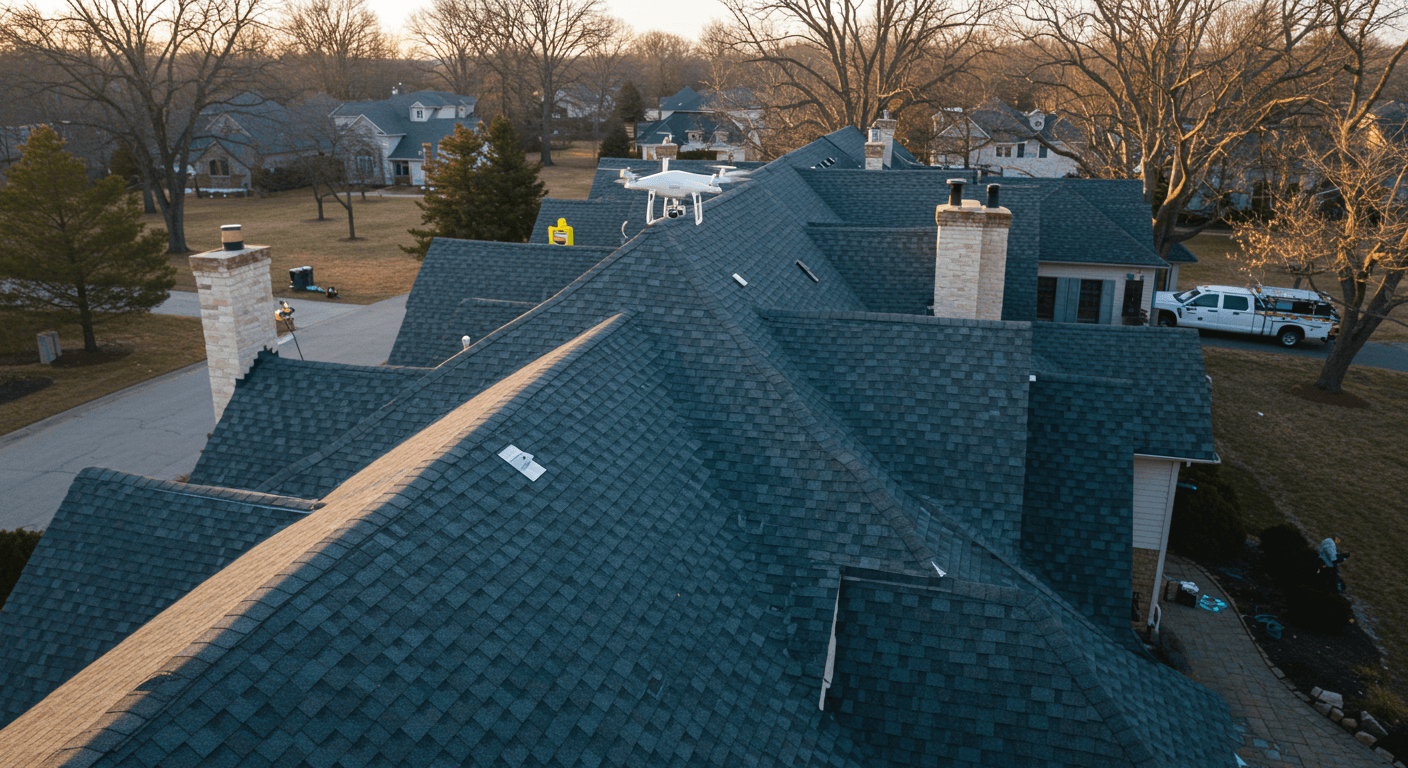
Your current estimating process is likely the most expensive "free" task in your entire roofing operation. If your reps are still pulling out tape measures and hand-drawing diagrams for every ranch in Livonia or colonial in Grosse Pointe, you aren't just being traditional—you're being inefficient to the tune of about $1,147 per rep every single month.
I was standing on a driveway in Royal Oak last Tuesday with a sales manager named Jaxon. He's a sharp guy, runs a crew of six, but his frustration was visible. He had three leads to hit before 5:00 PM, and he was already running 22 minutes late because the previous measurement took twice as long as expected due to a complex valley and dormer setup. While Jaxon was up on a ladder, his competitor had already emailed a digital quote to the homeowner. By the time Jaxon climbed down, the "sold" sign was effectively already in the yard.
The Detroit market doesn't forgive slow movers. With our unpredictable weather windows and a saturated contractor pool in Oakland and Macomb counties, the speed of your estimate is often the deciding factor in who gets the signature. When you automate that process, you aren't just buying software; you are buying back the 14.8 hours a week your top earners spend squinting at shingles instead of closing deals.
At a Glance
Operational Savings: Reducing manual measurement time by 74% allows reps to handle 2.3x more leads per week.
Accuracy Gains: Automated lidar and aerial tools reduce human error in material ordering by 8.7%, saving thousands in restock fees.
Close Rate Impact: Delivering an estimate within 15 minutes of a site visit increases the likelihood of a "one-call close" by 32%.
Competitive Edge: High-tech presentations build instant trust with tech-savvy homeowners in metro Detroit's suburban corridors.
The True Cost of the "Drive-and-Drop" Estimate
Many owners I coach think manual estimating is free because they already pay their reps' salaries. That is a dangerous accounting error. When you factor in gas, vehicle wear-and-tear on the Lodge Freeway, and the opportunity cost of a sales rep who could be prospecting instead of measuring, that "free" estimate costs the company roughly $153 per appointment.
I recently analyzed a mid-sized shop in Warren that was running 40 leads a week. They were strictly "old school"—tape measures and pitch gauges. After we looked at their numbers, we realized their reps were spending 112 hours a month just on the physical act of measuring and drawing. At a modest $35/hour burden rate, that's $3,920 a month in labor alone before a single shingle is sold.
The problem isn't just the time; it's the inaccuracy. According to Harvard Business Review, operational inefficiencies in small businesses often stem from a lack of standardized data. In roofing, a 2-square error on a 30-square roof in Bloomfield Hills can wipe out 15% of your net profit on that job. Manual measurements are prone to "rounding up," which inflates your bids and makes you lose to the guy who has the exact math.
Tiered Comparison: Finding the Right Automation for Your Crew
Not every tool fits every business model. In the Detroit metro, where we deal with everything from flat commercial roofs in the city to steep-slope Victorians, you need to match the tech to the terrain.
Tier 1: Digital Takeoff Software (Manual Point-and-Click)
These tools allow you to trace roof lines over satellite imagery. They are the "entry-level" of automation.
- Pros: Extremely low cost (often $50-$100/month); better than a tape measure.
- Cons: Still requires 15-20 minutes of a rep's time; satellite resolution in some older Detroit neighborhoods can be grainy.
- ROI: Good for small shops doing under $800k, but it doesn't solve the "time" problem for scaling.
Tier 2: Third-Party Aerial Reports (The Gold Standard)
Companies like EagleView or SkyMeasure provide 99.4% accurate CAD files and reports.
- Pros: Zero effort from your team; professional reports you can show the homeowner.
- Cons: Costs $35-$65 per report; can take 1 to 24 hours to receive.
- ROI: High. Even at $50 a pop, saving 2 hours of a rep's time (valued at $70+) makes this a net win.
Tier 3: AI-Powered Instant Estimating
The newest players use high-resolution flyover data and AI to generate a bid the moment a lead comes in.
- Pros: Speed is unbeatable. You can have a bid ready before you even put the truck in park.
- Cons: Requires a higher monthly subscription; might struggle with heavy tree cover in areas like Birmingham or West Bloomfield.
- ROI: Massive for high-volume shops. This is where you see the "one-call close" percentage skyrocket.
The "Hybrid" Measurement Strategy
"Don't rely 100% on the computer. I teach my reps to use automated reports for the bulk of the bid, but always do a "ground-level audit." Look for things the satellite misses: rotted fascia, specific flashing details near chimneys, or hidden satellite dish mounts. This "High-Tech, High-Touch" approach builds more trust than a tablet alone."
The Psychology of the Instant Bid
Why does automation actually help you close? It's not just about the numbers; it's about the psychological trigger of professional competence. When Jaxon started using automated reports, I sat in on a sales call with him.
Instead of saying, "Let me get my ladder and I'll get back to you with a price by Friday," he sat at the kitchen table and opened his tablet. He showed the homeowner a 3D model of their own roof.
"Mr. Thompson," Jaxon said, "our system has mapped every facet of your roof with 98.7% precision. We know exactly how many feet of starter strip and ridge vent we need. That's why we don't have to pad our bids for 'surprises' like the other guys might."
The homeowner's posture changed immediately. He wasn't looking at a contractor; he was looking at an expert. This shift in perception is why I'm such a proponent of platform features that integrate real-time data into the sales process.
Operational Cost Reduction: The Detroit Math
Let's look at the localized ROI. If you're a contractor in Troy, Michigan, your average job size might be around $14,600.
- Manual Method: 4 hours total (Travel + Measure + Calculate + Follow-up). Labor cost: $140.
- Automated Method: 45 minutes total (Review report + Site visit). Labor cost: $26.
- Total Savings per Lead: $114.
If you run 25 leads a month, that is $2,850 back in your pocket. Over a year, that's $34,200—the price of a new mid-sized work truck or a very healthy marketing budget. We built our company because we were frustrated with these kinds of drains on the roofing business, and seeing these numbers in black and white makes the decision easy.
Speed builds trust and eliminates buyer's remorse
Moving Toward a Leaner Model
The roofing industry is shifting toward a model where the "salesman" is more of a "consultant." In this new environment, your value isn't in your ability to climb a ladder—it's in your ability to solve the homeowner's problem quickly and accurately.
If you're still doing things the way they were done in 1995, you are essentially paying a "manual tax" on every job you bid. In a market as competitive as Detroit, that tax will eventually put you out of business. The guys winning the most jobs in Novi and Farmington Hills right now aren't the ones with the longest ladders; they're the ones with the fastest data.
Action Plan
How to Transition Your Detroit Crew from Manual to Automated Estimating
A step-by-step process to implement automation without mutiny from your sales team.
The Audit Phase: Track your reps' time for 14 days. Most will be shocked to see they spend 35% of their day just calculating.
The Pilot Program: Pick your most tech-forward rep (the "Early Adopter") and give them the automated tool for 10 jobs.
The Data Reveal: Compare the Pilot's close rate and material waste against the rest of the team at your Monday morning meeting.
The Standard Operating Procedure (SOP): Mandate that every roof over 25 squares requires an automated report. No exceptions.
Continuous Education: Use resources like SCORE to find business mentors who can help you refine your back-office tech stack.
Want to skip the manual work and get exclusive, verified leads instead?
Get $150 in Free CreditsOvercoming the "Accuracy" Fear
The biggest pushback I get from veteran roofers in Macomb County is: "Noah, a computer can't see what I see from a 40-foot ladder."
They are half-right. A computer can't see if the decking is soft under a specific valley. But a computer is infinitely better at calculating the total square footage of a 12/12 pitch roof than a guy with a tape measure and a calculator with a dying battery.
The goal of automation isn't to replace the roofer's eye; it's to eliminate the "busy work" that leads to human error. When you free up your brain from doing geometry, you can spend that mental energy looking for the actual problems on the roof that will lead to change orders or upsells. You can find more tactical advice on balancing tech and craft on our blog.
I've seen shops in the 313 area code increase their net margins by 4.3% just by tightening up their estimating accuracy. That might not sound like much, but on a $2M per year business, that's an extra $86,000 in profit.
The Bottom Line
Automating your estimating isn't just a "nice to have" anymore. It is a fundamental shift in how successful roofing businesses operate in the modern era. Start by picking three upcoming jobs and ordering an automated report for them. Compare the computer's numbers to your own. If you're like most contractors I train, that one experiment will be all the proof you need to ditch the tape measure for good.
For additional guidance on building efficient business systems, consider reaching out to SCORE for free business mentoring and education resources tailored to contractors.