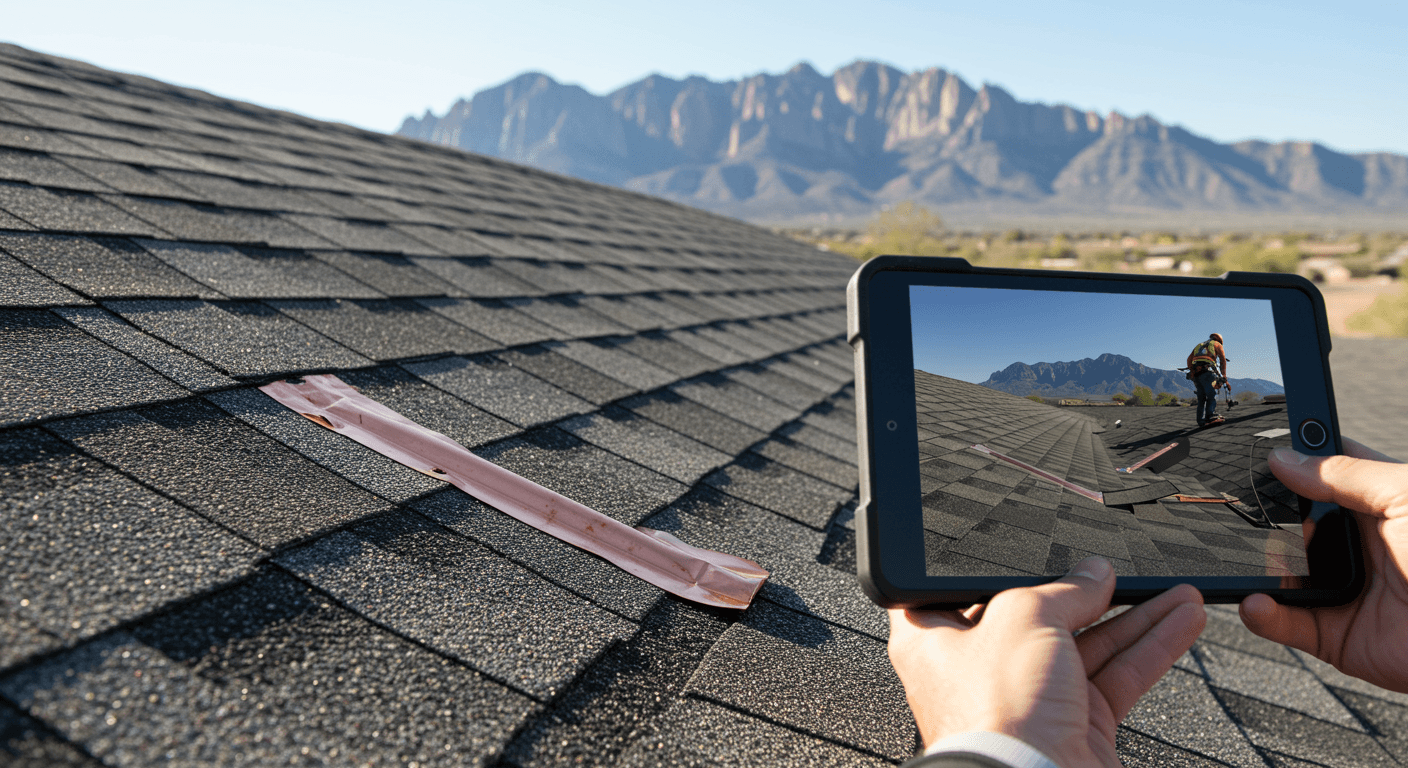
Most roofing owners still treat a 60-photo checklist like daylight they cannot spare. They lean on a foreman's eye to catch mistakes and "prove" the job. Last July I was in an office off Main Street in Las Cruces, watching Jaxon scroll a denied $4,387 supplement on a steep job near New Mexico State University. The adjuster did not care about 18 years in the Mesilla Valley. They wanted the valley liner photo. That afternoon it clicked: his fast crew was the expensive crew, because speed was torching supplements month after month.
Documentation is not a backup file anymore. In southern New Mexico, sun-cooked shingles and monsoon wind events turn small scope gaps into real margin swings. If you cannot show three layers of tear-off with timestamps, you should not expect to get paid for three layers. The roof either earns what the photos support, or it does not.
Structured uploads give adjusters the layering story without a second argument. That is where the hidden dollars show up.
The quiet leak in Chihuahuan Desert margins
Las Cruces can look busy while net profit stays thin if carriers keep shaving line items.
When Jaxon and I first mapped his books, the shop looked healthy from the street. Steady work in Sonoma Ranch and Picacho Hills masked the problem: net margin hung around 11.4% on about $3.2 million in revenue, which is a bad place to live in roofing. We pulled his last 14 insurance claims. On 11 of them, the carrier had dropped obvious needs (high-profile ridge, specific flashing) off the original scope.
Crews were racing tear-off, loading debris, and hauling it away before the office could photograph what was actually on the deck. By the time the supplement went in, the proof was in the landfill. According to the IBISWorld roofing contractors industry report, competition is tight enough that those small misses compound fast. In Jaxon's audit the average omitted scope per affected job landed near $2,143. Across 75 insurance-heavy jobs a year, that is real capital stuck in someone else's spreadsheet.
The crews were not unskilled. They were unmanaged on evidence. Nobody had treated the phone like a revenue tool, so the company kept funding speed with denials.
What clean documentation actually buys you
Carriers move faster when photos show code-obvious layers, flashings, and valleys instead of a verbal argument.
Pre-existing shots of gutters, siding, and landscaping short-circuit back-charges that start as he-said conversations.
Real-time uploads let PMs catch high nails, unsealed vents, and drip edge gaps before shingles hide the fix.
A simple progress folder gives homeowners a clear story, which supports pricing on insurance work that rewards detail.
Why Las Cruces QA needs a digital trail
Heat and sudden rain expose sloppy details faster here than in milder climates.
Southern New Mexico heat is brutal on membranes and shingle seals. A vent that is not sealed or a shingle that is high-nailed will show itself quickly under UV and thermal movement. Jaxon once rolled to Mesilla after an August downpour: homeowner leak call, lead installer pulled off a paying job, 25 miles each way, three hours on the roof. One turtle vent fastener never got sealant. Labor, fuel, and the opportunity cost on the other job landed around $384. A required close-up of every vent seal would have flagged it from the office in seconds.
Systems like this are not about hovering. They are about defining done. When drip edge photos upload before the field crew moves on, craftsmanship tightens because the standard is visible, not guessed.
Flashings read better at an angle
"Train crews to shoot flashing from about 45 degrees instead of flat-on. You see layering and sealant continuity, which is what adjusters scrutinize on chimney and wall transitions."
Photo discipline versus a few minutes of labor
The math is blunt once you stop treating uploads as soft cost.
Pushback usually sounds like software fees or lost production. Run the labor: roughly eight minutes a day for 40 targeted photos is about $4.50 at typical Las Cruces burdened wages. One approved starter line the adjuster skipped can land near $280. That is not a rounding error. Even without supplements, callbacks are expensive reputation tax. ConsumerAffairs roofing statistics spell out how high the stakes are for homeowner satisfaction. One sour callback story in a tight market can cost more than a season of software.
Manual folders versus a systematic photo path
| Metric | Old way (text or random rolls) | Systematic capture |
|---|---|---|
| Time to find one specific photo | 15–20 minutes | Under 30 seconds |
| Typical supplement approval rate | 45%–55% | 85%–92% |
| Callback frequency (rolling average) | 4.2% | 1.8% |
| Adjuster friction | High (memory vs. memory) | Low (evidence first) |
Time to find one specific photo
Typical supplement approval rate
Callback frequency (rolling average)
Adjuster friction
The landfill problem
If tear-off leaves the property before photos exist, you voluntarily erase the evidence carriers want. Slow the trailer for ten minutes, not the whole job forever.
Rolling out photos without a crew revolt
Pay for the behavior you need, then keep the checklist stupid simple.
Jaxon's veterans pushed back with the classic line: I roof, I do not shoot weddings. We tied money to the outcome instead of nagging. A $75 documentation bonus hit when the checklist was complete, and a small share of approved supplements went to the crew lead. Overnight the same people started hunting scope the office would have missed, because the incentive matched the work.
Action Plan
Five photo stages that stay realistic on a hot deck
No art school required. These are evidence shots tied to insurance and QA, not portfolio glamour.
Arrival: pre-existing damage (driveway cracks, gate, dented gutters) before ladders go up.
Deck: stripped deck, new plywood if applicable, ice and water shield placement.
Details: valleys, drip edge, starter course, penetrations while they are still visible.
Completion: finished roof from four corners plus a clean yard shot.
Trash: dumpster photo that supports tear-off volume when carriers question debris.
Real-time folders also calm the office. When production photos land in order, dispatch and supplements stop playing phone tag. Shops that want less chaos between sales and production can see how verification and handoffs work in LeadZik's four-step flow. It is the same idea as the roof: show the next person exactly what is real before money moves.
Once Jaxon trusted his numbers, he bid larger insurance work without padding mystery callback risk. That only works if the pipeline matches the standard. Perfect folders tied to junk leads still waste labor. When you are ready to test demand with credits and preview real scope before you buy, you can feed the documentation machine with jobs that actually reward detail.
Nineteen months later his net margin moved from 11.4% to 17.8%. Same volume, different proof. On $3.2 million that gap is about $204,800 back in the business, not from working nights, from treating photos like money.