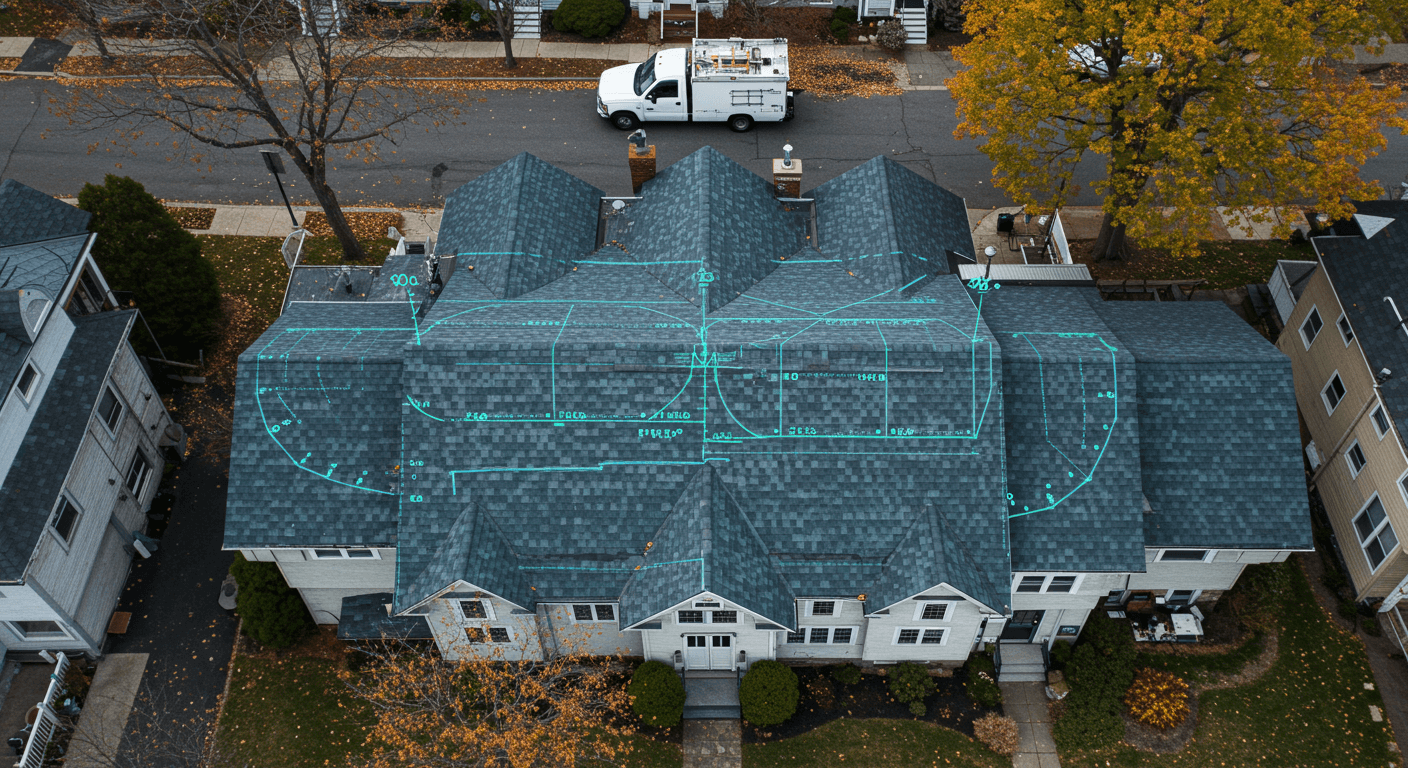
Climbing a 12-pitch roof in the middle of a New Haven sleet storm just to capture a linear foot reading is an operational failure, not grit. I watched Jaxon, a seasoned roofing contractor out of Westville, lose an $18,400 contract last October because his manual estimate took three days to compile. By the time he emailed his bid, a competitor using aerial measurement reports had already signed paperwork with the homeowner. Jaxon stayed in the old-school trap, convinced that if he did not touch the shingles himself, the quote would not be accurate. That single delay cost more than one job. It cost him the rhythm of a busy season.
This is not about being tech-savvy for its own sake. In a market where labor for experienced estimators in Connecticut sits near $38.50 per hour, every minute on a ladder is a drag on net profit. If your team spends four hours driving to a site, setting ladders, and hand-drawing diagrams for a standard ranch in Hamden, you are burning capital you could redeploy toward fleet capacity or cleaner lead flow. The headline question is blunt for a reason: when that pattern repeats across a month, the bleed can land in the same band as the $4,820 figure owners see once they stack drive time, redraws, and overtime on estimating.
Tape fatigue, skipped facets, and conservative waste buffers compound. The loss rarely shows up as one bad order. It shows up as steady margin leakage across dozens of bids.
The 28-minute estimating shift in New Haven
Speed after a storm is not attitude. It is throughput.
The traditional workflow for a New Haven roofing shop is often bloated. You capture a lead, schedule a site visit, spend an hour measuring, then burn another two hours back at the office on waste factors and pitch math. That manual cadence, as described in the IBISWorld Roofing Contractors Industry Report, creates bottlenecks when hail and wind events flood the phone lines. When weather turns, quoting faster than the shop down the street is a real competitive edge.
Digital measurement tools can deliver a full report, including waste calculations and facet breakdowns, in well under half an hour. I recently audited a shop in East Rock that moved to a virtual-first estimating model. They used measurement reports to pre-qualify leads before sending a truck. Roofs under 15 squares with homeowners clearly price shopping received a rough range anchored to the report. That discipline saved roughly 14.5 hours of drive time per week.
Measuring for margin
Cut site visit requirements by 64% using remote measurement reports for first-pass takeoffs.
Increase supplement accuracy by 12.8% on insurance-related claims with consistent line-item documentation.
Reduce material waste by 7.4% through precision facet calculations instead of blanket waste buffers.
Accelerate sales cycles from five days down to twenty-four hours once math ships with the first proposal.
Connecticut's steep slopes and multi-families
When the architecture fights you, ladders become the risk center.
New Haven mixes sprawling Victorians in Westville with dense multi-family stock near Yale. Those buildings are slow and hazardous to measure by hand. A three-story Victorian with four gables and a turret is not a quick tape exercise. It is a liability conversation.
Aerial reports remove the worst of the exposure for junior estimators on steep-slope systems. Accuracy has tightened to where variance often loses to a tired human pacing a ridge line in fading light. Recent roofing market data from ConsumerAffairs points to broader adoption of measurement tech as operators push back on rising insurance pressure. When you can hand an adjuster a third-party report with crisp ridge lengths and dated imagery, supplements move faster. I've seen Jaxon's competitors reclaim an average of $3,425 per job by documenting line items like starter and ridge cap that the carrier initially skipped.
Ladder-first takeoffs vs. aerial-first qualification
| Factor | Ladder-first | Aerial-first |
|---|---|---|
| Typical time to first confident quantities | 3+ hours (drive + measure + redraw) | Under 30 minutes for the base report |
| Exposure on steep multi-family | High | Low until you choose a verify visit |
| Insurance documentation strength | Varies with photo discipline | Strong when imagery is third-party and timestamped |
| Sales motion | Estimator disappears onto the roof | Rep stays with the homeowner while math is pre-baked |
Typical time to first confident quantities
Exposure on steep multi-family
Insurance documentation strength
Sales motion
Neither column replaces a final field verify before you commit materials. The win is where you spend senior time first: on the roof or at the kitchen table.
The precision trap
Do not blindly trust the suggested waste percentage on every software export. Connecticut details around ice and water shield, ventilation, and local amendments can force a manual adjustment between roughly 3.2% and 5.7% so you do not run short mid-job.
From measurer to closer
Change the job title in practice, not only on LinkedIn.
The hardest part for Connecticut contractors is rarely the software. It is the mindset shift. Estimators should not be professional climbers first. They should be closers. Hand someone a completed measurement report before they turn onto Whalley Avenue and the kitchen-table conversation changes. Instead of forty minutes on the roof while the homeowner waits inside, your rep reviews high-resolution renderings at the table, talks synthetic underlayment, and explains wind ratings for shoreline work in East Haven. The platform handles the math. The human handles trust. Shops that commit to this split often see closing lift near 18.2% because the presentation feels engineered, not scribbled.
Open with the chimney, not the truck
"When a report is already on screen, lead with the detail homeowners fear most (flashing, penetrations, ventilation) before you talk price. It signals you did real work before you asked for time."
Weave aerial measurement into the week
Start where paperwork already pays for itself.
Do not rip out your process overnight. Begin with insurance leads. Those files already demand documentation, so a $35 to $55 report pays for itself quickly. Roll the fee into administrative overhead on the claim like any other defensible job cost.
Action Plan
A practical rollout for a Connecticut roofing shop
Sequence the change so estimators feel relief before they feel surveillance. Momentum beats a big-bang mandate.
Week 1 to 2: Run parallel reports on storm claims only. Compare aerial quantities to your field notes before you change pricing habits.
Week 3 to 4: Standardize a one-page verify checklist for orders over a set square count or pitch threshold.
Week 5 onward: Extend the same workflow to retail. When you buy verified roofing demand, pull a report before the first call so you can reference squares, pitch, and chimney flashing without stalling the conversation.
If you are sourcing opportunities through paid channels, treat every contact like it owes you a fast answer. The LeadZik blog covers how operators pair better intake with field execution so aerial reports do not sit idle on a drive full of maybes.
Finalizing the numbers for 2026
The spreadsheet is boring until it buys back a truck payment.
The math for a New Haven roofing business is straightforward. If a measurement report costs $42 but saves a $40-per-hour estimator three hours of work including travel, you are roughly $78 ahead before shingles hit the roof. Multiply that across fifteen leads a month and annual operational savings climb past $14,000.
When systems are tight but the calendar still looks thin, the constraint is usually upstream. Read our FAQ on exclusivity, refunds, and lead quality so you understand how to feed the faster machine you just built.
Connecticut roofing is not getting easier. The operators who win will treat time as inventory, not a badge, and refuse to let ladder minutes replace margin.