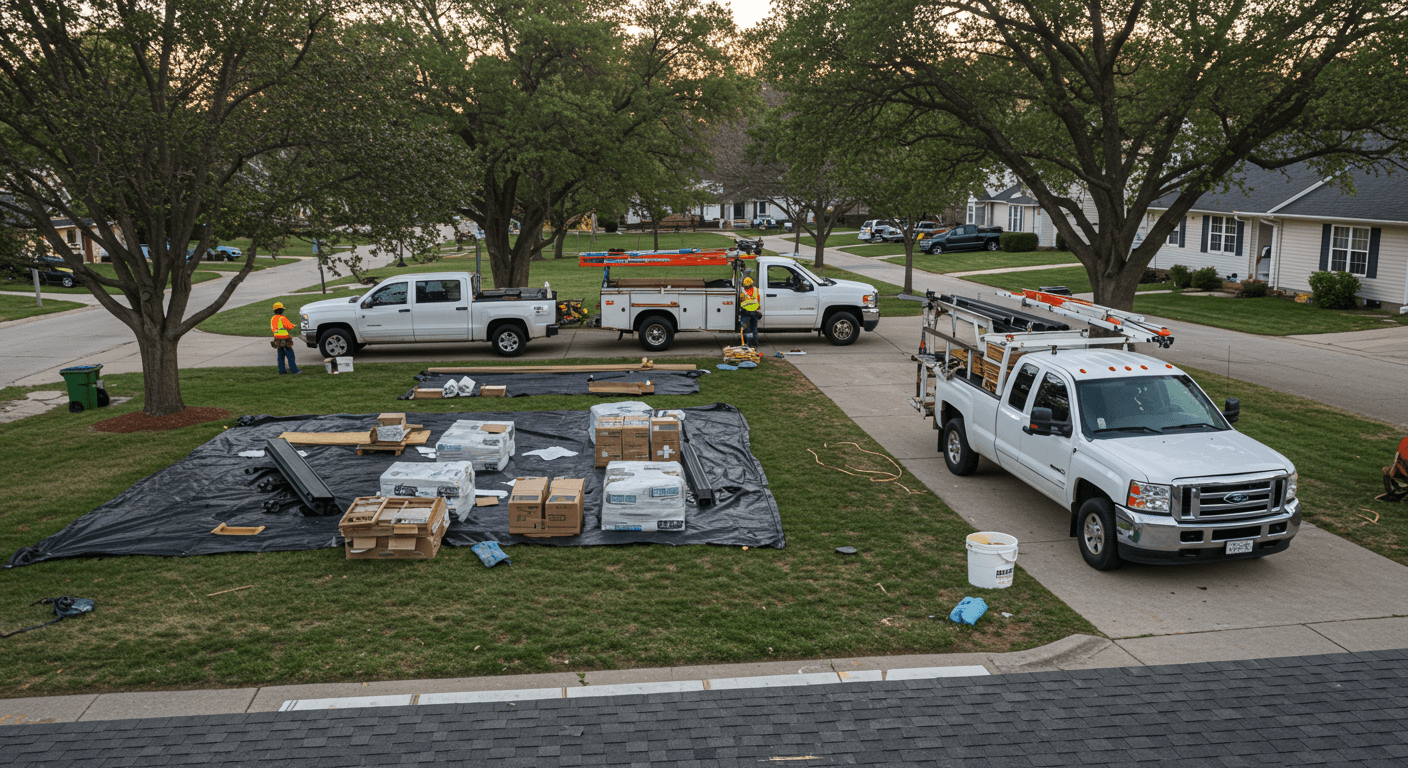
One roofing company in Indianapolis keeps three crews waiting at the material yard until 8:15 AM every Tuesday, which burns about $640 in hourly wages before a single shingle is stripped. Another shop twenty miles away pushes digital dispatch packets to foremen at 6:00 PM the night before, so trucks are staged and ladders are up when the sun hits the gables. That 135-minute gap is not a cute scheduling story. It is the line between a shop that survives on storms and one that compounds margin through discipline.
Last spring I worked with Ethan, a production manager, who reclaimed about 4.5 production hours per week by moving staging off a whiteboard and into a live cloud board. Across a twenty-six-week peak season, that time compounds. The math stops feeling like convenience and starts feeling like payroll you cannot afford to donate to the parking lot.
If your mornings start late, the loss shows up in wages first, then in missed squares you never get back.
Table of Contents
The invisible leak in Midwest roofing margins
Humid summers and early winters do not negotiate. Dispatch has to match that urgency.
Midwest roofing runs on tight weather windows. An Ohio Valley August can turn slick fast, and a Great Lakes November can end exterior work without warning. Hours of clear sky are assets, yet plenty of owners still treat dispatch like a reactive chore instead of a lever on margin. According to the IBISWorld roofing contractors industry report, competition is pushing shops to squeeze efficiency out of current operations, not just chase more top-line volume.
The slow leak often starts with what I call driveway-brain management. One owner or one production lead carries addresses, gate codes, and crew quirks in a notebook or memory. When that person is buried on a sales call or an adjuster meeting, production idles. Crews sit at gas stations waiting for a text back. That is not a morale issue only. It is net profit walking out the door.
When one person holds every detail
If dispatch pauses every time a single leader is unavailable, you have hidden single-point-of-failure risk. Split knowledge across a shared system before the busy week proves it for you.
Dispatch habits that protect margin
Push night-before job packets so discrepancies surface before the crew is on the customer's curb.
Use live status and GPS thoughtfully so check-in calls are not eating the first hour.
Align material timing with crew arrival so paid hours are not spent watching a flatbed run late.
Keep photos, notes, and safety requirements in one mobile folder so subs and leads see the same facts.
Why whiteboards fail the scalability test
Two crews can share a wall. Seven crews share rumors.
I audited a Des Moines shop running seven crews off one breakroom whiteboard. It worked at two crews. At seven, details fell through. A steep-slope team showed up without the harness kit that was still on a warehouse shelf because the note never left the dry-erase corner.
Recent roofing market statistics from ConsumerAffairs underscore that homeowners expect timely, professional service. Your external promise only holds if your internal calendar is not a game of telephone. Boards and long group threads rarely give you one source of truth, which is how you get a Thursday start promised to the homeowner, a Friday start in the production manager's head, and a Monday material drop on the supplier side. That fragmentation creates extra site visits, not extra squares.
Three pillars of a dispatch system you can scale
Past roughly $3M in the Midwest, feel stops working. Data and rhythm carry you.
1. Forward-loaded scheduling
The day should not begin in the office. It should begin on the roofline. Strong shops push job start packets to the foreman's device at least half a day early: aerials, material lists, and customer notes like where not to park. If something is off, you hear about it the night before, not at 7:30 AM while the homeowner is pouring coffee.
2. Dynamic resource allocation
Midwest weather moves in cells. Your board needs drag-and-drop rescheduling that pings everyone affected. If storms pin Grand Rapids, you should be able to pivot crews to interior repairs or warehouse work without a phone tree that eats the dispatcher's morning.
3. Verified intake and job fit
Efficiency starts before a job hits the board. I have watched a crew lose half a day because a lead was marked good while the roof was a specialty system the crew never trained on. Tight intake means fewer mismatched assignments. If you want more context on how we think about verification and field economics, the LeadZik blog library collects practical notes for operators, not generic hype.
The 4:00 PM material audit
"Have every foreman confirm specialty flashings and ventilation parts for tomorrow before they clock out. Five minutes at the end of the day beats a two-hour scramble when the supplier line is packed."
What belongs in a night-before packet
Aerial measurement PDF plus waste assumptions the crew agrees with.
Material list matched to supplier tickets and on-site delivery window.
Customer notes: pets, pavers, HOA rules, and preferred ladder placement.
Site photos for steep access, low wires, and staging limits.
Insurance or storm docs when the job is claims-driven, including adjuster contact.
Operations comparison: manual vs cloud-backed dispatch
| Metric | Old-school manual | Systematic cloud |
|---|---|---|
| Morning prep time | 45 to 60 minutes per crew | About 5 minutes per crew |
| Communication method | Phone chains and group texts | Status updates everyone can see |
| Material sync | Verbal confirmations | Automated vendor alerts tied to the job |
| Data accuracy | Subjective memory | Photo-backed facts in one folder |
| Scalability ceiling | Roughly three to four crews | Scales with disciplined roles, not heroics |
Morning prep time
Communication method
Material sync
Data accuracy
Scalability ceiling
Implementation: move the needle without a mutiny
Frame the tool as fewer headaches for foremen, not more surveillance.
Digital dispatch often scares longtime foremen. When I helped Adrian in Milwaukee adopt a field app, we skipped the tracking lecture. We talked about never driving across town for a missing work order again. Convenience sold faster than compliance.
Action Plan
14-day pilot that earns trust
Pick your most field-comfortable foreman, run the workflow for two weeks, and log every avoided delay. Numbers persuade faster than a mandate from the office.
Choose one crew and one dispatcher pairing so feedback loops stay tight.
Mirror the old whiteboard columns in software so the mental model feels familiar.
Log every saved trip, avoided idle hour, and early material catch for two weeks.
Review the log with the whole leadership team, then expand crew by crew.
If you are tightening qualification at the same time, the LeadZik FAQ spells out how credits, refunds, and exclusivity language actually work, which saves you from guessing while you rebuild dispatch.
ROI of the systematic pivot
Small daily slips become real wage checks fast.
Picture a four-crew operation where each crew loses thirty minutes a day to confusion. That is ten paid hours a week. At a $45 burdened rate, wages alone are $450 a week left on the table. The bigger hit is capacity. Those ten hours might have finished a job half a day sooner, which can be the difference between squeezing another $8,500 roof into the month or not.
That weekly wage slip is only the line item you can see. The quieter cost is the roof you never booked because the calendar could not flex, which is why dispatch discipline shows up in net margin before it shows up in any morale survey.
Labor is the tightest constraint for most Midwest shops I work with. Protecting the hours you already pay for is the fastest lever on net margin, especially when storms and insurance cycles swing volume without warning.
Common Questions
Moving from hustle culture to systems culture is the hardest jump a roofing owner makes. It means trusting a quieter rhythm instead of glorifying chaos. In the Midwest, where weather loves to wreck a plan, dispatch that can pivot fast is not a nice extra. It is the part of the business that keeps revenue on the calendar when nothing else will.