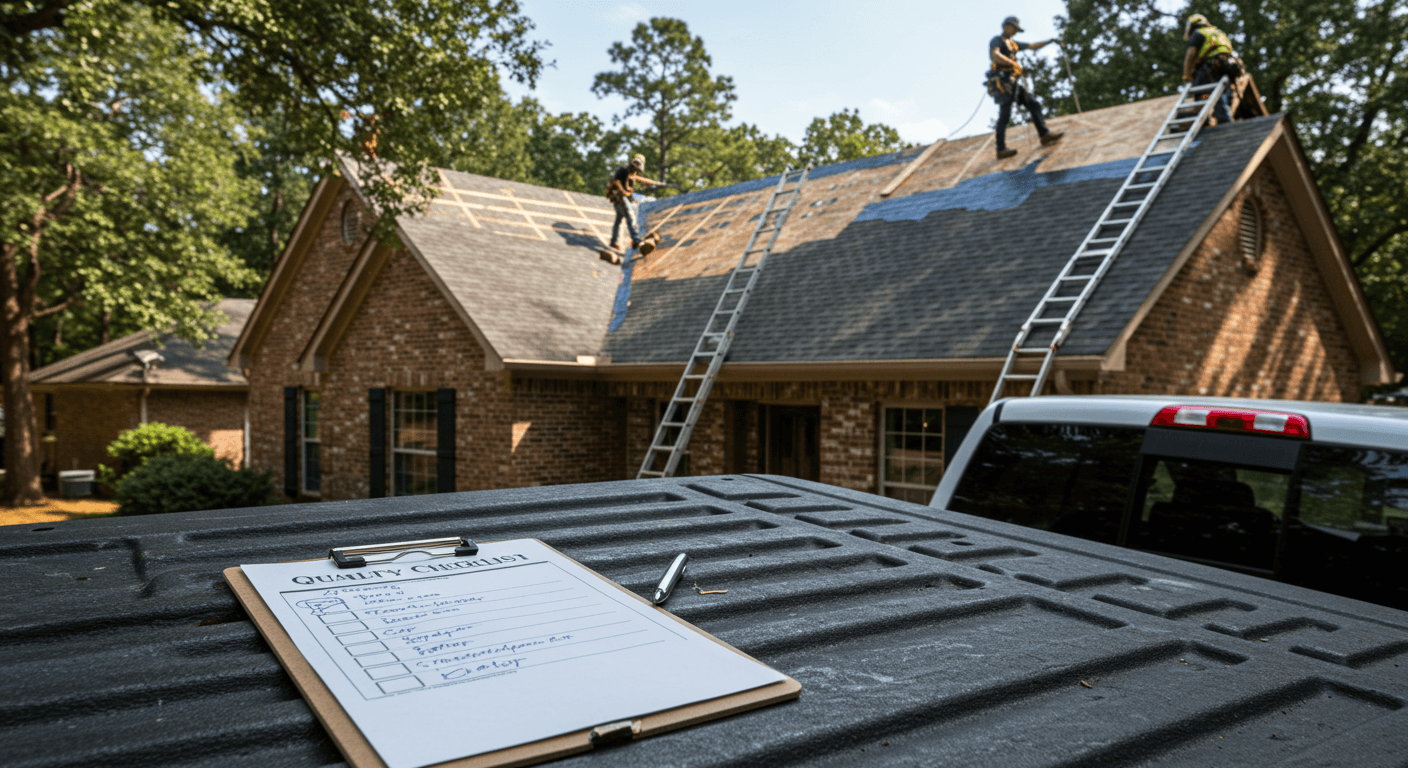
Profit margins in the River Region do not disappear in the sales room; they bleed out on the ridge vent during the final hour of a Friday install. Most roofing business owners I coach in Central Alabama believe they have a quality control process because they "look at the roof" before the trailer pulls away. But looking is not the same as verifying. I recently sat down with Xavier, who runs a high-volume shop out of Prattville, and we looked at his numbers from the previous quarter. Despite a record-breaking $842,500 in sales, his net profit was down by 19.4%. Why? He was spending $418 on every "simple" truck roll back to a job site in Millbrook or Wetumpka to fix minor flashing issues his leads missed.
Your reputation in Montgomery is built on the roofs that don't leak during a July thunderstorm, but your bank account is built on the roofs you only have to install once. When I work with sales teams and production managers, I see the same friction: sales promises perfection, and production delivers "good enough." This gap is where your profit dies. We need to move past the era of the "tailgate walkthrough" and into a structured system that holds every shingle and every crew member accountable. Whether you are managing two crews or twelve, the way you audit a finished project determines if you're actually growing or just spinning your wheels in the Alabama red clay.
At a Glance
Standardize or Subsidize: Without a formal checklist, you are effectively subsidizing your crew's mistakes through expensive call-backs and warranty work.
The $415 Rule: Every return trip to a job site costs an average of $415 in labor, fuel, and opportunity cost; reducing these by 15% can save a mid-sized shop $12,450 annually.
Client Perception vs. Reality: Professional QC documentation is a powerful sales tool that justifies higher estimates against cheaper, "fly-by-night" competitors.
Safety Integration: Quality control and safety are inseparable; using the OSHA Stop Falls Campaign framework ensures your QC process also protects your insurance premiums.
The High Cost of the "Montgomery Callback"
In a market like Montgomery, the climate is your harshest auditor. The intense humidity and rapid temperature swings mean that a poorly sealed penetration or a botched valley installation will show its face within 18 months, not five years. I watched Xavier's team struggle with a repeat leak on a steep-slope job over in the Garden District. They had been out there three times. Each time, the homeowner's frustration grew, and Xavier's profit on that $14,830 job vanished into thin air.
The problem wasn't the materials. It was the lack of a standardized verification loop. In sales, we talk about "closing the loop" with a prospect. In operations, you must close the loop with the install. If your production manager doesn't have a specific, non-negotiable list of 25+ points to photograph and sign off on, you don't have a QC process. You have a hope-based business model.
When you look at your lead verification processes, you expect a certain level of data before you buy. Why wouldn't you demand that same level of data from your own crews before you pay them? I've seen Montgomery shops increase their referral rate by 31% simply by handing the homeowner a "Completion & Quality Report" that includes photos of the ice and water shield and the properly installed starter strip.
The Owner-Operator Trap
Many Montgomery contractors fail to scale because the owner is the only 'Quality Controller.' If the system relies on your physical presence at every job site in Pike Road and Prattville, your growth is capped at your own exhaustion level.
Comparing the Three Tiers of Quality Control
Not every roofing business needs the same level of complexity, but every business needs a documented path. Let's break down the three primary ways I see Alabama contractors handling their audits and the ROI associated with each.
1. The Manual "Supervisor Walkthrough"
This is the most common method. A production manager or lead hand walks the perimeter, climbs the ladder, and eyeballs the work.
- Pros: Low upfront cost; immediate feedback to the crew.
- Cons: Highly subjective; no "paper trail" for warranty defense; prone to "Friday afternoon fatigue" where the last 10% of the roof gets ignored.
- ROI Analysis: This method usually results in a 12-15% callback rate because humans are naturally inconsistent. On a $12,000 roof, a single return trip to fix a chimney flashing error erodes about 3.5% of the total job margin.
2. The Digital Checklist System
This involves using a mobile app or a dedicated roofing CRM to require photos of specific stages: deck prep, underlayment, valley construction, and final cleanup.
- Pros: Creates a permanent record; allows for remote auditing; forces crews to slow down and document their work.
- Cons: Requires training and "buy-in" from crews; small monthly software fees.
- ROI Analysis: Contractors implementing digital checks often see callbacks drop to under 4.8%. If you're doing 100 roofs a year, that's dozens of saved truck rolls and potentially $14,000+ back in your pocket.
3. The Third-Party Inspection Model
For high-ticket commercial jobs or premium residential projects in neighborhoods like Wynlakes, some owners hire independent inspectors to sign off on the work.
- Pros: Ultimate liability protection; massive trust builder for high-end clients.
- Cons: Expensive ($350–$650 per inspection).
- ROI Analysis: While the cost is high, the "peace of mind" premium allows you to charge 10-15% more for your services. You aren't just selling a roof; you're selling a certified installation.
Implementing the "River Region Moisture Defense" Protocol
To get Xavier's profit margins back on track, we didn't just tell the crews to "do better." We implemented a specific StrategyBreakdown that focused on the high-failure points common in Montgomery's architecture.
We started by referencing the National Center for Construction Education (NCCER) standards for roofing applications. We didn't want my opinion; we wanted industry-standard benchmarks. We turned these into a 22-point digital checklist that must be completed before the final invoice is sent.
Action Plan
The 3-Stage Verification Loop for Montgomery Roofers
A systematic approach to quality control that prevents callbacks and protects margins through documented verification at critical installation stages.
The Deck Audit: Before a single shingle is laid, the crew lead must take 4 photos of the redecking or prepared surface, specifically focusing on the eaves and any replaced wood.
The Flashing & Valley Snap: Documentation of the metalwork. In Alabama's heat, expansion and contraction are killers. This stage requires a 'physical check'—literally pulling on the flashing to ensure it's mechanically fastened, not just caulked.
The 'Magnet Sweep' & Final Walk: A photo of the dumpster area and driveway after the magnet sweep. Most negative reviews in Montgomery aren't about leaks; they're about flat tires in the driveway.
The Homeowner Sign-Off: A digital signature collected on-site that confirms the homeowner has seen the photos and agrees the job site is clean.
Want to skip the manual work and get exclusive, verified leads instead?
Get $150 in Free CreditsThe Sales Psychology of Quality Control
Here is the secret most Montgomery roofers miss: QC is a sales tool. When your rep is sitting at a kitchen table in Millbrook, they shouldn't just talk about shingles. They should show the prospect a sample Quality Audit from a previous job.
I coached one of Xavier's reps, a guy named Jaxon, to change his pitch. Instead of saying, "We have a 50-year warranty," Jaxon started saying, "Most companies leave your roof and hope it doesn't leak. We perform a 22-point moisture-defense audit that is documented and emailed to you before we even ask for the final check. Here is what that looks like."
Jaxon's close rate jumped from 22% to 34.6% in six weeks. Why? Because he removed the risk. He proved that the company cares more about the install than the homeowner does. If you're curious about how this transparency impacts lead quality and conversion, you might find our pricing and quality FAQ helpful in understanding how we apply similar rigor to the leads we provide.
Sales reps who show prospects a Quality Audit report see significantly higher close rates by removing perceived risk.
Data-Driven Decisions: Manual vs. Digital
Let's look at the hard numbers. If you are running a shop in the Montgomery metro area, your overhead is likely increasing. Labor is tighter than ever. You cannot afford to waste hours on "re-work."
Manual vs. Digital QC System Comparison
| Metric | Manual (Status Quo) | Digital Checklist System |
|---|---|---|
| Average Callback Rate | 14.2% | 3.7% |
| Annual Cost of Rework | $18,430 | $4,810 |
| Time Spent on Inspections | 2 hrs/day (Owner) | 20 mins/day (Reviewing Photos) |
| Customer Referral Rate | 1 in 8 jobs | 1 in 4 jobs |
| Sales Close Rate | 21% | 29.4% |
Average Callback Rate
Annual Cost of Rework
Time Spent on Inspections
Customer Referral Rate
Sales Close Rate
The transition from manual to digital isn't just about a "fancy app." It's about creating a culture where "good enough" is replaced by "verified." When you stop being the "firefighter" who is constantly driving to job sites to fix mistakes, you can finally become the "CEO" who focuses on scaling the business.
If your crews feel like you are "spying" on them, you're positioning it wrong. I tell my coaching clients to frame it as protection. "I'm asking for these photos so when a homeowner claims we scratched their driveway or didn't install the flashing right, I have the proof to defend you." That shift in psychology changes everything.
Pro Tip
"Track callback costs for 30 days. Most Montgomery contractors are shocked to discover that a single callback costs $415+ when you factor in lost production time, fuel, and opportunity cost. That number makes the case for preventive QC checks."
The Role of Safety in Quality Control
You cannot have a quality roof without a safe job site. I often see Montgomery crews getting lax with fall protection on "quick" repairs. This is a massive liability for the business owner. By integrating the OSHA Stop Falls Campaign guidelines into your QC checklist, you kill two birds with one stone.
One of the requirements in our new protocol for Xavier was a "Safety Snapshot" taken at 10:00 AM every morning. The crew lead had to snap a photo showing anchors and lines in use. If the photo wasn't uploaded, the job was paused. Not only did this protect his workers, but it also became a major selling point for commercial property managers in downtown Montgomery who are terrified of job site accidents.
Finalizing the Montgomery Blueprint
Implementing these changes isn't an overnight fix. It took Xavier about four months to fully bake this into his company culture. He had to fire one sub-crew that refused to take photos, but the crews that stayed became more efficient. They realized that if they followed the checklist, they didn't have to go back and fix things on their weekends.
The result? Xavier's net profit margin climbed back up to 24.3%. He saved nearly $13,600 in fuel and unbilled labor costs over six months. More importantly, he stopped getting angry phone calls at 7:00 PM on rainy Tuesdays.
If you are tired of the chaos and want to see how a more verified approach to your business can change your bottom line, reach out to our team directly via our contact page. We don't just provide leads; we help you build a business that is capable of handling them with precision.
Xavier's shop recovered from 19.4% profit decline to 24.3% margin by eliminating preventable callbacks.