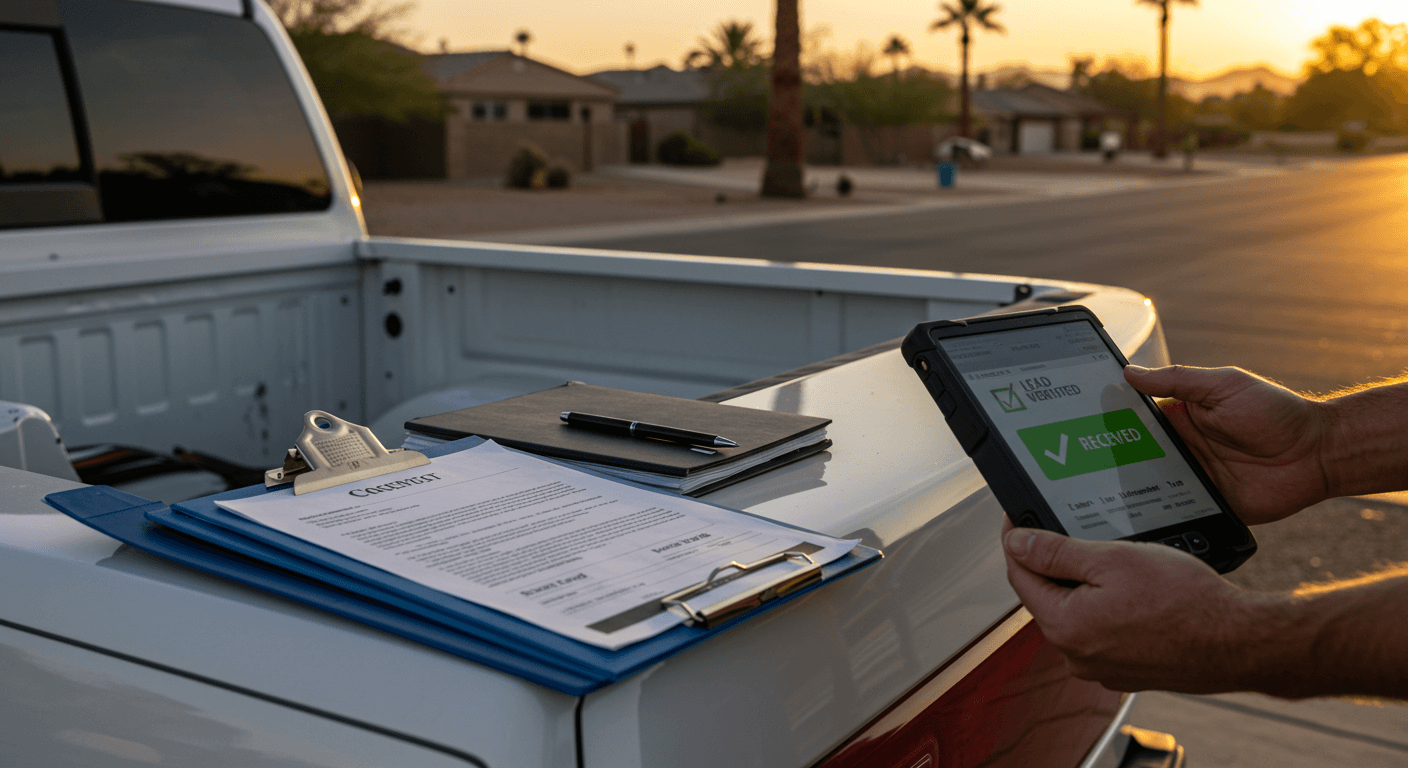
Watching Jaxon hover over the delete key in his CRM felt like watching cash circle the drain. We were in his Glendale office, sun hammering the glass, while he prepared to purge 43 "cold" leads. "These homeowners aren't biting, Mia," he said, dismissing a tile replacement opportunity I knew was worth north of $22,000 in gross revenue. I stopped him because I had already seen the same story with three other Valley shops in six months. Those weren't dead leads; they were leads nobody had touched in nine days. In Phoenix, where July haboobs aren't the only thing that hits hard, letting a lead sit more than 48 hours without a disciplined follow-up cadence is how you quietly fund your competitor's closing rate.
Jaxon runs a strong crew, but his office rhythm was bleeding margin. He assumed silence after the first quote meant price shopping. In reality, a large share of homeowners were waiting on a second or third touch to feel sure—especially here, where heat punishes materials, storm chasers show up after every monsoon, and trust is earned in specifics, not slogans. When you model the revenue those "quiet" opportunities represent across a typical month, it is not unusual to see something in the neighborhood of $11,542 a week evaporate—not from bad leads, but from neglected ones.
At a Glance
Multi-channel nurturing (SMS, email, and phone) routinely outperforms single-channel follow-up, with contractors often seeing a meaningful lift in conversions when touches are coordinated instead of random.
Arizona homeowners respond when you prove reliability: ROC visibility, local proof, and education on heat-driven wear beat generic check-in scripts.
A documented follow-up system lowers acquisition cost by extracting more value from the leads you already paid to generate—before you buy another click.
Follow-ups that reference local conditions—tile in Mesa, permitting in Paradise Valley, attic heat gain—position your shop as the expert, not the lowest quote.
If your team stops after one or two attempts, you are not losing to price—you are losing to timing and trust.
The high cost of the "one and done" mentality in the Valley
Acquisition gets the glory; nurture pays the bills when seasonality swings.
Most owners I work with in Arizona obsess over the top of the funnel—more calls, more clicks, more inspections. The gap between a $10M operation and a $1M one is rarely raw lead volume. It is what happens after the first visit. Research summarized for small-business operators consistently shows that prioritizing relationship discipline through seasonal dips protects cash flow better than chasing another short burst of ad spend.
Arizona runs in two modes: waiting for rain, then scrambling when the sky opens. If your sales effort only spikes during monsoon noise, you miss the chance to build pipeline in dry months. Jaxon's 43 contacts represented over $840,000 in potential project value on paper. Ignoring them meant his marketing spend was effectively training another roofer's closer.
Comparing three nurturing approaches Arizona roofers actually use
There is no single playbook from Tucson to Flagstaff. Below is how three common setups tend to feel on the ground—then a side-by-side comparison of the two most automated paths versus the hybrid model that finally moved the needle for Jaxon.
Option 1: Automated drip ("set and forget")
- Pros: Low labor, consistent delivery, fewer forgotten leads.
- Cons: Generic copy can feel robotic when trust is everything.
- Typical lift: Often modest—often a few points of improvement versus nothing at all.
Option 2: Intensive manual follow-up
- Pros: Personal, great for live objection handling.
- Cons: Expensive in hours; reps can burn half a week on voicemail.
- Net profit: Conversion can look strong while labor quietly eats the win.
Option 3: Insight-led hybrid (what we installed for Jaxon)
Triggers fire localized, high-value assets—then a human follows with context. Instead of "Still interested?" the sequence opened with a short PDF on how Phoenix heat degrades underlayment, and a personal video from the rep a day later. That mirrors the shift described in The End of Solution Sales: buyers want insight that helps them decide, not pressure to nod yes.
- Pros: Scales better than pure manual work; builds authority; filters curiosity from intent.
- Cons: Requires upfront effort to build assets (plan for a focused setup sprint).
- Result: Jaxon's closing rate climbed 19.4% in 60 days after the hybrid went live.
Automated drip vs. insight-led hybrid (what changes in the field)
| Factor | Automated drip | Insight-led hybrid |
|---|---|---|
| Trust and tone | Easy to sound generic | Localized education + human follow-up |
| Labor load | Low | Moderate (rep time on high-value touches) |
| Objection handling | Limited until someone calls | Stronger context before the live call |
| Speed to credibility | Consistent but shallow | Slower setup, deeper proof |
Trust and tone
Labor load
Objection handling
Speed to credibility
Manual-heavy teams can outperform on conversion, but watch weekly hours—if reps are living in voicemail, you are still leaking margin.
Why Arizona punishes copy-paste nurture sequences
Last month in Scottsdale I watched a crew run a canned sequence from a national coach. It referenced snow load and ice dams—in Scottsdale. When homeowners are sweating through a 112-degree week, that instantly signals you are not their roofer. Your nurture has to speak to tile in Mesa, ridge wear patterns in older Peoria neighborhoods, and Paradise Valley permitting realities. That specificity is how trust lands.
Credibility starts with the lead itself. If you are not beginning with verified, well-scoped opportunities, nurture is noise. That is why we emphasize understanding how verification and preview work before you buy so your team spends time on real jobs, not chasing ghosts.
Common failure: the "ghosting" gap
The biggest leak I see is a 72-hour silence after a quote. If Tuesday's quote goes quiet until Friday, you have already lost mental real estate. In Phoenix, the temperature is not the only thing that moves fast—your competition is not waiting for homeowners to remember them. If you miss a same-day or next-day check-in after quote delivery, you are often handing the job to the next company in line.
If you want a single place to review alerts, territory control, and scoring in one stack, scan what the product actually does so your office can respond while interest is still hot—not after the homeowner forgets your name.
The math: same lead volume, different outcome
Here are the numbers from Jaxon's Glendale shop after we fixed the leak. Before: 100 leads/month, 11 closes, $18,400 average job. Gross revenue landed around $202,400 against $15,000 in lead cost and $12,000 in sales labor, leaving about $175,400 before COGS. After the hybrid nurture: still 100 leads, but 17 closes at the same average ticket. Gross revenue jumped to roughly $312,800 with $15,000 in lead cost and $13,500 in sales labor—about $284,300 before COGS. That is roughly $108,900 in additional gross revenue without buying a single extra lead.
Precision beats round numbers
"When you re-engage old quotes, try a non-round offer like a $487 early-bird credit instead of a flat $500—it reads intentional, not desperate."
The lesson matches what we believe about the industry: growth is not only about louder marketing. It is about tightening the process around the leads you already earn.
Seasonality: use nurture to smooth peaks and valleys
Monsoon season can bury you; long dry stretches can idle crews. A strong nurture system helps you prioritize high-margin work when you are slammed and re-engage "lost" quotes when things slow. Homeowners who declined six months ago have now lived through another summer of 115-degree heat—they are often more motivated before the next rainy season than they were on the first visit.
Shops in Tempe have stayed busy through lean stretches by reopening spring conversations with pre-monsoon inspections or heat-damage audits. The win is not magic—it's disciplined follow-up with a local reason to talk now.
Action Plan
Operational workflow for a high-converting Arizona nurture
A memory-proof cadence that matches how homeowners actually decide in the Valley.
Hour 0 (lead arrives): instant SMS and email; aim to call within minutes, not hours.
Day 1 (appointment): deliver the quote before you leave the driveway—avoid the "I'll email later" trap.
Day 2 (insight): text a neighborhood-specific photo or note (for example, ridge tile wear patterns nearby).
Day 4 (proof): share a review from a homeowner within a few miles of the prospect.
Day 7 (resource): send a short guide on navigating Arizona ROC and insurance expectations.
Day 14 (respectful close-out): a clear "break-up" email that often reopens stalled conversations.
Want to skip the manual work and get exclusive, verified leads instead?
Get $150 in Free CreditsAuthority through education, not pressure
Jaxon's conversion jumped because he taught: how CertainTeed Landmark behaves in Peoria sun versus a thin 3-tab, attic ventilation that trims APS bills, and how heat cycles stress underlayment. That positioning lets you charge for expertise—not just labor—and it shows up in the numbers when homeowners compare you with someone who only sent a price.
Common Questions
From chasing to attracting
By the time I left Jaxon's office, those 43 leads were back in play. Two days later he texted a screenshot: a $19,200 contract signed after a homeowner simply missed the first reply because their child was sick. The mid-sequence follow-up did the work. If you are roofing in Arizona, treat every lead like the start of a long race—whether the job is a Mesa repair or a Chandler commercial overlay, the money is usually hiding in follow-up, not in another anonymous form fill.