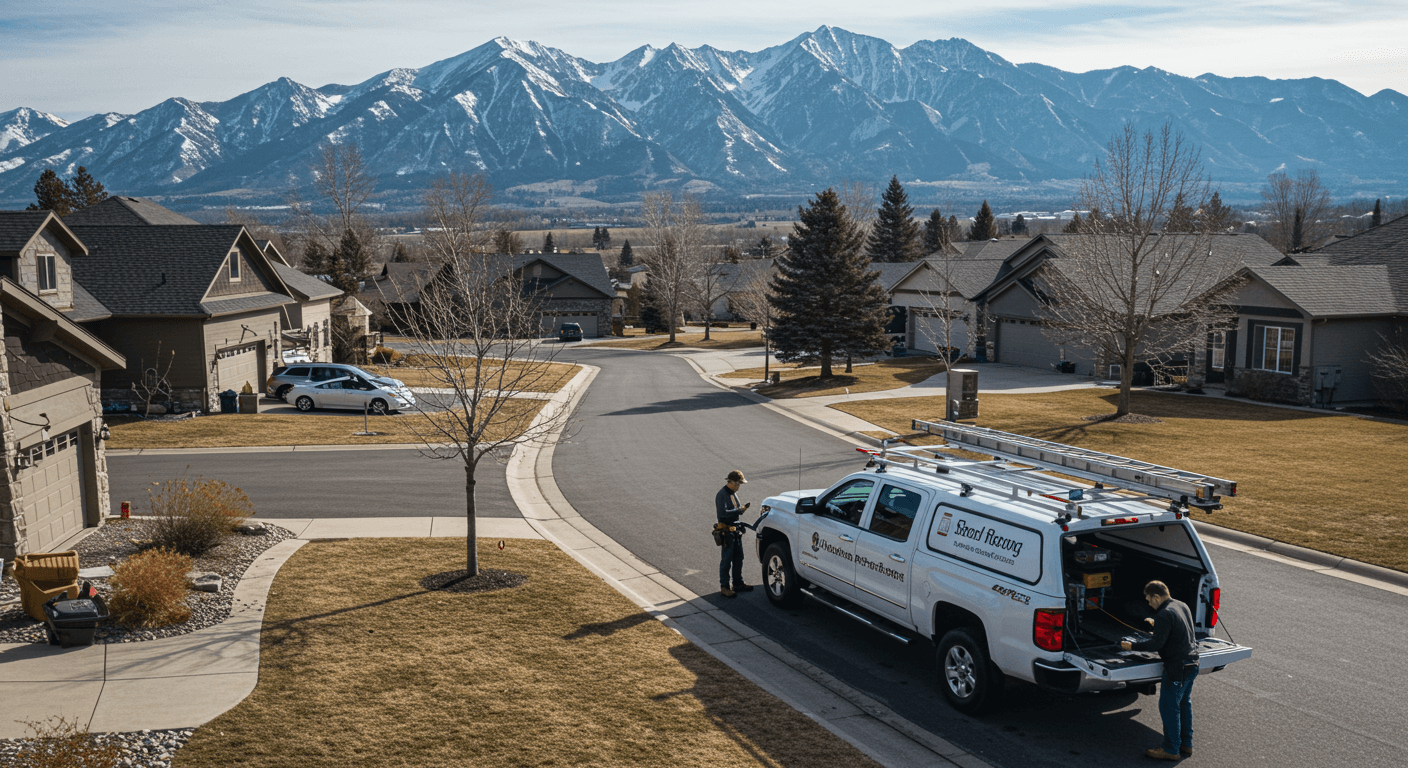
Your Google Ads dashboard is likely lying to you about the health of your roofing business. I sat in a truck parked near the mouth of Provo Canyon last month with a contractor named Jaxon, looking at a screen that showed a "healthy" 8.4% conversion rate. On paper, things looked great. In reality, Jaxon was frustrated because those conversions were mostly homeowners looking for "free roof repairs" or DIY enthusiasts asking where to buy shingles in Orem. He was spending $4,328 every month to generate calls that his sales team couldn't close because the intent simply wasn't there. We dug into his search terms and found he was paying $22 per click for phrases like "how to fix a leaky roof myself." That is not a lead; that is a donation to Google's bottom line.
At a Glance
Stop using broad match keywords that trigger ads for DIY "how-to" searches and irrelevant local queries.
Tighten your geographic radius to specific Provo and Orem zip codes to avoid paying for leads in areas your crews won't travel to.
Implement negative keyword lists aggressively to filter out price shoppers and job seekers before they click.
Focus on "Intent-Driven" search terms that signal a homeowner is ready to hire a professional immediately.
The High Cost of "Broad" Ambition in Utah County
Most roofing owners in the Provo-Orem metro fall into the trap of thinking more clicks equals more revenue. This is a dangerous assumption. When you set up a campaign using broad match keywords like "roofing contractor," Google takes a massive amount of liberty. They might show your ad to someone in Spanish Fork looking for a "roofing apprenticeship" or a student at BYU researching "roofing materials for a shed."
According to the Bureau of Labor Statistics (BLS), the median pay for roofers is around $50,970, and with a projected 6% job growth, the competition for skilled labor is high. This often leads to your ads being clicked by job seekers instead of customers. If you aren't excluding terms like "jobs," "salary," and "hiring," you are subsidizing the local job market's research. Jaxon realized that 14.3% of his total ad spend was going toward people looking for work, not people looking for a new roof.
In Provo, the market is unique because of the density of the residential areas combined with the rapid expansion toward Lehi and Eagle Mountain. If your ads are reaching into Salt Lake County but your yard is in South Provo, you're paying a premium for clicks in a service area where your overhead—specifically fuel and travel time—will eat your margins alive. We shifted Jaxon's focus to "Phrase Match" and "Exact Match" only. The click volume dropped by 32%, but his actual scheduled estimates rose by 19% in the first three weeks.
After switching from broad match to intent-based local targeting in high-competition markets like Provo.
Why Geography is Your Secret Weapon
Provo isn't just one big block of houses. You have the older, established neighborhoods near the foothills and the newer developments popping up toward the lake. Each requires a different sales approach. A homeowner in an older home near 800 North might be looking for a full tear-off and replacement due to age, while someone in a newer build in Vineyard might only need a minor repair after a heavy windstorm coming off the water.
When you run Google Ads, you can't just "set it and forget it" for the whole county. We started segmenting campaigns by zip code. This allowed Jaxon to bid more aggressively on neighborhoods where we knew the housing stock was over 22 years old—prime territory for full replacements. We also used "location exclusions." If you know your crews hate fighting traffic on I-15 during the afternoon rush to get to North Lehi, why are you paying for leads there?
By narrowing the radius to a 12-mile circle around his warehouse, we reduced his cost-per-lead (CPL) from $114 down to $76. This wasn't magic; it was just refusing to pay for clicks from people who were too far away to be profitable. Many contractors worry that narrowing their reach will dry up the pipeline. In reality, it just cleans the pipeline. You want your mobile app notifications to represent jobs you actually want to bid on, not distractions two towns over.
Broad Match vs Intent-Driven Local Targeting
| Factor | Broad Match (The "Money Pit") | Intent-Driven Local (The "Growth Engine") |
|---|---|---|
| Keyword Control | Google decides what is "relevant" | You decide exactly which phrases trigger ads |
| Budget Efficiency | High waste on DIY and job seeker clicks | Low waste; focused on high-intent homeowners |
| Lead Quality | Mixed; many "tire kickers" and low-budget calls | High; homeowners ready for estimates |
| CPA (Cost Per Acquisition) | Usually $150+ in Provo market | Often sub-$85 with proper optimization |
| Scalability | Hard to scale without wasting thousands | Easy to scale by increasing bids on winning zips |
Keyword Control
Budget Efficiency
Lead Quality
CPA (Cost Per Acquisition)
Scalability
The Negative Keyword Shield
One of the most overlooked parts of a successful Google Ads strategy is the negative keyword list. This is a list of words that, if included in a search, prevent your ad from showing. For Provo roofers, this list needs to be extensive.
I've seen shops lose thousands because they didn't exclude "metal roofing" when they only install asphalt shingles. Or they didn't exclude "repair" when they only want $20,000+ replacement jobs. If you're using a platform that provides exclusive, verified leads, you're already ahead of the game because you aren't fighting for the same junk leads as everyone else. But if you're still running your own Google Ads, you need to be your own gatekeeper.
Jaxon's "Burn List" (as we called it) eventually grew to over 450 words. We included things like "cheap," "discount," "free," "apartment," "commercial" (since he only did residential), and even names of competitors. Why pay for a click when someone is specifically looking for the phone number of the guy down the street?
The 'Snow Load' Strategy
"In Provo, homeowners often search for "roof snow removal" or "ice dam prevention" during the winter months. Don't waste your primary "Roofing Replacement" budget on these low-margin service calls. Create a separate, small-budget campaign for these terms to keep your crews busy during the off-season, but keep them away from your high-value replacement ads."
Beyond the Click: Conversion Tracking That Matters
If you are measuring success by "clicks," you are measuring the wrong thing. Google wants you to focus on clicks because they get paid per click. As a business owner, you need to focus on ROI.
I worked with another shop near Orem that was obsessed with their "Click-Through Rate" (CTR). They had a 5.2% CTR, which is quite high. But when we looked at their CRM, only 2% of those clicks turned into a signed contract. The problem? Their landing page was generic. It didn't mention Provo, it didn't show pictures of Utah homes, and it didn't mention their 10-year workmanship warranty. It looked like a template for a roofer in Florida.
We swapped the photos to show projects they'd done near the Timpanogos High School area and added a specific "Provo's Trusted Local Crew" headline. We also added a simple form that asked for the age of the roof. Suddenly, the sales team knew which leads to prioritize. They weren't just guessing.
When you can see the lead previews and job details before you commit your time, your closing rate naturally climbs. Google Ads should function the same way. Your landing page should act as a filter, not just a net. If someone sees "Minimum project size: $5,000" on your page and they only have a $200 leak, they won't fill out the form. That saves your sales guy an hour of driving and a frustrating conversation.
Action Plan
5-Step Google Ads Audit for Provo Roofing Contractors
A systematic approach to identifying and eliminating wasted ad spend in your Google Ads campaigns.
Scrub the Search Terms: Go to your 'Search Terms' report. If more than 20% of the terms have the word 'how', 'DIY', or 'repair' (and you only want replacements), you are bleeding cash.
Audit Your Geography: Check the 'User Location' report. Are you paying for clicks in Salt Lake or Juab County that you don't actually service? Exclude them.
Review Your Extensions: Ensure your 'Call Extension' is active and only shows during your business hours. There is no point in paying for a 'Click-to-Call' at 2 AM if nobody is there to answer.
Test Your Landing Page: Open your landing page on a phone. If you can't find the 'Request Estimate' button within 3 seconds of scrolling, your conversion rate is suffering.
Set Up Conversion Actions: Don't just track 'Submits.' Track 'Phone Calls' longer than 60 seconds. This ensures you're measuring actual conversations, not just misdials.
Want to skip the manual work and get exclusive, verified leads instead?
Get $150 in Free CreditsNavigating the Competition in "Silicon Slopes"
The proximity to the tech corridor means the digital competition in Provo is higher than in many other cities of its size. You aren't just competing with other local roofers; you're competing with national lead aggregators who have million-dollar ad budgets. To beat them, you have to be more relevant, not just more expensive.
Homeowners in this area value expertise and local reliability. As noted in the BLS guide on how to become a roofer, the job requires significant on-the-job training and physical stamina. Highlighting your crew's experience and their ties to the community. Mentioning that your team has handled the specific heavy snow loads common in the Wasatch Front creates a level of trust a national aggregator can't touch.
I've seen contractors try to use "Smart Campaigns" because Google promises they are "easier." For a roofing business, "easier" usually means "more expensive and less effective." Smart campaigns give up almost all control over where your ads show. One roofer in Lindon found his ads were showing on mobile gaming apps for kids. Why? Because the "Smart" algorithm thought it was a "relevant placement." It wasn't. It was just a waste of $440 that month.
Avoid 'Smart' Campaigns
Avoid 'Smart' or 'Express' campaigns at all costs. These are designed for convenience, not profitability. They often ignore negative keywords and bid on broad terms that bring in low-quality traffic, significantly increasing your cost per acquisition.
The Long Game: Turning Data into Dominance
By the time Jaxon and I finished our second month of optimization, his total spend had actually stayed the same, but his revenue from those ads had doubled. We weren't spending more; we were just spending smarter. We used the data to see that Tuesday mornings were his highest-converting times, so we increased his bids by 25% during those hours. We saw that weekends were mostly people doing "research" but not booking, so we pulled his bids back by 40% on Saturdays and Sundays.
If you're tired of the "feast or famine" cycle that comes with unreliable lead sources, it's time to treat your digital marketing like a job site. It needs a plan, the right tools, and constant supervision. If you don't have the time to manage a complex Google Ads account, using a system that provides verified lead opportunities can bridge the gap while you get your internal marketing in order.
The goal isn't just to get your name out there. In a market like Provo, everyone knows the major players. The goal is to be the one who appears at the exact moment a homeowner realizes their roof didn't survive the last canyon windstorm. That requires precision, not a shotgun approach.