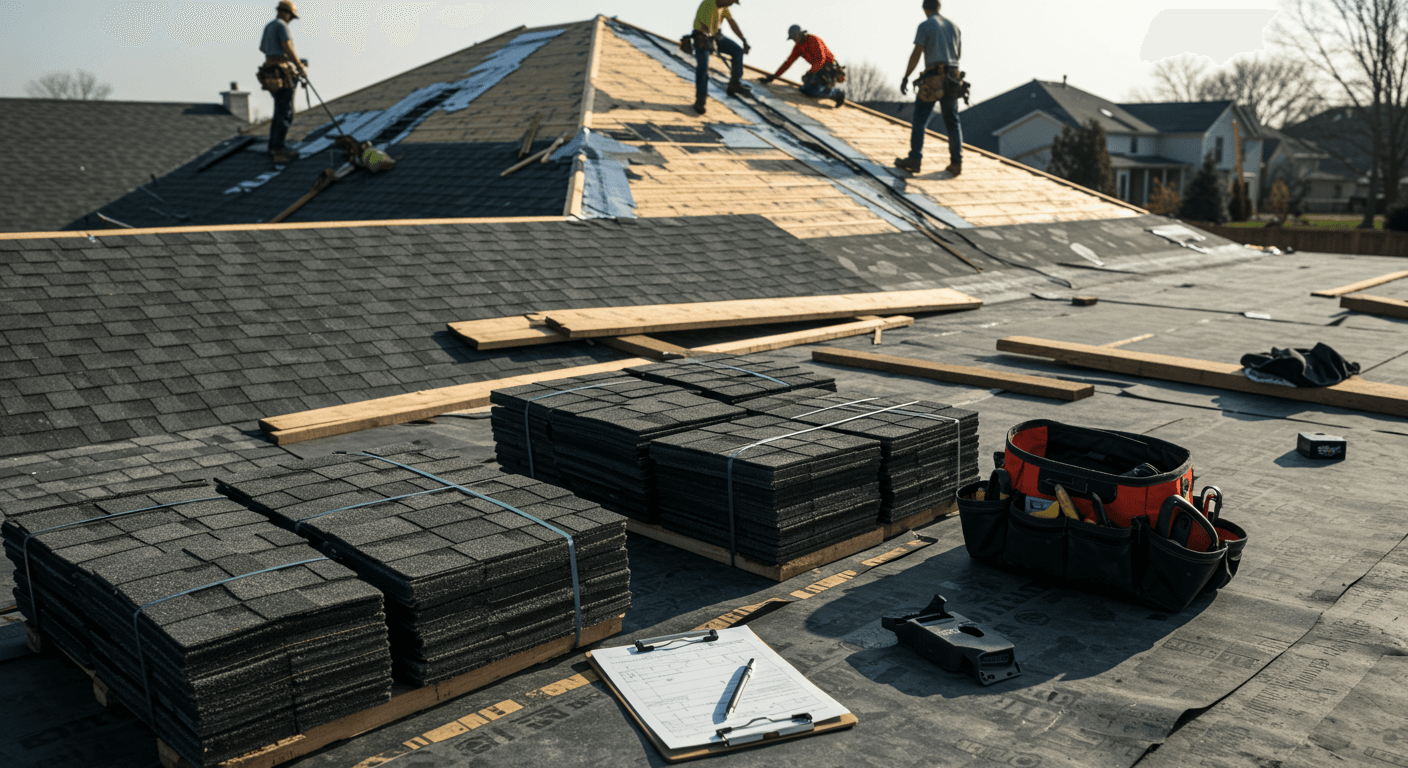
Behind the cab of the flatbed, the driver shook his head, refusing to unstrap the pallets of architectural shingles until he got a call from his dispatch office. Carter, a contractor I've worked with for 14.5 months, stood in the driveway with his phone pressed to his ear, his face turning a deep shade of red. The supplier had frozen his credit line because of a single invoice that was only 6.2 days overdue. It didn't matter that Carter had $142,380 in accounts receivable sitting in insurance claim limbo. It didn't matter that his crew was already on the roof ripping off old felt. Without those shingles, the job was dead, the labor cost was sinking into the red, and his reputation in the neighborhood was taking a hit.
This isn't just a story about a bad morning. It's a snapshot of the working capital crisis that throttles roofing companies across the country. I've seen shops doing $4.2M in annual revenue fold because they couldn't manage the gap between paying for materials and collecting the final check. Working capital isn't only a line item on your balance sheet. It is the oxygen your business breathes. When that oxygen gets thin, even the best crews start to gasp for air.
Table of Contents
The hidden cost of the cash conversion cycle
The metric that decides whether you are still roofing three years from now is often buried in timing, not top-line revenue.
Most roofing owners I talk to focus on top-line revenue or their gross margin on a specific steep-slope project. While those numbers matter, the real metric that determines if you'll still be in business in 3.5 years is your Cash Conversion Cycle (CCC). This is the time it takes for a dollar spent on labor or materials to travel through the job site and return to your bank account as profit.
In the roofing industry, this cycle is notoriously long. You might pay a 50% deposit for materials on Monday, pay your crew on Friday, and then wait 24.7 days for the homeowner to get their insurance check or for their financing to clear. If your CCC is 45 days but your vendors expect payment in 30, you have a 15-day liquidity gap that you have to fund out of your own pocket.
Mismatched payables, slow AR, and reactive financing quietly eat margin before you notice.
According to guidance on growing service businesses, managing these gaps is the difference between scaling and stagnating. I once analyzed a shop in the Midwest that was doing $2.8M. Their CCC was 52 days. By implementing a stricter deposit policy and a faster supplement filing process, we got that down to 34.2 days. That 17.8-day improvement put an extra $87,400 of liquid cash back into their operating account without them selling a single extra roof.
Four pillars of roofing liquidity
Working capital is what lets you weather 31-day payment gaps and sudden material price moves without freezing production.
Cutting inventory hold time from about two weeks to a handful of days can free meaningful cash without adding revenue.
Deposits, disciplined AR, and faster supplements shorten the cash conversion cycle and reduce expensive short-term borrowing.
High-growth phases often need multiples more liquid cash than steady-state operations, even when P&L looks healthy.
Inventory: the silent profit killer
Bulk buying can feel smart until you add storage, shrinkage, and the opportunity cost of idle cash.
There is a common temptation to stock up when shingle prices are rumored to rise. I've seen contractors fill entire warehouses with ventilation components and underlayment, thinking they are outsmarting the market. While a small hedge can work, excessive inventory is often just cash rotting on a shelf.
Every bundle of shingles sitting in your warehouse is cash that isn't being used to market your business or hire a better sales manager. Plus, there is shrinkage. Materials get damaged, lost, or borrowed by crews for side jobs. When you calculate warehouse space, insurance, and damage risk, that 4.8% discount you got for buying in bulk is often eaten alive.
Modern roofing management benefits from leaning toward just-in-time delivery. By coordinating more closely with suppliers and making sure homeowners you pursue are verified and ready to move, you reduce the time materials sit idle before a signed job. I recommend keeping no more than about 6.5 days of inventory on hand for standard items so capital stays fluid and deployable where it earns a return.
Bulk stocking versus just-in-time delivery
| Factor | Bulk stocking | Just-in-time |
|---|---|---|
| Cash tied up before install | Large upfront buys | Pay closer to job start |
| Storage and carrying costs | Warehouse rent, insurance, handling | Minimal on-site hold |
| Damage, loss, and side-job drift | Higher exposure on the yard | Shorter window on the ground |
| Liquidity for marketing and payroll | Often squeezed during busy seasons | More room to fund growth levers |
Cash tied up before install
Storage and carrying costs
Damage, loss, and side-job drift
Liquidity for marketing and payroll
The goal is not zero inventory. It is enough on hand to avoid stockouts without turning your yard into a bank account.
Navigating insurance supplement friction
Treat supplementing as finance, not paperwork. Slow files are a working capital tax.
If you do insurance restoration work, your working capital is at the mercy of the adjuster's desk. The initial Actual Cash Value check rarely covers the full cost of a quality replacement once you factor in code upgrades, ice and water shield, and proper ridge venting.
The supplement process is where working capital goes to die. I've seen files sit for 43.6 days because of a missing photo or a slow-moving desk adjuster. To optimize capital, you must treat supplementing as a core financial function, not an administrative afterthought.
One company I consulted for hired a dedicated supplement coordinator whose only job was to close that gap. They paid a base plus a 2.4% commission on recovered funds. Within eight months, average time-to-collect on supplements dropped from 56 days to 22.1 days. That let them pay down high-interest equipment loans and move to cash-basis material purchases, capturing about 2.1% more in early-pay discounts from their supplier.
The 2% early-pay angle
"Most major shingle distributors offer a 1% to 2% discount if you pay within 10 days instead of 30. On $1M in materials, 2% is $20,000 straight to the bottom line if you have the liquidity to pay on time."
The danger of "growth at all costs"
Revenue can rise while cash falls if payroll and material bills outrun collections.
I've witnessed more roofing companies fail while they were growing than while they were shrinking. Rapid growth is a massive consumer of cash. When you jump from three crews to eight, weekly payroll explodes and material bills multiply. If your payment cycle hasn't been optimized, you run out of cash long before the profits from those new jobs hit your account.
Writers at Harvard Business Review's small business coverage often highlight how owners overlook the self-sustaining growth rate, the pace you can sustain on internally generated cash. In roofing, if you outrun that rate, you lean on outside debt. Debt is not evil, but it has a cost. Funding a job with a 14.2% credit line while the gross margin is 28% means profit erodes every day the job stays open.
I tell clients to keep a liquidity buffer of at least 12.5% of annual revenue in a high-yield savings account. That cushion absorbs seasonal slumps and the inevitable multi-week rain stretch that idles crews and leaves invoices pending.
Action Plan
Optimize working capital in the next 30 to 60 days
Practical moves that tighten timing between spend and collection without requiring a full finance overhaul.
Map your current cash conversion cycle by job type (retail, insurance, commercial) and find where dollars stall longest.
Negotiate a 1% or 2% early-pay discount with your primary distributor and align AP timing to capture it when cash allows.
Move to a three-payment model where it fits your market: material deposit, second at material drop, balance at completion.
Assign supplement ownership so photos, line items, and follow-ups do not sit in queue while you float labor and materials.
Review aged receivables weekly and enforce a clear late-fee policy after an agreed due date so slow payers do not become the norm.
Labor retention and the capital link
Reliable payroll is not a nice-to-have. It is a lever for quality, callbacks, and speed to final pay.
Labor is the most volatile variable in the roofing equation. When cash gets tight, payroll often slips first. That is a fatal mistake. In a nationwide market where skilled roofers are in high demand, being even a day late on a Friday afternoon can send your best sub-crew to a competitor.
Optimizing working capital lets you be the most reliable payer in your market. When crews trust your checks, you can demand tighter workmanship and fewer callbacks. Callbacks are a silent leak. Every truck roll to fix a chimney leak spends money with no new revenue attached.
I've seen contractors reduce callback rates by double digits simply by paying like clockwork and attracting stronger installers. Better installs mean faster final inspections and faster final payments. The loop starts with having cash ready for people who actually produce the work.
The "deposit trap"
Never use a deposit from Job B to buy materials for Job A. That pattern starts a spiral where the schedule looks full but the bank account cannot fund the next load. Each job should carry its own cash logic.
Leveraging data to protect your margins
Thin net margins leave little room for guessing on carrier pay cycles, close rates, or lead economics.
In seventeen years of consulting, the most successful roofers I know treat data like another tool belt. They track cost per lead, close rates by job type, and average days-to-pay by carrier. If you know a carrier averages 47.3 days on replacement claims, you can adjust deposits or staging so you are not blind-sided.
If you want help wiring those metrics into how you sell and schedule, open a thread on the contact page and talk with someone who works with growth-stage contractors. Without data, you are guessing, and in a business where net margins often sit between 8.4% and 14.8%, guessing is expensive.
Look at marketing through a working-capital lens too. Heavy spend on leads that take half a year to close ties up capital. Focusing spend on faster, well-qualified opportunities tightens the cycle and keeps liquidity healthier across seasons.
Common Questions
Building a resilient future
The next decade favors operators who can fund operations without panic.
The roofing industry is shifting. Consolidation, tighter lending, and more selective homeowners are all part of the landscape. The companies that will dominate the next eight or nine years are not always the ones with the flashiest trucks. Often they are the ones with the strongest balance sheets.
By focusing on working capital, reducing idle inventory, accelerating supplements, and managing your cash conversion cycle, you move from month-to-month stress toward a business that scales without choking on its own success. Carter eventually tightened his systems, adopted a digital payment flow that cut AR time by 12.3 days, and negotiated a credit line reserved for emergencies instead of everyday float.
Last time I saw him, he was not arguing with forklift drivers. He was watching a dashboard that showed enough liquid cash to run for 4.2 months without a single new sale. That is the kind of calm you get when finances get the same discipline as a dry, well-flashed roof.