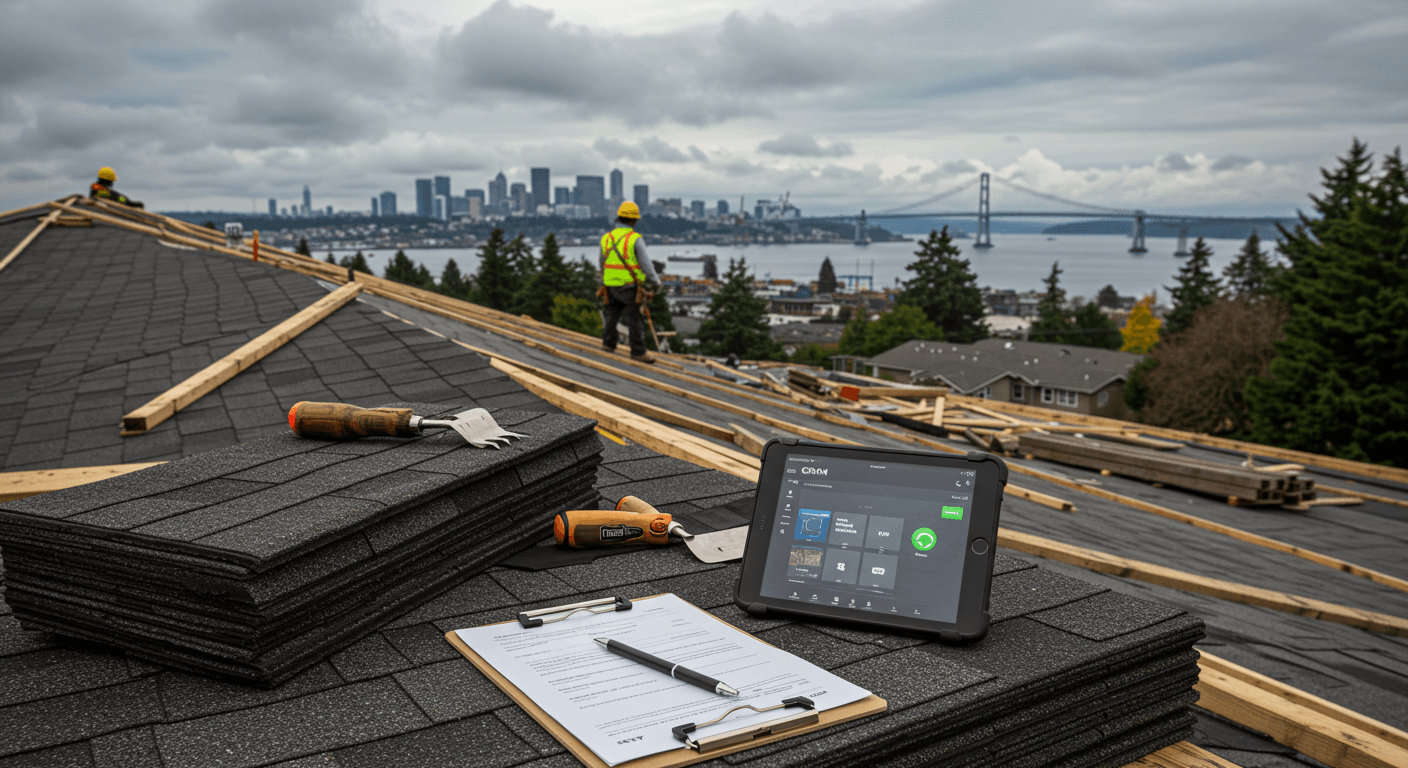
Conventional wisdom in the South Sound suggests that a solid reputation and a handshake are the only tools a roofer needs to dominate the Pierce County market. I spent last Tuesday afternoon with a shop owner near the Port of Tacoma named Jaxon, who was convinced his "paper and pen" method was more personal than any software. He felt that technology would alienate the homeowners in North Slope or University Place who value that old-school touch. But when we actually looked at his stack of folders, we found 14 unsigned estimates from the last 19 days alone. Those weren't just pieces of paper—they represented $114,682 in potential revenue that had simply gone cold because nobody followed up.
The myth that tech kills the "personal touch" is costing Tacoma contractors millions every year. In reality, the most successful shops I coach in the 253 area code are using CRM systems to be more human, not less. They use automation to ensure no one in Hilltop or Fircrest feels ignored. This article breaks down the hard data on why your current sales stack (or lack thereof) is likely leaking cash and how to plug those holes with a localized tech strategy.
Main Points
Centralizing lead data can increase your team's follow-up frequency by 4.2x without hiring additional office staff.
Automated "speed-to-lead" triggers in Tacoma's competitive market often result in a 23.6% higher appointment set rate.
Using localized data for neighborhood-specific pricing in areas like Proctor or Ruston improves margin accuracy by 8.4%.
The Tacoma Market: Why Manual Systems Fail in the South Sound
Tacoma isn't Seattle, and it certainly isn't Bellevue. The roofing market here is gritty, competitive, and increasingly dictated by rapid response times. When a storm rolls off the Sound and rattles the shingles in Browns Point, every homeowner is on Google within 14 minutes. If your lead intake process relies on a secretary writing notes on a legal pad, you have already lost.
According to the IBISWorld Roofing Industry Report, operational efficiency is now the primary differentiator between shops that scale and those that stagnate. In Tacoma, where we face unique permitting hurdles and weather patterns, your sales technology needs to do more than just store phone numbers. It needs to act as a flight recorder for your business.
I recently worked with a sales rep named Piper who was struggling to hit her numbers. She's a killer closer, but her "system" was a series of sticky notes on her truck's dashboard. We did a deep dive into her last 47 leads. Because she didn't have real-time alerts or a centralized dashboard, her average response time was 6.2 hours. In a market where the top five Tacoma roofers are responding in under 8 minutes, Piper was essentially handing her commissions to the guy down the street.
The Psychology of the "Locked" Lead
One of the biggest psychological hurdles for roofing owners is trusting the data they buy. I've heard the complaints from shops on South Tacoma Way: "The leads are junk," or "They already talked to six other guys." This happens because most lead sources sell the same info to everyone simultaneously, creating a "race to the bottom" on price.
This is where the tech stack becomes your armor. When you utilize a platform that offers exclusive, verified leads, the psychology of the sale changes. Your reps aren't calling defensively; they're calling as a consultant. New contractors often claim $150 in free credits to test how their close rates shift when they are the only ones at the kitchen table.
When Jaxon finally moved his shop to a digital system, he noticed a shift in how his team talked about their pipeline. Instead of "I think I have some appointments," they were saying, "I have 12 verified previews locked in for the North End this week." That shift from "maybe" to "verified" changes the energy of the entire sales floor.
The 7-Minute Follow-Up Rule
"Data shows that your chances of closing a roofing lead drop by 391% if you wait more than 30 minutes to call. In Tacoma, aim for under 7 minutes. Set up your CRM to send an immediate SMS to the homeowner the second a lead hits your system. This "stops the shop" and keeps them from calling your competitors."
Transitioning from Spreadsheets to a High-Performance CRM
Most contractors I talk to are terrified of the "onboarding" process. They imagine weeks of downtime and thousands of dollars in consulting fees. But if you're still running a $3 million shop off an Excel sheet, you're essentially trying to fly a Boeing 747 with a bicycle handlebar.
Recent analysis from Construction Dive indicates that construction firms adopting integrated sales technology see a 14.8% reduction in administrative overhead within the first year. For a Tacoma shop with three crews, that is the equivalent of adding an entire extra job to the schedule every month without increasing payroll.
The key is starting with the basics. You don't need a system that does 500 things; you need a system that does three things perfectly:
- It captures every lead instantly.
- It forces a follow-up schedule.
- It gives you a "clean" look at your numbers.
Understanding how the verification process works is the first step in cleaning up your data. If your CRM is filled with bad phone numbers and "test" emails, your sales team will stop using it. They need to know that when they open their app, the person on the other end is actually looking for a roof in Pierce County.
Action Plan
The 4-Step Tacoma Tech Audit
How to audit and upgrade your Tacoma roofing sales stack in 4 weeks.
The Leak Detection (Week 1): Track every lead that came in over the last 30 days. How many did you actually talk to? If it's under 82%, you have a technology problem, not a lead problem.
The CRM Selection (Week 2): Choose a platform that integrates with your lead sources. Look for territory locking and lead scoring to ensure your reps are focused on high-margin zip codes like 98406 or 98407.
The Data Migration (Week 3): Move your active prospects first. Don't worry about the 5-year-old "dead" leads yet. Focus on the ones currently in the "estimate sent" phase.
The "Live" Training (Week 4): Have your best rep run a full day using only the new system. Show the rest of the team how it saves them 45 minutes of paperwork per job.
Want to skip the manual work and get exclusive, verified leads instead?
Get $150 in Free CreditsWhy Neighborhood Data Matters in Pierce County
Tacoma is a patchwork of different housing stocks. A roof in the West End requires a different sales approach than a Victorian in the Stadium District. A high-performing CRM allows you to tag leads by neighborhood and age of home.
Imagine your rep, Carter, pulls up to a house in Puyallup. Before he even gets out of the truck, his CRM tells him that he's done four roofs on this block in the last 18 months. He can see that the average project cost for these 1970s split-levels is $16,842. He isn't guessing; he's walking in with market-specific authority.
This level of granular data is what separates the "chuck in a truck" from the professional roofing enterprise. When you can tell a homeowner, "We just finished the Smith house three doors down, and they had the same flashing issue you're seeing," you've won the job before you even pull out the tape measure.
Platforms with territory locking and lead scoring help you focus your team's energy on the neighborhoods where your margins are highest. Instead of chasing every lead across Pierce County, you can build a reputation in specific zip codes where your crews excel.
The "Feature Creep" Trap
Don't buy a CRM because it has a pretty dashboard. I've seen shops waste $12,400 on enterprise software that was too complicated for their field reps to use. If your guys can't update a lead status in three clicks or less while wearing work gloves, they won't use it. Keep it simple or it will become a very expensive digital paperweight.
ROI: The Real Cost of Staying "Old School"
Let's do the math for a typical Tacoma roofing operation. If you generate 40 leads a month and your current close rate is 22%, you're booking 8.8 jobs. At an average ticket of $14,500, that's $127,600 in monthly revenue.
By implementing a CRM that enforces a 5-touch follow-up sequence and uses verified lead previews, I've consistently seen shops bump that close rate to 28%. That might not sound like much, but that's now 11.2 jobs per month. That is an extra $34,800 in revenue every single month, or $417,600 a year.
What would an extra $417,000 do for your shop? It buys two new trucks. It pays for a better staging warehouse near Fife. It allows you to hire a dedicated production manager so you can finally take a weekend off at Lake Tapps.
Conclusion: Stop the Leak
The transition to a tech-forward sales process isn't about being "fancy." It's about survival in a market that is moving faster every day. The contractors who are still relying on memory and paper folders are the ones who will be complaining about "slow months" while the tech-enabled shops are booking out six weeks in advance.
Take a look at your desk right now. If there are more than three pieces of paper with homeowner names on them, you're losing money. It's time to stop the leak.