Are you accidentally bidding against your own reputation by blending into the sea of generic "free estimate" yard signs currently clogging up the I-5 corridor?
Three months ago, I was looking over the CRM data for a contractor in Bellevue named Wesley. He was burning through $11,432 a month on digital ads, but his lead-to-close ratio had plummeted to a dismal 8.4%. When we audited his messaging, it looked identical to every other guy with a ladder and a business license in King County. He was selling "quality roofing" and "honesty," which are the bare minimum requirements for entry, not a brand strategy. We realized that in a market as dense as Washington, being a generalist is the fastest way to commit financial suicide.
The Washington market is uniquely fragmented. You have the moisture-heavy demands of the Olympic Peninsula on one side and the high-desert heat of Yakima on the other. Yet, most firms use the same "we do it all" template. If you want to stop the race to the bottom on price, you have to lean into specific market analysis and technical differentiation that makes your bid the only logical choice.
At a Glance
Niche specialization can reduce Customer Acquisition Cost (CAC) by up to 18.7% by speaking directly to high-intent pain points.
Safety culture is a powerful B2B selling tool, especially given the high risk of falls in the industry.
Washington-specific environmental expertise (moisture/snow load) creates higher perceived value than generic manufacturer certifications.
Data-driven positioning allows for premium pricing even in high-competition zones like Tacoma or Everett.
Action Plan
A 4-Step Framework for Identifying Your Unique Market Position in the Pacific Northwest
Transform from a generic contractor to a specialized authority that commands premium pricing in Washington's competitive market.
Audit the Competition: Map out the top 15 competitors in your specific ZIP codes and identify their primary messaging (likely 'free estimates' or 'family owned').
Identify Service Gaps: Look for underserviced niches like historic cedar shake restoration in Seattle or high-wind metal roofing in the Columbia Gorge.
Align with Regulations: Use Washington L&I compliance and safety standards as a marketing pillar rather than just a legal hurdle.
Quantify Value: Move from 'we're the best' to 'our systems reduce attic moisture by 22.4% more than standard ridge vents.'
Want to skip the manual work and get exclusive, verified leads instead?
Get $150 in Free CreditsThe High Cost of Being "Just Another Roofer"
When Wesley and I dug into the numbers, the reality was stark. Because his brand didn't stand for anything specific, he was forced to compete on price for every single tear-off. In the roofing world, the National Roofing Contractors Association (NRCA) emphasizes that professional standards are the bedrock of a sustainable business, yet many owners ignore these in their marketing.
In Washington, where the Department of Labor & Industries (L&I) keeps a tight leash on registrations, you are competing against over 12,850 registered construction entities. If your brand doesn't immediately signal a specialized solution, you are essentially a commodity. Commodities are bought on price. Authorities are bought on expertise.
I've seen shops increase their average ticket by nearly $3,400 simply by pivoting their brand from "Residential Roofing" to "Western Washington Moisture Management Specialists." It's the same labor, the same shingles, but a completely different value proposition in the mind of a homeowner who has been dealing with moss and rot for six years.
The highest in the construction industry according to the BLS.
Safety as a Brand Differentiator
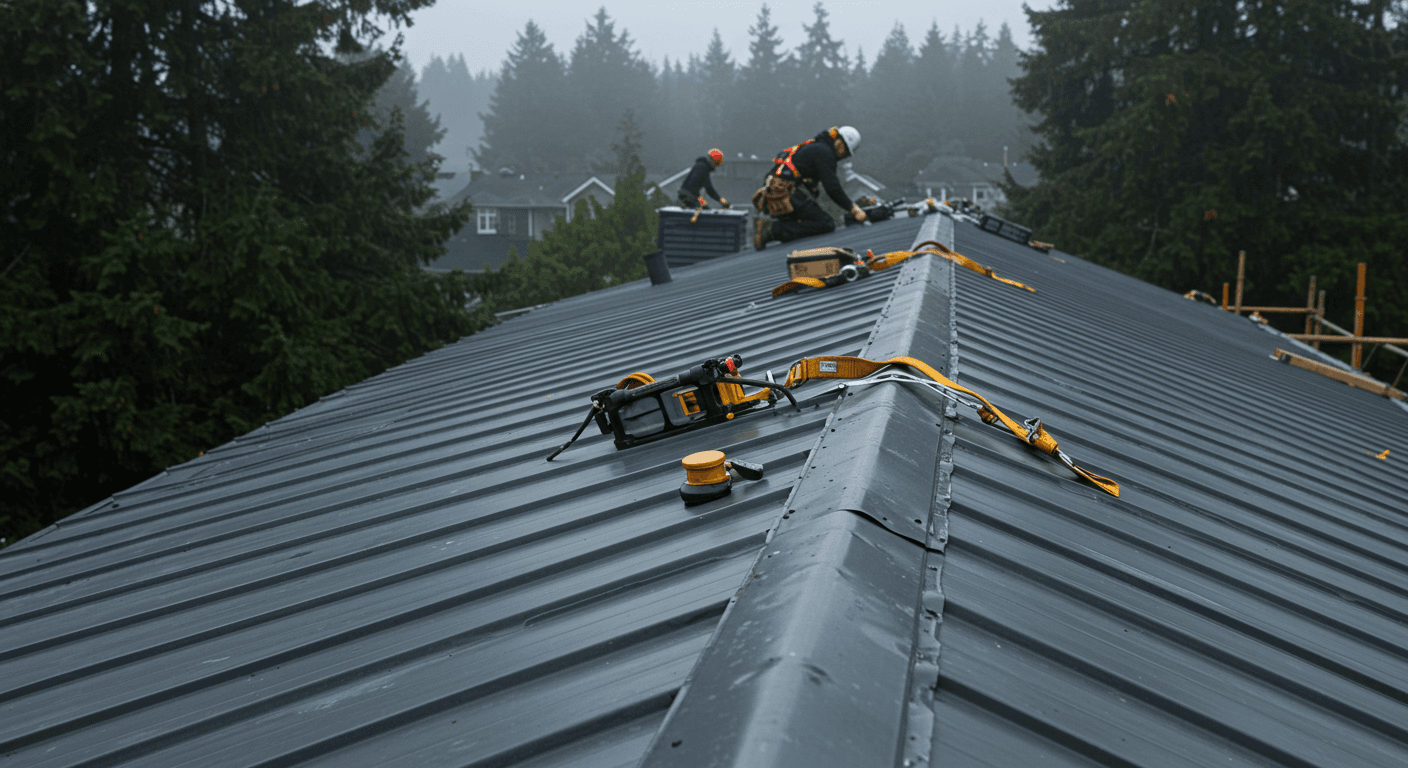
Most contractors treat safety as a back-office headache. However, savvy owners in regions like Spokane or Vancouver are starting to use their safety record as a primary sales tool. According to a 2025 report from the Bureau of Labor Statistics (BLS), there were 110 fatal falls in the roofing industry in 2023 alone.
When you explain to a property owner that your crew utilizes specialized fall-arrest systems and rigorous daily safety briefings, you aren't just bragging about compliance. You are mitigating their liability. In a litigious state like Washington, that peace of mind is worth a 12.5% premium on the total project cost. I once watched a crew lead explain a complex tie-off point to a curious neighbor in Kirkland; that neighbor signed a contract two days later without even asking for a second bid.
Regional Data: The Tale of Two Washingtons
Your differentiation strategy must change the moment you cross the Cascades.
- Western Washington: Focus on moss resistance, ventilation math to prevent mold, and the logistics of working during the "big dark" months.
- Eastern Washington: Focus on UV resistance, thermal expansion of metal roofing, and snow load calculations.
If your website and sales decks don't reflect these regional realities, you're leaving money on the table. One client I worked with in the Tri-Cities shifted his focus to high-reflectivity materials to combat the 100-plus degree summers. By branding his services as "Thermal Defense Roofing," his inbound call volume from commercial property owners jumped by 31% in a single season.
Brand Positioning Impact
| Factor | Generalist Contractor | Specialized Authority |
|---|---|---|
| Avg. Lead-to-Close | 9-12% | 24-28% |
| Primary Sales Objection | Price/Quote | Technical Specs/Timeline |
| Marketing Focus | Discounts/Volume | Expertise/Durability |
| Profit Margin per Job | 14.2% | 21.8% |
Avg. Lead-to-Close
Primary Sales Objection
Marketing Focus
Profit Margin per Job
Turning Metrics into Messaging
To truly differentiate, you need to get comfortable with the numbers. I often tell shop owners that "quality" isn't a metric. "A 4.3-day average completion time with a 0% callback rate over 147 projects" is a metric.
When you use a platform that provides exclusive job previews, you get the data you need to refine your niche. You can see which neighborhoods are leaning toward specific materials or where storm damage is concentrated. This allows you to tailor your brand messaging in real-time. If you know a specific pocket of Snohomish County is dealing with aging cedar shakes, your "Modern Synthetic Shake Conversion" brand should be front and center in those territory-locked leads.
The 48-Hour Review Loop
"Don't just ask for a review. Ask for a review that mentions the specific problem you solved. Instead of 'Great job,' prompt them with: 'How did our moisture-management system solve your attic humidity issue?' These keyword-rich reviews do more for your brand differentiation than 100 generic 5-star ratings."
The ROI of the "Expert" Pivot
Is it expensive to pivot your brand? It's certainly more expensive to continue paying a high CAC for leads that treat you like a line item. When we revamped Wesley's Bellevue shop, we didn't just change his logo. We integrated a sophisticated lead scoring system that prioritized high-value architectural shingle projects.
By the end of the second quarter, his marketing spend had actually decreased by $2,100, but his net profit was up $19,450. Why? Because he wasn't wasting time on tire-kickers looking for the lowest bidder. He had differentiated himself as the local expert on high-end residential systems in King County.
Common Questions
Choosing to stand out is a business decision, not a creative one. In Washington's crowded market, your ability to articulate why you are different—backed by regional data and a commitment to safety—is the only thing standing between you and a flatlining bottom line.