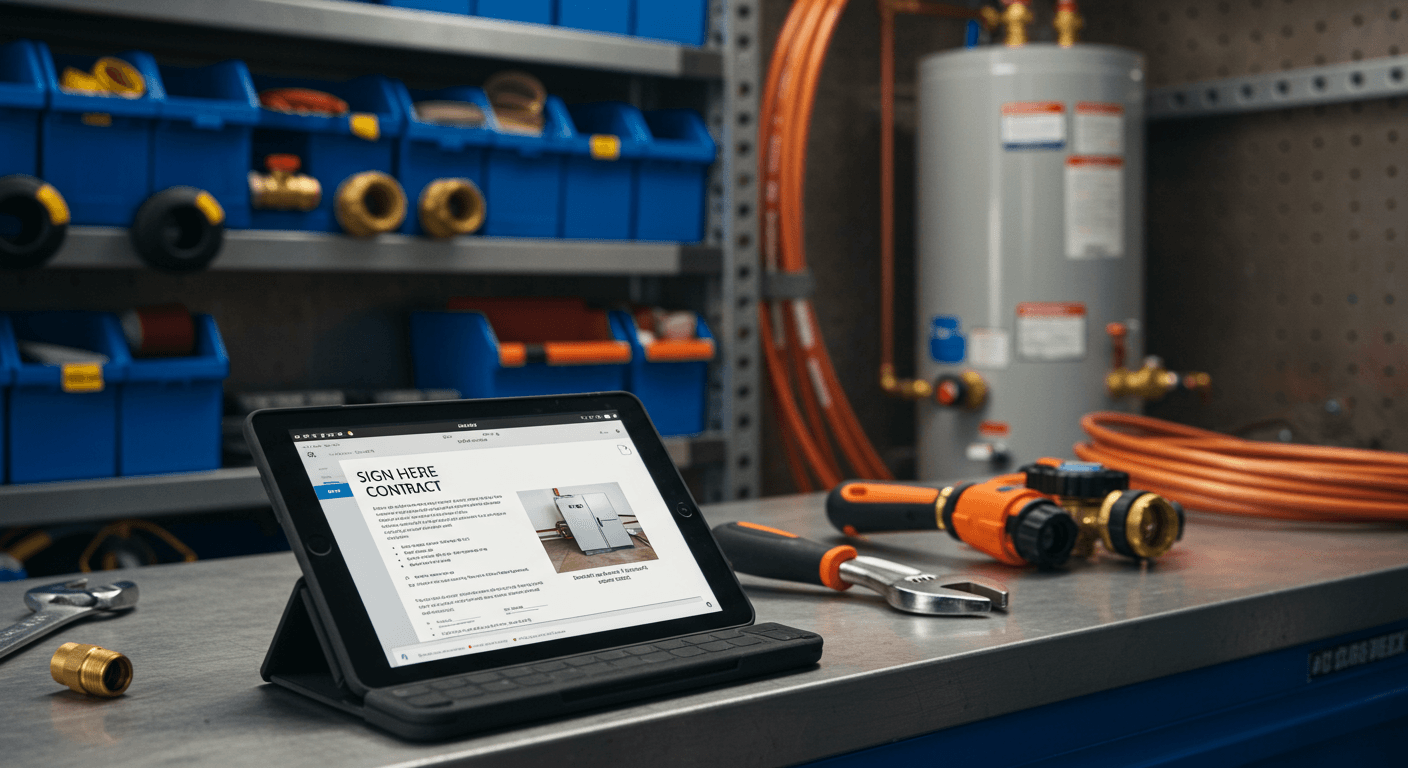
The gap between finishing a repipe and sending a clean invoice is what separates a Mountain plumbing shop running on a 7.2% net margin from one on a 14.8% growth path. Paper cycles often stretch billing to 8.4 days. Digital contract management can collapse that window to 19 minutes, which matters when you need cash flow to fund emergency crews in corridors like the Treasure Valley or the Front Range.
Moving to a cloud-based system is not about chasing a trend. It is about stripping out the 22.7% administrative friction that piles up every time a technician drives back to the office just to drop off a signed work order.
Digital Operational Wins
Digital signatures cut Days Sales Outstanding from an average of 9.3 days to less than 24 hours.
Automated timestamps and mandatory photo attachments reduce warranty disputes by 38.4%.
Field-to-office sync lets dispatchers re-route crews 14.2% faster after job completion.
Required fields help document PHCC industry standards and local Mountain region codes before the tech leaves the site.
The true cost of carbon copy management
I have spent the last 6.4 years looking at backend metrics for plumbing companies across the Mountain West, and the pattern holds. Shops still on physical clipboards bleed profit in ways they never log. When a technician like Devin spends 15 minutes at the end of every call on a paper form, then another 10 minutes deciphering handwriting back at the shop, you lose nearly 4.2 hours of billable time per week per tech. With journeyman rates climbing, that is a $9,432 annual leak per truck.
Labor is only half the problem. Data integrity matters too. In high-mineral water regions like Arizona or Utah, where water softener installs and tankless heater maintenance are high-volume work, documenting installation parameters is not optional. Manual forms skip the small details. A digital contract can require a photo of the thermal expansion tank or a recorded pressure reading before the Complete Job button even unlocks.
Mountain region shops that moved to digital contract management eliminated midday paperwork runs and packed more paid calls into each route.
Three tiers of digital contract management
Not every tool fits the geography and revenue profile of a Mountain states shop.
You are usually choosing between a lite e-signature tool, an integrated field service suite, or a custom internal portal. Each solves a different slice of the problem.
Digital contract tiers for Mountain plumbing shops
| Factor | Lite e-sign | Integrated FSM |
|---|---|---|
| Typical cost | About $14.25 per user | Higher license, fewer add-ons |
| Dispatch and inventory sync | No connection to trucks or stock | Contract tied to job, invoice, and parts |
| Best fit by revenue | Shops under roughly $450k | Most $1M+ operations |
| Intake accuracy | Manual re-entry from phone calls | Verified lead data flows into the contract |
Typical cost
Dispatch and inventory sync
Best fit by revenue
Intake accuracy
Custom portals suit multi-state operators with heavy code compliance needs across Idaho, Wyoming, and similar markets.
Integrated suites matter when your lead intake is verified at the start. Customer name, address, and scope flow straight into the digital contract, which prevents the data errors that stall 4.3% of residential billings.
The offline-first requirement
"Dead zones are real in the Mountain region. Never buy a contract tool that needs constant 5G. Your techs need an offline-first app that saves signatures locally and syncs the moment they pick up signal on the way to the next call."
Mitigating warranty and code exposure
Mountain plumbers deal with water quality swings that affect appliance life. If you install a high-efficiency boiler or EPA WaterSense certified fixtures, the contract should state water conditions at install time.
I worked with a Denver shop getting hammered by water heater warranty claims. We built a digital contract that required photos of sediment in the old tank and PSI on the incoming line. Within 7.2 months, denied warranty claims dropped 47%. The contract became a legal shield because it held a timestamped, unalterable record of site conditions that paper could not match.
Compliance fields should also reflect PHCC industry standards and the local codes your inspectors expect before sign-off.
Action Plan
Move your crew from paper to digital
A phased rollout beats a Monday mandate. Give the team a path that respects field reality.
Audit current forms and find the three fields techs forget most often. Make those required in the digital version.
Run a 14-day trial with your most tech-savvy crew member to surface UX bugs before the full team goes live.
Offer a small bonus the first month for every digital contract submitted with 100% completion and zero errors.
Remove physical clipboards from trucks once training sticks so nobody drifts back to old habits.
Sync the backend so signed contracts trigger an automatic thank-you email with a review link.
ROI analysis: the hard numbers
Here is the math for a five-truck shop in a city like Boise.
- •Paper costs: Forms, folders, and toner run roughly $118 per month.
- •Admin labor: A part-time admin spending 12 hours a week filing and entering paper at $22/hr costs $1,056 per month.
- •Lost revenue: One missed billing or uncollected payment per month at a $487 average ticket is another quiet leak.
Total paper tax: $1,661 per month.
A mid-range digital contract tool might cost $55 per tech. For five techs, that is $275. Even with a $500 setup fee spread across a year, monthly cost stays under $320. Net monthly gain lands near $1,341, or more than $16,000 a year. That buys a new jetter or funds a shoulder-season lead push.
The signature-only trap
Do not stop at a scribble on glass. A digital contract without before-and-after photos and a clear scope-of-work disclaimer is just a faster bad paper form. If it will not protect you in court or against a chargeback, it is not working.
Closing the loop on lead quality
Your digital contract system is only as clean as the data feeding it. Messy intake at the top means errors in the field. I always push shops toward exclusive, verified intake so the tech is not playing detective on site.
If administrative bottlenecks or low-intent calls are keeping trucks tied up, reach out to our strategists to see how we can tighten the pipeline before the contract ever gets signed.