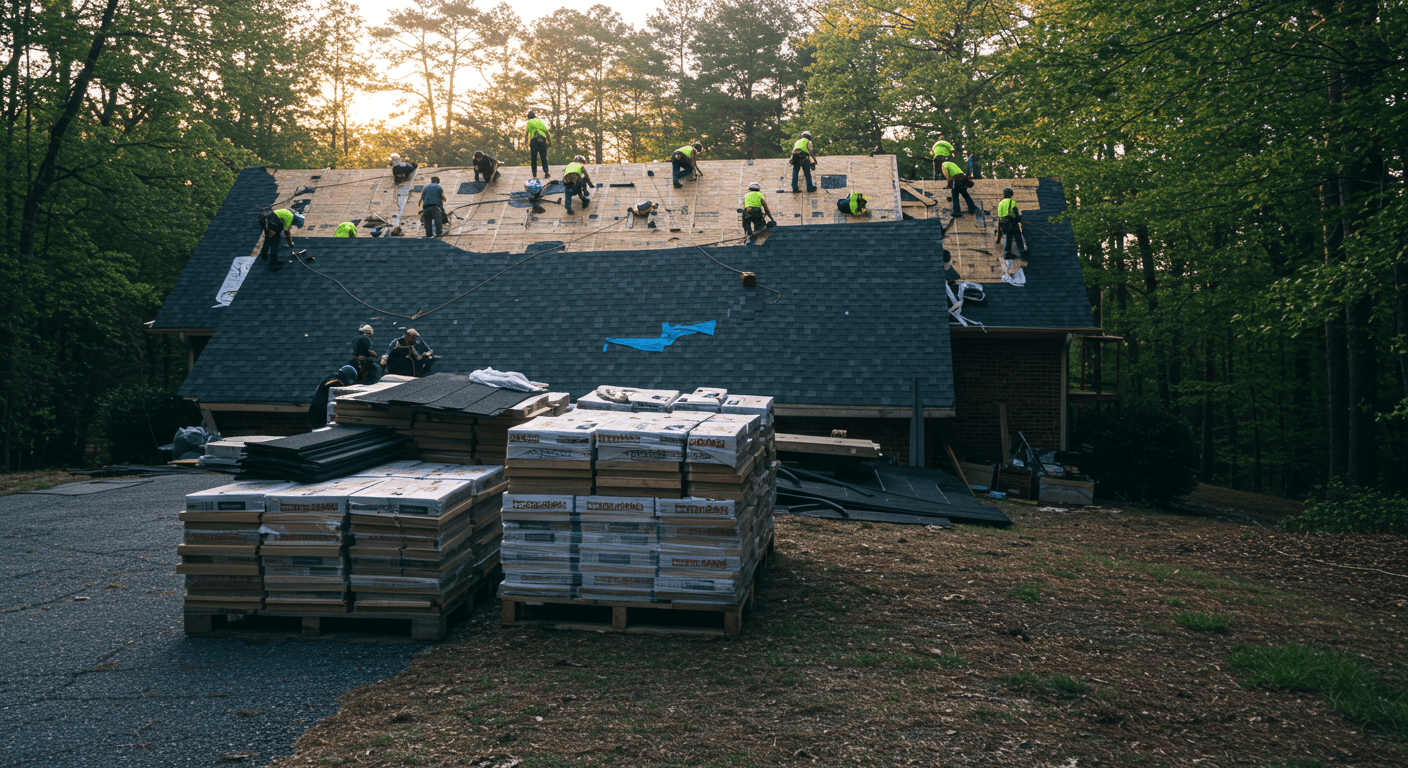
Twenty-four bundles of charcoal architectural shingles sat staged on a damp tarp in a Greensboro driveway while Jaxon's phone buzzed against his thigh for the eleventh time that morning. It was barely 7:42 AM, but the Piedmont hailstorm from three nights prior had already turned his digital calendar into overlapping installs and permit delays. I stood there with him, watching him read a text from a sub-crew about a steep-slope delivery mix-up while a homeowner leaned out to ask about a gutter tweak. Jaxon did not look angry. He looked hollow. That is the moment when North Carolina roofing companies either tighten the operation or start paying for it in callbacks and turnover.
The pressure is not only volume. It is what happens when one person becomes the default brain for dozens of open insurance claims, code quirks, and crew schedules. According to the IBISWorld roofing contractors industry report, the trade stays fragmented and competitive, so losing an experienced production manager can cost a mid-sized Raleigh shop roughly $84,300 in efficiency and hiring drag across six months. That is not drama. It is math tied to stalled installs and rushed replacements.
Blended benchmark from shops we track across the Piedmont and Triangle when hail volume spikes. It is not a badge of hustle. It is a warning that your system is asking one human to carry the whole board.
The North Carolina storm cycle and the decision fatigue trap
Coastal wind, Piedmont hail, and mountain pitch all land on the same PM calendar. That mix is what fries judgment first.
North Carolina throws a tri-zone problem at operators. Wilmington deals with hurricane season exposure, the Piedmont sees volatile hail, and the mountains add steep-slope work with tighter access. Your production manager is not only sequencing shingles. They are juggling different material stacks, county interpretations, and lift plans that change when you cross a line on the map.
The burnout I see from Charlotte to Winston-Salem rarely starts with nails and tear-off. It starts with decision fatigue. Every time a PM solves a problem a checklist should have caught, they burn focus you cannot invoice. Hunting missing ventilation parts or re-litigating a job that sales never qualified drains the same mental budget that keeps supplements tight and crews aligned.
The 15-minute morning clearance huddle
"Before crews leave the yard, stand for fifteen minutes on red-flag jobs only. If a file lacks a signed supplement or a confirmed delivery, it does not move to the active board. That single gate keeps the PM from chasing emergencies all afternoon."
Quantifying the leak when a PM hits the wall
The first casualty is the hand-off, and the invoice shows up as rework long before anyone updates a job title.
When a production manager goes flat, verification loosens. I audited a Fayetteville shop where net margin slid from 34% to 21% during a strong storm run. The owner assumed material spikes. The real driver was rework. Exhausted managers stopped matching orders to field measurements. They accepted a sales rep's rough numbers just to clear the desk. We traced about 13.7% of project cost to dry runs where crews arrived with the wrong flashing or a ridge vent that did not match the shingle profile.
Labor and materials are unforgiving right now, which makes efficiency the lever you still own. Recent roofing industry statistics from ConsumerAffairs underscore steady employment alongside rising input costs. If your PM is too tired to catch a $450 measurement miss, that $450 leaves your margin, not the carrier's narrative.
Operational posture: firefighting versus flow
| Operating signal | Reactive PM | Systems PM |
|---|---|---|
| Daily communication | Eighty-plus interrupt calls | Scheduled huddles plus written crew updates |
| Material ordering | Same-day supply house rescues | Verified forty-eight hours ahead of metal and underlayment |
| Quality control | Site visits only after a complaint | Structured midpoint walk with a short checklist |
| Turnover signal | Twelve to eighteen month churn risk | Retention tied to fewer fires, not hero saves |
Daily communication
Material ordering
Quality control
Turnover signal
Lead-to-production handoffs that stop the bleeding
When sales forwards messy files, production becomes a filter instead of a finisher.
I coach owners to enforce production-ready folders. That means verified pitch photos, access notes for lifts, and dumpster placement thought through before the crew maps the route. If the PM has to call the homeowner to ask where to stage debris, the packet failed upstream. Clean intake buys back hours for supplements, crew coaching, and the inspections that keep carriers honest.
Technology helps when it shortens the guesswork. Teams that use LeadZik to read locked previews on incoming jobs can match crew skill to roof complexity earlier. Production sees the same facts sales saw, so the board stops filling with jobs that looked easy on a map and feel impossible on the slope.
The hero trap
Do not celebrate the midnight delivery save or the patched crew mistake as your culture win. Praise calms the chaos that should never have shipped. Reward quiet weeks where nothing heroic happened because the plan held.
Managing the North Carolina material mix without losing the PM
Asheville pitch, coastal humidity, and Piedmont hail do not belong on the same whiteboard row without guardrails.
Unstructured PMs drown when fifteen distinct assemblies all demand different underlayment, ice and water details, and ventilation math. We built a simple complexity score for a Raleigh client. Jobs rated one through five on pitch, height, and material sensitivity. The rule was no more than three level-five jobs active at once. Self-reported PM stress dropped 42% in a quarter because the calendar stopped pretending every square was the same.
Field data has to move with the PM. When alerts and claim notes live on a phone, the manager can claim, assign, and confirm details from the driveway instead of batching admin after dark. LeadZik's mobile app is built for that rhythm, which matters when the next storm front is twelve hours out and your best person is already on hour eleven.
Compensation that tracks storm reality
Flat salary in July and flat salary in January teaches the wrong lesson when July runs seventy-hour weeks.
Tie pay to outcomes you actually want: margin retention and clean installs. A margin-retention bonus when actual production cost stays inside three points of estimate aligns the PM with purchasing discipline. Add a small kicker when callbacks stay under two percent. The mindset shifts from pushing volume to protecting quality on the first pass.
Finn, a shop owner I trained recently, watched his PM deflate because effort only showed up in Finn's bank account. We added a $1.15 per square quality completion bonus. Over four hundred squares in a month that is $460 in the PM's pocket for doing the fundamentals right. It is not flashy, but it links sweat to a scoreboard they can read.
Action Plan
Four production triage moves for peak NC volume
Use this cadence when boards are full and carriers are moving fast. The goal is to protect verification windows instead of hoping adrenaline fills the gaps.
7:00 AM gatekeeper audit: the PM walks every install for missing components. If drip edge color or starter strip is wrong, delay before wheels turn. No exceptions.
11:00 AM to 1:00 PM supplement window: photos, notes, and carrier-facing documentation while decks are open, not after crews leave.
3:00 PM forward look: confirm deliveries for the next forty-eight hours so tomorrow morning is not a scavenger hunt.
Digital hand-off before leaving site: upload notes and photos to the CRM from the driveway. Office homework should not follow the PM home.
Licensing pressure belongs in the PM job description
North Carolina expects defensible installs. A tired PM is a compliance risk, not only a morale problem.
The North Carolina Licensing Board for General Contractors does not grade on intent. If crews skip roof-to-wall flashing details or nail patterns in high-wind zones, the PM is the person standing with the inspector. Burnout shows up as skipped six-nail checks and loose drip edge habits. That path leads to callbacks, fines, or worse.
Elevate the PM as your compliance officer, not only a dispatcher. Give them authority to stop work, pair that with training time, and fund the assistant work that keeps them sharp. Pride in protecting the license is one of the few cultural levers that competes with pure overtime pay.
Future-proofing the Piedmont pipeline
The goal is a shop that absorbs hail without the internal team fracturing the week after.
Move the identity from constant rescue to repeatable process. Triage blocks, honest incentives, and cleaner intake give your production manager room to think. When that role stabilizes, crews stay on better jobs, supplements stay documented, and homeowners stop feeling like they are part of your internal chaos.
The shops that last in North Carolina are not always the ones with the biggest lead firehose. They are the ones that can fulfill what they sell with accuracy and a bench that does not quit every spring. Protect the PM, and you protect the throughput everything else depends on.
What actually moves the 32% number
Decision fatigue is the early warning. When verification slips, margin leaves before anyone updates a job title.
Production-ready packets and honest complexity caps turn PM time into planning instead of detective work.
Compensation that tracks quality and margin keeps storm-season hours from feeling like a donation to the owner's account.