Homeowner patience for 48-hour diagnostic windows has thinned out. National averages now sit closer to a 2.3-hour window of opportunity, which a solo owner-operator cannot defend while they are wedged in a crawlspace. That shift creates a hard ceiling for the one-person shop, where total revenue tracks your stamina and daylight more than your skill.
I have watched strong technicians stall near $248,500 a year because they are still playing lead installer, dispatcher, and bookkeeper in the same day. Moving to a multi-crew model is not only buying a second van. It is separating your personal income from your own wrench time through real delegation.
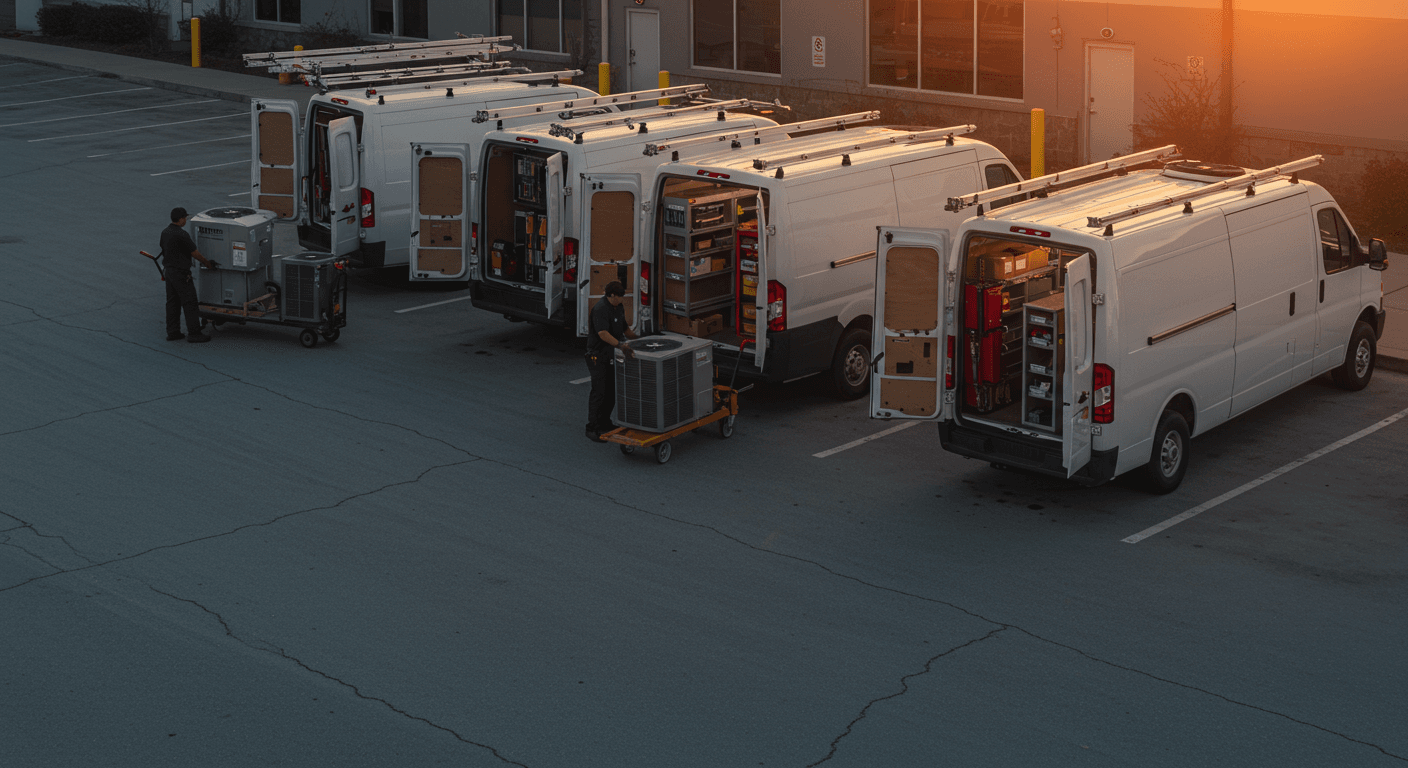
Mid-sized firms running three to six trucks are winning a large share of high-margin system replacements by being available now. To compete, you need repeatable intake and technician utilization that still works when you take one afternoon away from the field. Below is the path I use for owners who want structure, not chaos, on the way toward roughly $1.9M with five trucks and the owner off the tools.
Strategic milestones for HVAC expansion
Efficiency threshold: multi-crew math usually needs about 38.4% gross margin on service work to fund the first non-billable hire without choking cash.
Helper trap: an apprentice hired too early can pull billable efficiency down about 17.6% while you carry training drag on every ticket.
Lead mix: word-of-mouth alone will not keep several vans busy. You need proactive, verified demand so payroll does not sit idle.
Standard quality: documented technical benchmarks so every crew returns close to the same gross margin the owner used to produce personally.
The revenue ceiling: the solo trap
Busy is not the same as scalable.
Most solo HVAC owners I talk with are near 62-hour weeks and still feel behind. The better you are in the field, the more busy work lands on you, which blocks the quiet work that actually grows the company. When you are the one taking the 2:00 AM no-heat call, you are not rebuilding your pricing model or negotiating distributor terms.
The break often shows up between $250,000 and $310,000 in annual gross revenue. At that band you are running four to six calls, billing at night, and trying to quote between lunch and the next refrigerant leak. I recently worked with Finn, a contractor outside Atlanta, who feared a $55,000 salary for a lead tech. He was leaving about $8,430 a month on the table in replacement opportunities he never quoted because follow-up after service visits simply did not happen.
Reframing the math helps. If you bill roughly $150 per hour in the field, an hour on $22-an-hour paperwork is not neutral. It is opportunity cost. The point is not staying busy. It is building a system that produces billable hours through other people's hands.
Solo operator vs. five-truck owner (what actually changes)
| Operating lever | Solo owner-operator | Five-truck operator |
|---|---|---|
| Who owns quality control | You, on every job | SOPs, photos, field lead audits |
| Schedule truth source | Memory, texts, whiteboard | FSM with live dispatch board |
| Demand planning | Hope the phone rings | Forecasted funnel + capacity dial |
| Owner time | Mostly billable labor | Hiring, pricing, partnerships |
Who owns quality control
Schedule truth source
Demand planning
Owner time
Phase 1: the first hire and the $12,400 mistake
Hire for autonomy, not just an extra set of hands.
The helper-first mistake
Hiring only for capacity usually means a green apprentice who speeds up lifting, not decisions. You still own every diagnosis, which means you never unlock a second real truck.
The expensive version of this mistake is about $12,400 in mixed labor, callbacks, and lost tickets before owners admit the first hire did not change how the day flows. Your first scaling hire should be a lead technician who can run a van alone. It is a bigger check than a helper, but it is the only clean way to double capacity.
When Finn finally brought on a seasoned tech, profit dipped about 14.3% during onboarding and vehicle overhead. Inside four months the second van was producing about $28,700 a month, covering its own burden and feeding overhead instead of draining it.
Standards matter immediately. Following ACCA Quality Assured guidance gives the new crew a clear bar for installs and service so small shortcuts do not turn into Friday callbacks. One bad callback can erase the margin from several clean calls.
Language has to shift from this is how I do it to this is the company standard. That sounds corporate until you see how fast variance shows up when two vans are moving at once.
Action Plan
Four moves toward operational autonomy
Use this sequence before you add the second van so payroll does not outrun documentation, pricing, or demand.
Financial audit: confirm service rates carry roughly a 22% overhead buffer before you add salary and vehicle cost.
SOP pack: write your top five service sequences and install close-out steps so a lead tech can execute without calling you.
Lead hire: recruit a technician with at least five years in the field who can run calls without supervision.
Pipeline: secure exclusive, verified demand so the new technician can run about 85% booked time in the first weeks.
Building the operational backbone: tools and tech
At three vans, group texts stop being cute.
Two or three trucks in motion expose every gap in how information moves. A model number never hits the ticket. A homeowner never hears that parts are backordered. An invoice sits unsent for two weeks while cash flow tightens.
You need a field service platform that handles dispatch, invoicing, and customer updates in one thread. Shops that tighten routing and parts visibility often recover a double-digit lift in wrench time, the billable minutes actually tied to equipment, without asking techs to hustle harder on paper.
Teams that pair automated dispatch with cleaner intake and verified demand often see this kind of revenue-per-employee move inside six months.
Give people references they can open on a phone without paging you every twenty minutes. Pointing senior techs toward the ASHRAE Handbook for fundamentals and troubleshooting builds independent problem solving. Your role shifts from on-call professor to someone who sets guardrails and reviews outcomes.
Scaling the lead engine past word-of-mouth
Referrals are fuel. They are not a schedule.
Word-of-mouth built your solo years, but it jitters week to week. If four techs are on payroll and Tuesday goes quiet, you still burn labor, insurance, and depreciation. A three-van shop often carries a daily fixed burn between roughly $1,150 and $1,840 depending on region and benefits.
You need demand you can throttle with capacity. Cheap shared lists that drop three bids on the same house train your team to race on price. A strong tech sent into that situation often closes near single digits, which is demoralizing and expensive.
Higher-intent, exclusive work lets you match technician strength to job type. I have seen owners stabilize routing when they tighten how intake and verification happen before a van rolls, so the dispatcher sees scope instead of a vague “AC not working” line.
Phase 2: five trucks and a dispatcher
The messy middle is real.
Between three and five trucks, owners are half in the field and half in the office, but the revenue often has not caught up to a full management layer. At four vans, plan for a dispatcher or office manager who owns the board. Without that role, calls stack, parts orders lag, and crews improvise.
Yara ran four techs while still selling roughly $1M in changeouts herself. Mistakes crept in because nobody was auditing installs while she chased contracts. We carved out a field lead role, a senior tech spending about a quarter of the week on quality checks across the other three vans. Profit dipped short term. Callbacks fell about 31.4%. When she stopped being the emergency responder for every crew question, she could focus on partnerships and season planning. By truck five, the business carried itself without her on the tools.
The maintenance agreement buffer
"Do not wait for shoulder season to discover idle crews. Treat every service call as a chance to enroll maintenance. Aim for roughly 2.5 agreements per truck so you keep about 35% baseline utilization when weather goes mild."
Managing the financial shift
Margins compress before they expand.
Unit economics get honest when you add crews. Solo operators sometimes live on 15% net and feel fine. Add vans, insurance stacks, and software seats, and overhead can outpace revenue for a season. Pricing has to reflect the infrastructure, not the memory of one-truck rates.
I like a rolling 13-week cash forecast so a slow spring or a truck purchase shows up as a number, not a panic. If your lead-to-contract cycle is about eleven days, you should always know how many qualified opportunities are at the top of the funnel so crews stay fed two weeks out.
Common Questions
The mindset of a multi-truck owner
You fix the business that fixes the air.
The jump from solo to fleet is less about textbook HVAC theory and more about leadership and systems. Perfectionism that keeps you on every job is expensive. Your new job is building the machine: hiring, margin, routing, and standards.
When you can line up HVAC work that fits each van and schedule, the low-grade anxiety of where the next job comes from loosens. You get room to coach techs, tune pricing, and pick ZIP codes with intent instead of hope.