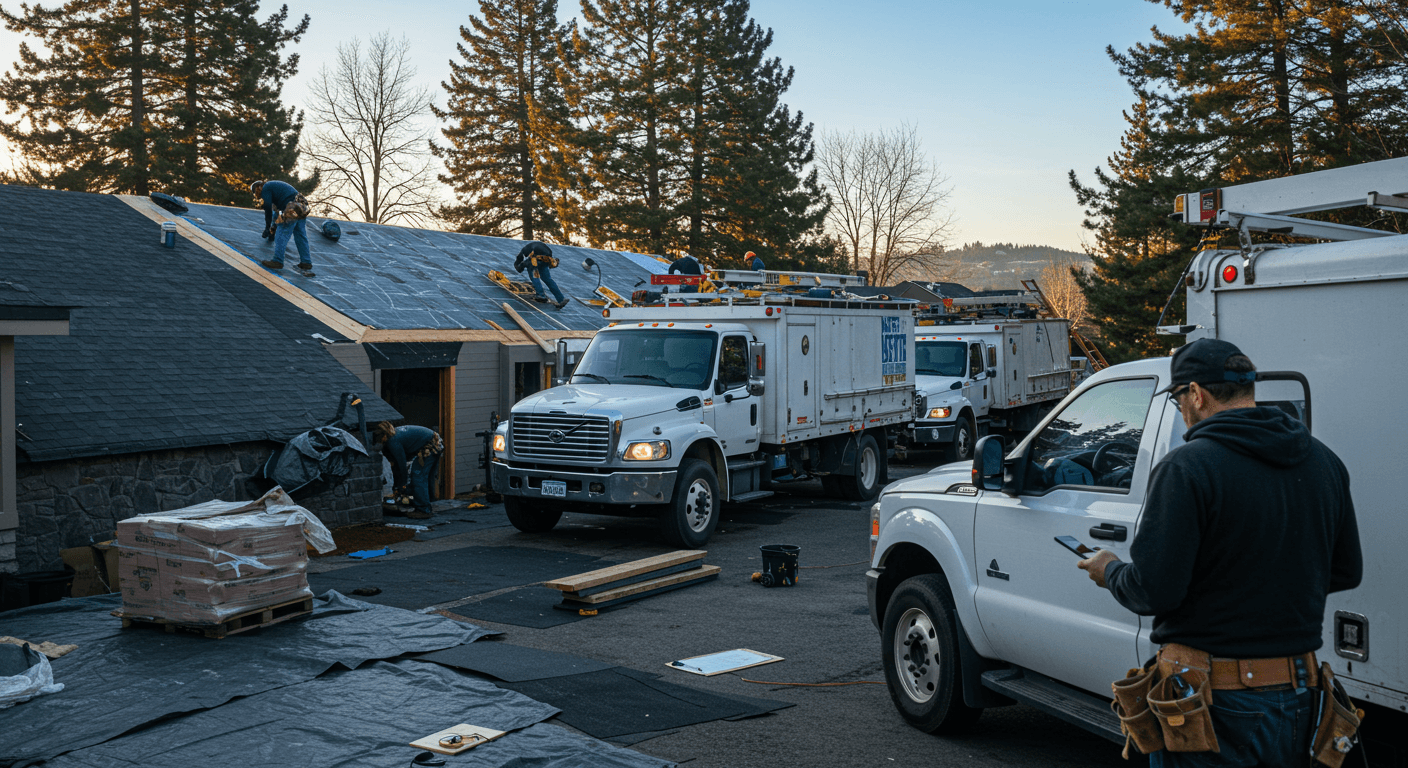
Exactly 74% of solo roofing contractors in the Inland Northwest hit a hard revenue ceiling at the $642,300 mark before burnout or quality slippage guts their referral pipeline. I recently stood in a dusty parking lot near East Sprague Avenue with Devin, a guy who had been running his own rig for nearly 13 years. He was exhausted. He had $147,200 in backlogged shingle jobs across the South Hill and Spokane Valley but was still the one hauling the debris trailer and manually checking every flashing detail. We looked at his P&L, and it was clear: he was not a business owner. He was a high-paid laborer with a mounting liability problem. Transitioning from a one-man show to a managed multi-crew operation is not just about hiring hands. It is about shifting the 19.4% of your time currently spent on manual labor into high-value project management and sales oversight.
At a Glance
Move from "Owner-Operator" to "Owner-CEO" by delegating production to a dedicated crew lead.
Target a 31.4% gross margin floor to ensure your additional overhead does not swallow your personal take-home pay.
Implement a 7-point lead verification system to ensure new crews are always hitting profitable, ready-to-buy residential jobs.
Leverage regional resources like the Western States Roofing Contractors Association to standardize safety and quality across multiple job sites.
The Revenue Wall in the 509 Area Code
Spokane presents a unique challenge for the solo roofer. Our seasonality is aggressive. Between the late-spring rains and the early November freezes, a solo contractor is often forced to choose between selling and doing. When you are on the roof in Liberty Lake, you are not answering the phone for a high-value lead in Mead. This creates a "feast or famine" cycle that prevents real growth. Devin was stuck in this loop for years. He would work 80-hour weeks all summer, only to spend the winter nervously watching his bank account dwindle because he had no time to build a pipeline while he was swinging a hammer.
The math of scaling in Spokane is specific. To support a second crew, your monthly top-line revenue needs to jump by roughly $38,400 just to cover the new payroll, additional insurance premiums, and the lease on a second truck. If your average ticket size is $14,200, you need to close three extra jobs per month consistently. This is where most guys fail. They hire the crew first but do not have the lead volume to keep them busy, leading to a 42% turnover rate in the first six months of expansion.
I told Devin that we needed to look at his business through the lens of a growth guide provided by the SBA, focusing specifically on capacity planning. You cannot scale on hope. You scale on predictable volume.
The 15% Capacity Rule
"Never hire a full second crew until your current backlog is at least 15% beyond your personal physical capacity for three consecutive months. This ensures you have the immediate "fuel" to keep new hires busy while you transition into a full-time sales and management role."
The "Crew Lead" Myth and the Management Gap
One of the biggest mistakes I see in the Spokane market is the "cloned owner" approach. Contractors think they can just hire a guy, give him a truck, and expect him to care as much as they do. It does not work. Devin tried this in 2019. He hired a buddy, gave him the keys to an old F-250, and sent him to a job site in Shadle Park. Two weeks later, he was out $4,800 in material waste and had a furious homeowner calling about a leaked valley.
To scale, you need a Crew Lead, not a clone. A Crew Lead is a production manager who owns the "how" while you own the "who" and the "how much." This requires a radical shift in documentation. If your installation process is all in your head, your business is a house of cards. We sat down and documented Devin's "Spokane Standard" (a 14-page PDF covering everything from ice and water shield placement to how to park on steep South Hill driveways).
When you have multiple crews, you can no longer be the primary point of contact for every homeowner. You need tools that allow you to see what is happening without being there. Many of the successful shops I work with use a mobile app for lead management to ensure that even when they are at a permit office on Broadway, they know exactly which leads are being claimed and which projects are moving toward a contract.
Hiring Pitfall
Do not hire your friends or family as your first crew leads. The emotional debt makes it nearly impossible to enforce the 98% quality compliance rate required to maintain your reputation as you scale. Professionalize your hiring process from day one.
Infrastructure for a $2M Operation
Scaling past $1M in annual revenue requires a different set of tools than a $500k operation. You are no longer just buying shingles; you are managing a supply chain. In Spokane, logistics can be a nightmare during the peak season. If your crew is sitting around waiting for a delivery in Spokane Valley while you are at a site in Airway Heights, you are losing approximately $124 per hour in unabsorbed labor costs.
This is where exclusive, verified lead sources become your best friend. A solo guy can survive on word-of-mouth and the occasional door knock. A multi-crew operation needs a machine. You need to know that the leads coming in are actually the homeowners, not tire-kickers or "estimate collectors." When we implemented a rigorous verification process for Devin's incoming calls, his closing rate jumped from 17.6% to 28.3% because he stopped wasting time driving to jobs that were never going to close.
The infrastructure also includes your financial "war chest." As you scale, your cash flow gaps get wider. A $15,000 job might have $7,000 in upfront material and labor costs. If you have four of those running at once, you are out $28,000 before you see a dime of the final check. I worked with Devin to set up a revolving line of credit specifically to bridge these gaps, ensuring he never had to tell a crew they had to wait until Monday for their paychecks.
Action Plan
The 3-Phase Multi-Crew Transition
A systematic approach to scaling from solo operator to multi-crew powerhouse without burning out or losing quality.
The Optimization Phase: Increase your solo closing rate by 12% through better lead filtering and automated follow-ups. Build a 60-day backlog.
The Lead Hire Phase: Bring on a dedicated Crew Lead. For the first 30 days, you are on-site 50% of the time, transitioning to 10% by day 90.
The Sales Pivot: Move yourself entirely off the roof. Spend 40 hours a week on high-value sales, local networking, and refining your production systems to maintain a 25%+ net profit margin.
Want to skip the manual work and get exclusive, verified leads instead?
Get $150 in Free CreditsNavigating Spokane Permitting and Local Regulations
Growth also means more eyes on your business. The City of Spokane and Spokane County have different permitting timelines and requirements that can trip up a growing operation. When you are solo, you might "forget" to pull a permit for a small repair. When you have three trucks with your logo on them parked in a neighborhood, you are a target for code enforcement.
We built a "Permit Playbook" for Devin. We identified that the City of Spokane's online portal was significantly faster for residential re-roofs than the walk-in counter during the summer rush. By systematizing the administrative side, he saved about 6.4 hours per week (time he used to spend sitting in a lobby or filling out paperwork). This administrative efficiency is what allows a business to scale without the owner losing their mind.
Resources like the Western States Roofing Contractors Association provide standardized safety protocols and quality guidelines that help maintain consistency across multiple job sites, which becomes critical when you cannot personally inspect every detail.
Comparing the ROI: Solo vs. Multi-Crew
Let's look at the actual numbers. As a solo operator, Devin was netting about $132,000 a year, but he was working 3,200 hours. His "true" hourly rate was around $41. After moving to a three-crew model, his business did $2,140,000 in revenue. Even with a 15% overhead for management and office staff, and a 42% COGS (Materials + Labor), his net profit sat at 18.2%.
That is $389,480 in net profit. More importantly, he was only working 45 hours a week, focusing on strategy and high-level sales. His "true" hourly rate jumped to over $166. That is the power of leverage. You are no longer trading your joints and your back for dollars; you are trading your systems and your brand.
Solo Operator vs. Multi-Crew Operation
| Metric | Solo Operator | Multi-Crew Model |
|---|---|---|
| Annual Revenue | $642,300 | $2,140,000 |
| Net Profit | $132,000 (20.5%) | $389,480 (18.2%) |
| Owner Hours/Week | 80 hours | 45 hours |
| True Hourly Rate | $41/hour | $166/hour |
| Crew Capacity | 1 crew (owner-operated) | 3 crews (managed) |
Annual Revenue
Net Profit
Owner Hours/Week
True Hourly Rate
Crew Capacity
This ensures additional overhead doesn't erode your personal take-home pay
Common Questions
The transition from solo to multi-crew is the hardest jump you will ever make in the roofing industry. It requires you to stop trusting your hands and start trusting your systems. If you are still the one answering every text and picking up every shingle, you are not growing; you are just getting busier.
Devin's shop is now one of the most respected mid-sized operations in Spokane. He does not climb ladders anymore unless he wants to. He built a business that works for him, rather than a job that he happens to own. That shift starts with a commitment to data, a refusal to accept "good enough" from your leads, and a relentless focus on the math of the 509 market.