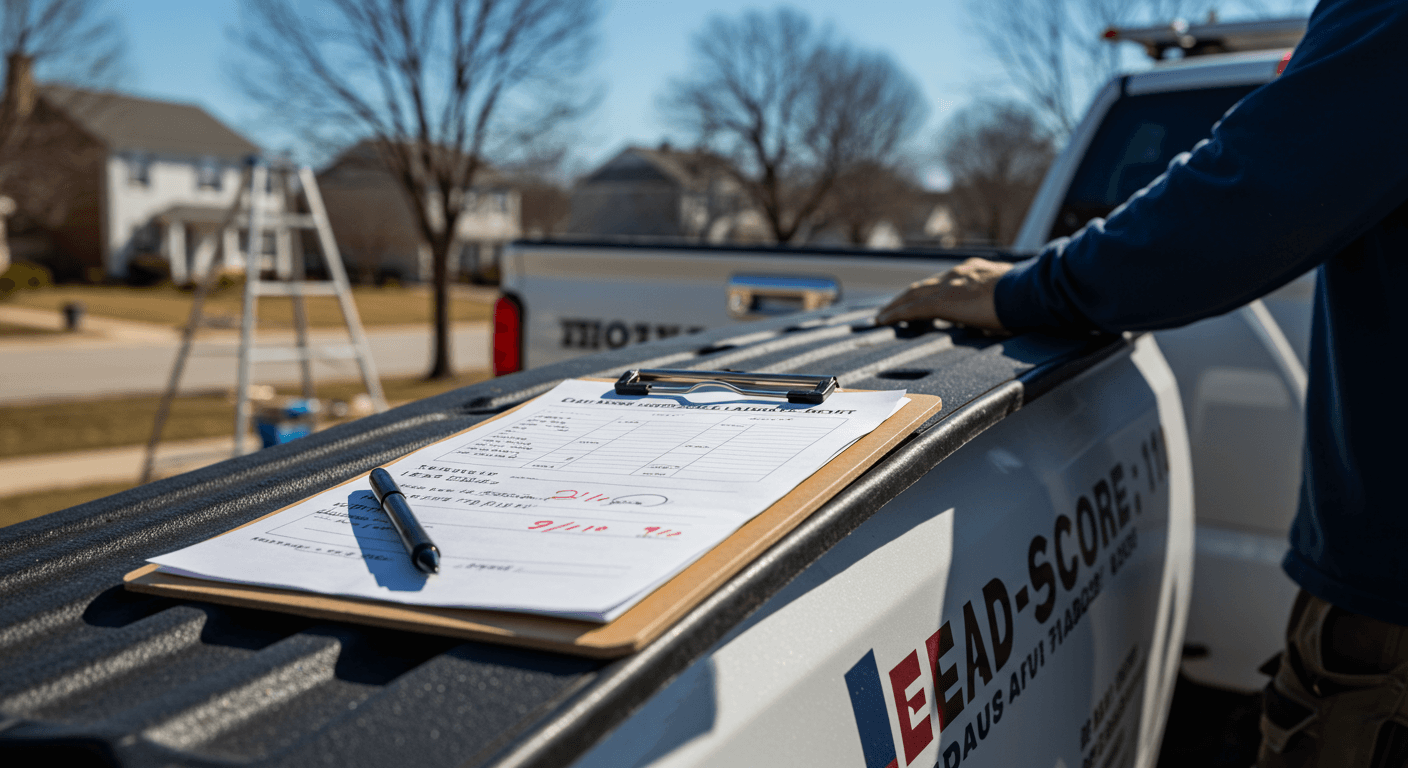
I spent last Tuesday at a shop near Worthington, sitting in on a post-storm debrief with a sales manager named Rafael. He showed me two different spreadsheets from their recent push in the Hilliard area. The first sheet was a "speed to lead" disaster: 47 raw inquiries from a generic Facebook ad campaign. The team had burned 21 hours calling them, resulting in exactly one signed contract for a $7,430 repair.
The second sheet was different. It contained only 12 leads, but each had been put through a basic scoring rubric before a rep ever saw them. From those 12, Rafael's top rep, a guy named Silas, booked 8 inspections and closed 3 full replacements totaling $44,820 in revenue. While the rest of the team was chasing homeowners who didn't even remember filling out a form, Silas was closing deals in New Albany because he knew exactly which doors were worth knocking on.
That 312% difference in per-lead revenue isn't luck. It's the result of treating lead quality as a data problem rather than a volume game.
At a Glance
Identify high-intent homeowners in the Columbus metro area before your sales team picks up the phone.
Reduce your cost per acquisition by 18.7% through rigorous lead qualification frameworks.
Implement a 10-point scoring system to prioritize roof replacements over minor repair inquiries.
Compare manual triage against automated verification to see which fits your current crew size.
The Cost of the "Every Lead is a Good Lead" Fallacy
Most Columbus roofing owners I coach are terrified of missing a call. They think that by casting a wide net across the 270 loop, they're maximizing their chances. In reality, they're just diluting their best reps' time. When your sales team spends 34% of their day talking to "tire kickers" or people looking for a $200 shingle patch, they lose the mental sharpness required to close a $22,000 architectural shingle job in Dublin.
According to the National Roofing Contractors Association (NRCA), operational drag is one of the primary reasons mid-sized roofing companies fail to scale. In our market, where competition is fierce and the weather is unpredictable, you can't afford to send a $100,000-a-year salesperson to an appointment that has a 5% chance of closing.
Developing Your Columbus Lead Scoring Rubric
To fix this, you need a scoring system that reflects the reality of the Franklin County market. I recommend a simple 1-10 scale based on four specific pillars. If a lead doesn't hit a "6" or higher, it doesn't go to your top closers. It stays in a nurture sequence or goes to a junior bird-dog.
1. Project Type and Scope
A full replacement on a 2,800-square-foot home in Westerville is a 10. A "leaky gutter" in a rental property is a 2. You need to know the intent before the dispatch.
2. Property Ownership and Data
Is the person on the phone the actual deed holder? I've seen reps drive all the way to Grove City only to find out they're talking to a tenant who has zero authority to sign a contract. Use the Franklin County Auditor's site to verify ownership instantly.
3. Roof Age and Material
A 19-year-old 3-tab roof after a Columbus hail spike is a goldmine. A 4-year-old metal roof is a waste of a drive unless there's catastrophic tree damage.
4. Financial Readiness
Are they asking about financing right away? In my experience, homeowners in areas like Clintonville who ask about monthly payments early are 22% more likely to sign on the first visit than those who say they "just want a ballpark figure."
Local Insight
"In high-competition zones like Upper Arlington, lead scoring must happen within 5 minutes. If you wait 2 hours to score a lead, they've already booked an inspection with the guy whose truck they saw down the street."
Comparing Your Qualification Options
How you actually implement this scoring depends on your current overhead. I've broken down the three most common paths I see contractors taking in the Midwest.
Lead Qualification Methods: Columbus Market
| Factor | Manual Office Triage | Verified Lead Previews |
|---|---|---|
| Response Time | 2-4 hours (manual triage) | Instant (automated preview) |
| Data Consistency | Varies by CSR skill | Standardized verification |
| Labor Cost | High (CSR time) | Minimal (automated) |
| Lead Waste | High (unqualified leads) | Zero (preview before purchase) |
| Rep Morale | Low (wasted drives) | High (quality appointments) |
Response Time
Data Consistency
Labor Cost
Lead Waste
Rep Morale
Manual triage is better than nothing, but it relies on an office manager or CSR who might not understand the nuances of a roof. I've seen shops where the CSR was so focused on being polite that they forgot to ask if the homeowner had insurance claim paperwork ready. This leads to what I call "The Inspection Gap"—where you have plenty of appointments but a closing rate that hovers around 14% because the leads were never actually qualified.
The more modern approach involves using a verified lead process where the heavy lifting is done for you. Instead of guessing if a lead in Reynoldsburg is worth the gas, you look at the data—roof age, verified homeowner status, and job type—before you ever spend a dime or a minute of your rep's time.
Strategy: The 48-Hour High-Intensity Filter
If you want to see an immediate jump in your numbers, try this framework I recently implemented with a crew in Delaware, Ohio. We called it the "High-Intensity Filter."
Action Plan
The Lead Priority Workflow
A systematic approach to filtering and prioritizing leads before they hit your sales team's schedule.
The Instant Scan: Within 60 seconds of a lead arriving, check the property age via public records.
The Intent Call: Use a 3-minute script focused on 'The Why.' Why now? Why us?
The Score Assignment: Apply your 1-10 score based on the four pillars.
The Tiered Dispatch: Scores 8-10 go to your 'A' closers. Scores 5-7 go to the newest reps for training. Scores below 5 are handled via automated email follow-up.
Last month, this specific shop saw their average contract value climb by $2,145 simply because their best closers stopped wasting time on junk. They weren't getting more leads; they were just getting the right leads to the right people.
Why "Verified" Beats "Volume" Every Time
I often hear owners complain that they "need more leads." After looking at their CRM, I usually find they have plenty of leads—they just have a 92% "junk rate." If you're buying 100 leads to get 8 jobs, you're not a roofer; you're a professional telemarketer.
By focusing on exclusive roofing leads, you eliminate the race to the bottom. In Columbus, the big players are spending $15,000+ a month on Google LSA. You can't outspend them, but you can out-prepare them. When Silas from our earlier example shows up to a house in New Albany, he already knows the roof is 22 years old and the owner is the sole decision-maker. That confidence is why his close rate is 47% while the guys chasing "shared" leads are struggling at 12%.
Research from Roofing Contractor Magazine shows that contractors who implement systematic lead scoring see an average 28.4% improvement in sales efficiency within the first quarter. The difference isn't in the volume of leads—it's in the quality of the conversations your reps are having.
Making the Math Work for Your Columbus Shop
Let's break down the real numbers. If you're currently spending $180 per lead and closing 8% of them, your cost per closed job is $2,250. But that doesn't account for the 21 hours Rafael's team wasted on the 46 leads that went nowhere.
When you switch to a scoring system and only pursue leads that score 6 or higher, your close rate jumps to 24%. Even if those leads cost $210 each, your cost per closed job drops to $875. That's a 61% reduction in acquisition cost, which directly hits your bottom line.
The key is having a system that lets you preview job details before committing resources. When you can see roof age, property ownership, and project scope before you buy the lead, you're not gambling—you're making an informed business decision.
Final Thoughts: Stop Measuring Volume, Start Measuring Value
If you're tired of seeing your sales team's morale drop every time a "hot lead" turns out to be a dead end, it's time to change the math. Stop measuring your success by the number of entries in your CRM and start measuring it by the quality of the conversations your reps are having.
The Columbus market rewards preparation. When your reps show up to an appointment knowing the roof age, the homeowner's name, and the specific damage, they close deals. When they show up blind, they waste gas and time. The choice is yours, but the data is clear: lead scoring isn't optional anymore—it's essential for survival in Franklin County.