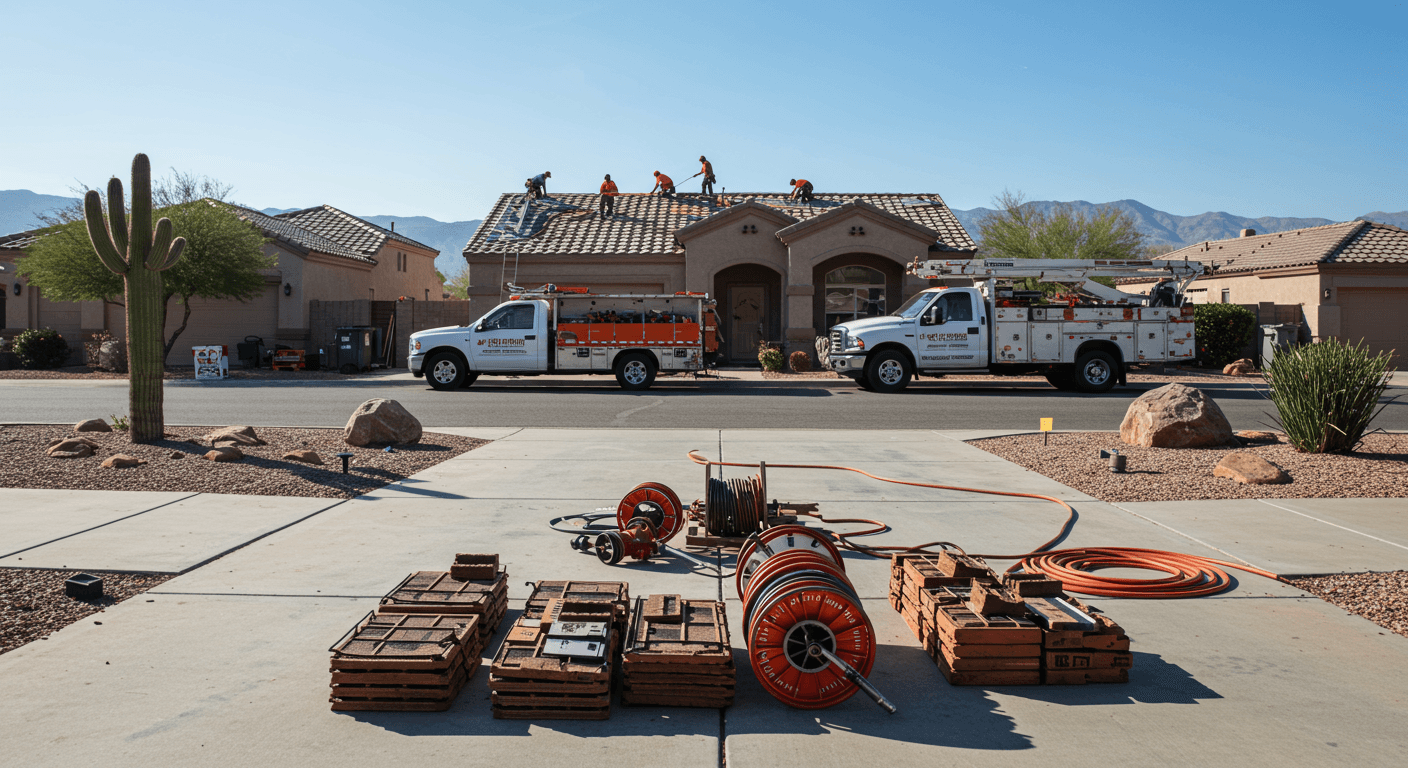
Jaxon squinted at a sun-bleached Xactimate printout on a tailgate in Scottsdale while his lead foreman waited on a ridge vent detail. The job was already three days behind, and about $1,432 in supplement opportunity was effectively invisible to the carrier because the first photo set missed steep-slope starter evidence. Most Southwest owners shrug at that kind of friction. For Jaxon, it was not a one-off annoyance. It was part of a pattern that was quietly chewing 14.3% of net margin and stacking about $9,430 a month in supplements that never made it into the file while the crew was still on site.
Table of Contents
What changed when the shop stopped chasing paper
Tight photo standards at intake recovered supplement leverage before tear-off, instead of after the evidence was gone.
Production scheduling stopped dancing to every big retail win, which cut idle payroll and yard time tied to unready jobs.
Verified, territory-fit demand gave reps room to finish packets instead of racing strangers to the next door.
A supplement desk with ownership of the thread pulled estimators out of archaeology work and back onto selling.
Moving from a crew that wings it to a crew that runs clean systems is less about hustle and more about plugging the leaks. In Arizona and New Mexico, monsoon spikes can fill a calendar fast. Without standards, that spike becomes a ceiling, not growth. The IBISWorld roofing contractors industry report keeps framing the same pressure many owners feel at the kitchen table: volatile demand, tight pricing, and a market where efficiency is often the real differentiator between a shop that scales and one that plateaus.
The anatomy of supplement chaos
When supplements live in someone's camera roll, the office inherits a guessing game.
When I first audited Jaxon's workflow, supplements were treated like a late-game rescue. A rep would shoot seven or eight usable-but-thin photos, then toss a folder to estimating that read more like vibes than evidence. By the time production found a custom drip edge profile or decking that was cooked past a repair, the adjuster leverage was already gone.
We clocked his estimators at about 9.4 hours a week rebuilding documentation for jobs that were already finished. That is basically a full sales day lost to admin archaeology. It also tracks with what you see across the broader roofing labor and admin picture, where field and office drift apart and overhead quietly balloons.
In unoptimized Southwest shops, incomplete documentation and slow supplement recovery often show up as a double hit: lost line items plus payroll burned on rework and chasing.
Do not start strip until the packet is real
If production can pull without a complete photo set, they will. Lock the handoff with a written rule and a dispatcher check. Otherwise you train the org to treat documentation as optional.
Shifting the burden to the intake phase
If the supplement story is not written before tear-off, you are negotiating from a weaker position.
The first change was blunt: a Photo Minimum Mandate. No tear-off until a 42-point photo checklist lived in the cloud with named angles for chimney flashing, valleys, intake and exhaust ventilation, and existing underlayment tells. It felt heavy on day one. It also moved the mess forward, where the evidence still exists.
Average claim value moved up about $1,847 per roof once the packet matched what production actually found. Adjusters are humans. They approve defensible line items faster when the proof arrives before the debris pile does.
The 15-minute field audit
"At the end of every inspection, spend 15 minutes hunting supplement triggers: non-code flashing, hidden felt layers, brittle starter, staged ponding. Log them before the contract is signed. Shops that do this see fewer price fights later because the file already tells the story."
Decoupling sales from production stress
A whale job should not erase the rest of the schedule without paying a real cost.
Jaxon had a habit of letting sales yank the board. When a big retail job landed, everything else wobbled. Materials sat in the yard, crews bounced across Phoenix, and the yard looked like a storage unit with a payroll problem.
We moved to production-first scheduling. A job earned a start date when materials were confirmed and the permit path was real, not optimistic. Mobilizations to sites that were not actually ready fell about 31.4%, which showed up as fewer paid hours spent standing down and fewer half-days burned on rework scheduling.
Better fuel for a disciplined machine
Chaos upstream makes discipline downstream almost impossible, no matter how good your checklist is.
Shared, wide-net leads were part of the problem. When six roofers chase the same small leak, reps skip nuance because nuance does not win the sprint. That behavior was actively fighting the documentation work we were trying to install.
We narrowed intake toward territory-locked opportunities with clearer verification signals. If you want the platform mechanics in plain language, LeadZik's feature set around alerts, territory locking, and scoring is built for exactly that kind of intake hygiene. The point is not volume for its own sake. The point is giving reps enough certainty to finish the packet.
Action Plan
The four-step operational discipline framework
Run these in order so you stop paying for supplements twice: once in lost line items, and again in payroll spent chasing ghosts.
Audit leakage: add up unsubmitted or under-supported supplements for the last 5.5 months and put a dollar on it.
Enforce photo standardization: tie pay and scheduling to a complete intake packet, not promises.
Centralize the supplement desk: pull the thread out of sales pockets and give it a single owner with templates and SLAs.
Stabilize lead intake: reduce shared-list sprinting so reps can execute the standard without feeling punished for thoroughness.
The Southwest territory advantage
Climate specifics turn into revenue when your packet can show why, not just what.
Markets like Albuquerque and Las Vegas punish generic pitches. UV aging, reflectivity, and underlayment choices are not vanity. They are survival details on a file. Jaxon started shipping simple Material Mix Reports with photos and manufacturer notes tied to local weather patterns.
Upgrade acceptance moved from about 12% to 29.5% because homeowners could see a system, not a sales script. That is also why LeadZik exists as a marketplace built for cleaner contractor demand. When your operation rewards proof, your marketing and intake should not constantly undercut it with random turf wars.
Comparing outcomes: chaos versus discipline
After 13 months, the delta was not vibes. It was tempo, cash, and owner hours.
Net profit lifted about $11,842 a month on average, but the bigger shift was operational tempo. Jaxon stopped living as the full-time chief solver and started acting like a CEO again, including looking at expansion north instead of fighting over small line items that should never have been controversial.
Chaos versus discipline: what moved
| Metric | Chaos model | Discipline model |
|---|---|---|
| Average days from lead to install | 34 days | 19 days |
| Supplement recovery rate | 41% | 93.4% |
| Crew downtime per month | 18 hours | 2.5 hours |
| Owner weekly hours | 65+ (high stress) | 42 (managed load) |
Average days from lead to install
Supplement recovery rate
Crew downtime per month
Owner weekly hours
Numbers reflect one disciplined Southwest shop after process, desk ownership, and intake changes. Your market mix will move the baseline.
Operational discipline is not a trophy you mount once. It is the daily decision to delay a start by 24 hours when staging is wrong, to say no to a job that fails your margin profile, and to treat the photo packet like part of the product. For Jaxon, that was the difference between a business that owned him and a business he could actually steer.