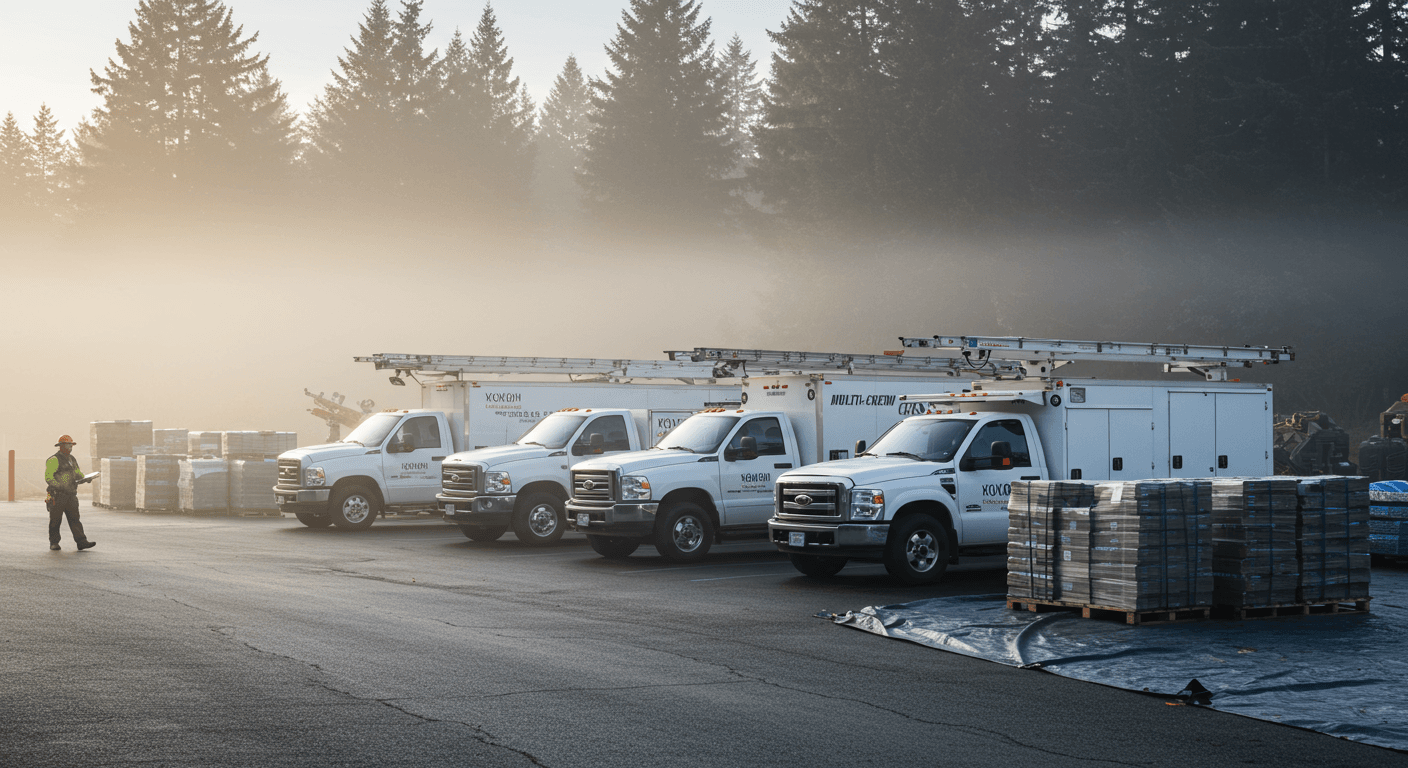
The fork is blunt. You either stay the person who lives in a tool belt and chases every supplement call, or you build something that still books work when you are not on a roof in Coburg. One lane often stalls near $618,000 in annual revenue. The other pushes toward a $3.4 million run rate when production, sales, and intake line up. In Eugene, 152 wet days a year compress the calendar, so the shops that hesitate on systems end up in the same scramble every time the forecast flips dry.
Moving past one steady crew is not a hiring problem first. It is a math and routing problem. Lane County owners who clear the jump usually reallocate overhead by about 22.4% and rebuild how demand enters the shop. I have spent 8.5 years watching Willamette Valley roofers leave the single van stage for three or four crews. The ones who win treat the company like a machine that turns verified intake into closed jobs, not like a bigger version of the same solo hustle.
Table of Contents
1. The revenue wall on owner-led sales
Many roofing owners in Lane County feel a hard ceiling near $743,000 in revenue. At that level you are probably running one crew while you still own estimates, material orders, and most supplement threads. If your average composite tear-off ticket in the Amazon neighborhood sits around $16,400 and net margin holds near 14.7%, there is simply not enough calendar left to babysit a second crew while you are also the only salesperson.
The break comes when you stop measuring profit only per job and start measuring output per crew week. Federal guidance on growing service businesses still frames it the same way: owners have to move from doing the work to managing the system. For roofers, that reads less like a title change and more like a real handoff of selling, scheduling, and standards. The SBA Grow Your Business guide is dry on purpose. It still names the shift from technical work to oversight, which is the same shift that makes a second crew financially possible.
Lane County shops that made the handoff held margin better because production calendars stayed full without the owner doubling as the primary closer.
Solo operator habits versus multi-crew requirements
| Operating layer | Single crew, owner at the center | Multi-crew, system at the center |
|---|---|---|
| Sales load | Owner runs most bids and follow-ups | Shared estimating paths with clear handoffs |
| Field decisions | Crew leads improvise details | Written standards by pitch, wind, and vent zone |
| Intake | Take every caller to get volume | Facts captured before anyone commits drive time |
| Owner calendar | Inspections and QC eat strategic hours | Photo checkpoints replace windshield audits |
Sales load
Field decisions
Intake
Owner calendar
2. Standardizing the Eugene material and detail stack
Eugene is not generic Pacific Northwest moisture on a brochure. You get steep slopes, long wet seasons, and homeowners who hear five different opinions about ventilation at the hardware store. A solo owner can adjust details job by job. Three crews spread across Springfield, Bethel, and Santa Clara cannot share one brain, so guesswork shows up as callbacks and margin leaks.
Standardization is margin protection. I have watched shops give up more than 6.2% of annual profit because each crew lead picked a different flashing sequence. You need a shop standard that is boring on purpose: named underlayment by pitch, nail patterns for exposed ridge lines, and vent math that beats minimum code when humidity stays high. Commentary on Harvard Business Review small business coverage still labels that operational excellence. On a roof, it means the same finished product no matter which crew opened the truck that morning.
Action Plan
Build a shop standard manual crews will actually use
Treat this like a production spec, not a policy binder that collects dust in the office.
List underlayment and ice barrier products by pitch bucket, including anything you want banned from the field.
Document nail spacing and cap sheet rules for wind-prone ridges south and west of town.
Write vent and bath fan exhaust math that exceeds one in three hundred where attic moisture is common.
Add photo requirements at dry-in, valley transitions, and penetrations so QC is visible, not tribal knowledge.
What changes when you add crews
Lane County revenue ceilings are often a sales capacity problem disguised as a labor problem.
Written install standards pay for themselves in fewer rework hours and cleaner supplements.
Scaling breaks when intake sends mixed-signal jobs to crews that need full replacement work to stay profitable.
3. Lead quality as a scaling lever, not a marketing flex
A new crew burns fast when the calendar is full of small patch asks and price shopping on roofs that really need a system replacement. When you were smaller, you could absorb a two hour visit that went nowhere. With multiple crews, those visits steal production hours that do not come back in a short season.
One Eugene shop I tracked was bleeding about four hundred eighty two dollars a day in labor opportunity cost because intake chased every damp-ceiling call without checking project intent. The fix was not louder ads. It was a tighter front door. A verified lead pipeline locks roof age, material type, and urgency before you commit a salesperson or a crew lead. That is how you keep multi-crew calendars weighted toward full replacements instead of random triage.
Volume is not a substitute for fit
Buying the cheapest lead bundles to keep new crews busy usually backfires. I have recorded double digit margin erosion when shops traded fit for raw count, then chased low margin work to cover overhead. Feeding crews matters, yet the feed has to match the work you actually make money on.
4. From estimator habits to executive time
I watched a contractor near the University District add a second crew while still insisting on every final walk himself. He was burning more than four hours a day driving between sites, which left no room for recruiting, banking relationships, or the larger tickets that keep multi-crew payroll sane.
Scaling asks you to trust documentation before you trust windshield time. Digital photos at tear-off, dry-in, and install milestones need to hit a shared thread the same day. If a crew lead cannot upload proof of ice and water shield in the right zones, you did not delegate QC. You duplicated it across more addresses.
Field note
"Pair your photo checklist with a single naming convention for files so estimators and PMs can find a valley detail without scrolling random camera rolls."
Once systems hold, owner time belongs on the front of the house again. If you need help matching territory and pacing to crew count, use the contact page so inbound work stays ahead of capacity without turning the week into chaos.
A multi-crew shop is hungry in a good way. It needs a steady rhythm of eighteen thousand to twenty five thousand dollar replacements, not a roller coaster of odd jobs that look busy on paper.
Scaling is less about brute hours and more about structure that carries load without you touching every shingle bundle. Standardize the Eugene details, tighten intake, and protect executive time. That is how you stay a roofer in skill and an owner in outcome.