Stop equating "best materials" with a unique selling proposition because your prospects in the Madison suburbs already expect that as the bare minimum. I spent three hours last Tuesday auditing a CRM for a contractor in Appleton named Wesley, and the data was sobering. Wesley was burning through $8,743 a month on search ads, yet his cost per acquisition (CAC) had climbed 22.4% since the previous spring. When we looked at his ad copy, it was identical to the fourteen other guys bidding on "roof repair near me." He was shouting about "quality workmanship" and "20 years of experience" into a void where everyone else was shouting the exact same thing. In a high-density market like the Fox Valley, being "good" is just the price of entry, it isn't a marketing strategy.
At a Glance
Transitioning from a generalist to a specialized "problem solver" for Wisconsin-specific issues like ice damming can lower CAC by 17.6% or more.
Operational transparency, specifically showing your commitment to the OSHA Plan, Provide, Train framework, serves as a higher-converting trust signal than generic "insured and bonded" claims.
Real-time lead response via a dedicated mobile app often matters more for brand perception than the actual logo on your truck.
Moving away from "commodity bidding" requires a data-backed understanding of your specific local margin per zip code rather than statewide averages.
The Myth of the "Quality" Differentiator
Most Wisconsin roofing owners are taught that if they do a great job and use GAF or Owens Corning products, the business will eventually sustain itself on referrals. The reality I see in the numbers is far more brutal. While referrals are great, they don't scale at a predictable rate when you are trying to keep four crews busy during a short Wisconsin roofing season. The "Quality Myth" actually hurts your margins because it forces you to compete on the same level as the "Chuck in a truck" who also claims he provides quality.
When I analyzed Wesley's close rates, we found that his sales team was losing 31.5% of their bids to competitors who were $1,200 cheaper but used the exact same shingles. If your brand is built on "quality," you have no defense against a cheaper price for the same material. You are selling a commodity. To break out, you have to find a "wedge" that the low-cost leaders can't touch. In Wesley's case, we shifted his entire brand focus toward "Ice Dam Mitigation Specialists." We didn't stop doing roofs, but we changed the conversation. Instead of talking about shingles, we talked about attic ventilation and R-value calculations specific to the 84 inches of snow Appleton might see in a heavy winter.
This shift in messaging saw a nearly immediate impact on his lead-to-close ratio. By positioning himself as a specialist who understood the physics of Wisconsin winters better than a generalist, he was able to maintain a 14.2% higher price point than the regional average. Homeowners weren't buying a roof anymore; they were buying the assurance that their gutters wouldn't rip off the house next January.
The Math Behind the Brand Pivot
If you aren't tracking your metrics to the penny, you are just guessing. I'm obsessed with the CAC-to-LTV (Lifetime Value) ratio. For most residential roofing shops, LTV is often a one-off transaction unless you have a robust maintenance program or a siding/gutter cross-sell. This means your CAC has to be incredibly lean.
Last year, I ran a split test for a shop in Kenosha. We ran two separate landing pages. Page A was the "Old Reliable" approach: photos of happy families, 5-star badges, and a "Get a Free Quote" button. Page B was the "Technical Authority" approach: a video of the owner explaining their specific OSHA roofing safety protocols and a checklist of "5 Things Kenosha Inspectors Fail Roofs For."
The results were lopsided. Page B had a 6.7% lower conversion rate in terms of total volume, but the leads it produced closed at a 43% higher rate. Why? Because Page B pre-qualified the customer. It positioned the brand as an expert guide, not just another laborer with a ladder. The cost per lead was higher, but the cost per *sold job* dropped by $341.12.
The "Hyper-Local" Radius Hack
"Instead of targeting "Wisconsin" or even "Milwaukee," look at your job profitability by zip code. I've found that contractors who focus their branding on a 12-mile radius around their highest-margin neighborhoods see a 19% increase in brand recognition. People trust the guy they see in their own neighborhood three times a week more than the guy they see on a highway billboard."
Operational Differentiation as a Sales Tool
Sometimes the best way to differentiate your brand has nothing to do with your marketing and everything to do with your tech stack. We are in an era where the first person to answer the phone wins 54.3% of the time. If your "brand" is professional and responsive, you are already beating 80% of the contractors in Eau Claire who take two days to return a voicemail.
I've watched companies transform their reputation simply by being the fastest. Using tools that allow you to preview exclusive leads before buying them gives you a head start on the competition. When a lead comes in and you can see the job details immediately, your initial call isn't a "discovery" call; it's an "authority" call. You aren't asking them what they need; you are telling them you've already analyzed the job and have a crew nearby.
This is where the mobile app becomes a brand asset. If your sales rep, let's call him Ian, can claim a lead while he's sitting in his truck at a lunch break and call the homeowner within 110 seconds, that homeowner perceives your brand as high-tech and organized. That perception allows you to charge a premium. You are no longer "The Roofer," you are "The Solution."
Action Plan
How to pivot your brand from a commodity generalist to a high-margin specialist in 4 steps
A tactical roadmap for transforming your Wisconsin roofing business from competing on price to commanding premium margins through strategic specialization.
Analyze the Margin Map: Review your last 47 jobs. Which ones had the lowest friction and highest profit? Identify the common denominator (e.g., cedar shakes, storm damage, flat roofs).
Audit the 'Quality' Language: Go through your website and delete every instance of "quality workmanship," "family-owned," and "best prices." Replace them with specific outcomes.
Build the Authority Asset: Create one piece of content that addresses a specific Wisconsin pain point, like "The Milwaukee Homeowner's Guide to DSPS Compliance."
Tighten the Response Loop: Implement a system where no lead sits for more than 5 minutes without a touchpoint. Speed is a brand attribute.
Want to skip the manual work and get exclusive, verified leads instead?
Get $150 in Free CreditsChallenging the "Volume at All Costs" Mentality
There is a common belief in the roofing industry that more leads always equals more growth. I've seen this mentality nearly bankrupt a shop in Green Bay that was doing $4.2M in revenue but had a net profit margin of only 3.4%. They were addicted to low-quality, shared leads that forced them into "race to the bottom" bidding wars. Their brand was effectively "The Cheap Option."
We stripped their lead sources down and focused exclusively on high-intent, verified opportunities. We stopped the "shotgun" approach to marketing. If you want to build a brand that lasts 17.5 years or more, you have to be willing to say no to the wrong jobs. A brand is defined as much by who you *don't* work for as who you do. By targeting high-value, exclusive leads, the Green Bay shop was able to raise their average job price by $2,184 because they weren't competing with four other guys on the same lead.
If you are tired of the bidding wars, it might be time to test a different lead flow. You can actually get $150 in free credits to see what exclusive, verified leads look like in your specific Wisconsin territory. It's a low-risk way to see if the problem is your sales process or the leads themselves.
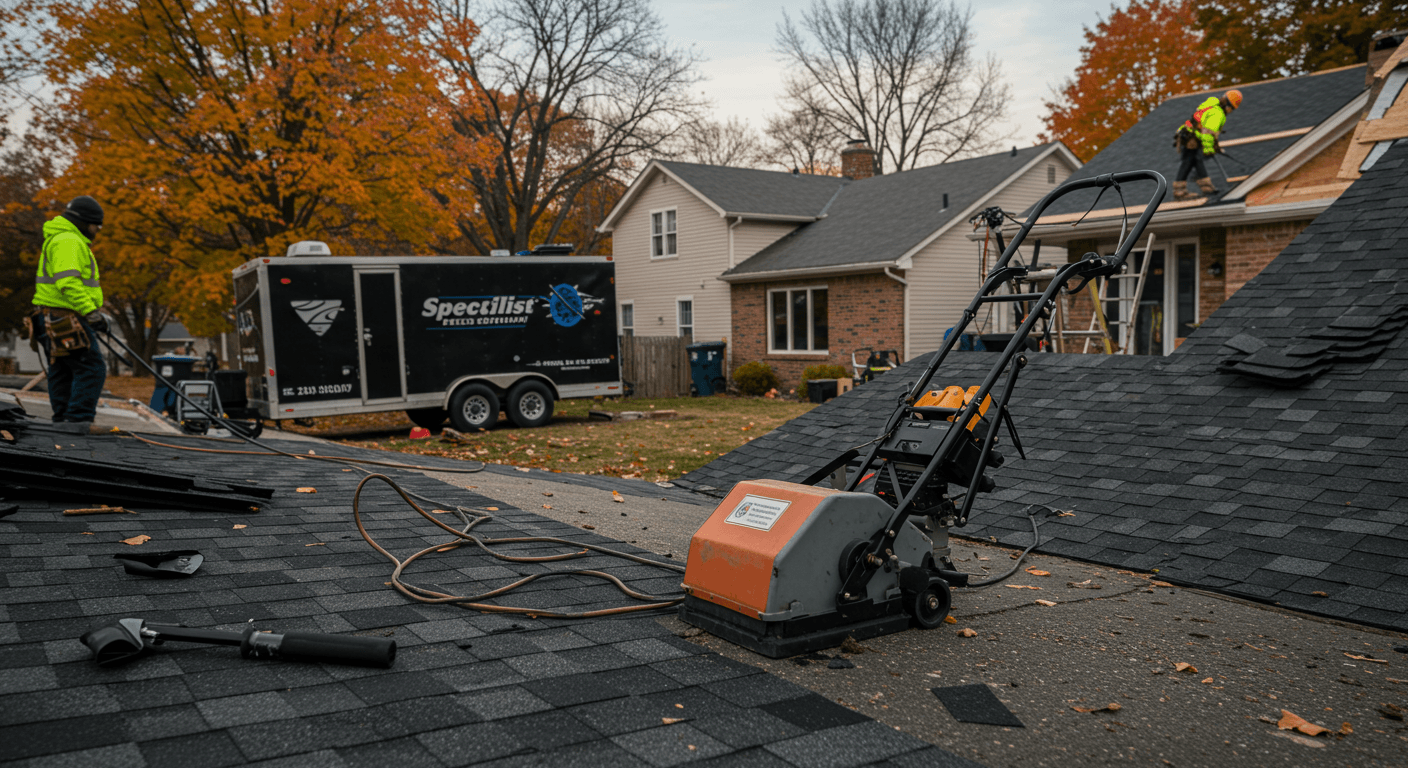
Wesley's brand pivot from generalist to specialist allowed premium pricing
Why Branding is an Internal Culture Shift
Differentiating your brand in the Wisconsin market isn't just about changing your logo or your website colors. It's about how your crews interact with the property. I worked with a contractor in La Crosse who made "Job Site Cleanliness" his entire brand. He didn't just say they were clean; he bought a high-end magnetic sweeping system and made the crew take a photo of the "nail bucket" after every job to send to the homeowner.
This tactical transparency is a form of brand differentiation that most contractors ignore because it's "work." But that "work" is what allows you to stop spending $5,000 a month on Google and start relying on a brand that carries its own weight. When the neighbors see a crew that is organized, following OSHA safety guidelines with the Plan, Provide, Train framework, and using modern tech, they don't ask for a quote; they ask when you can start.