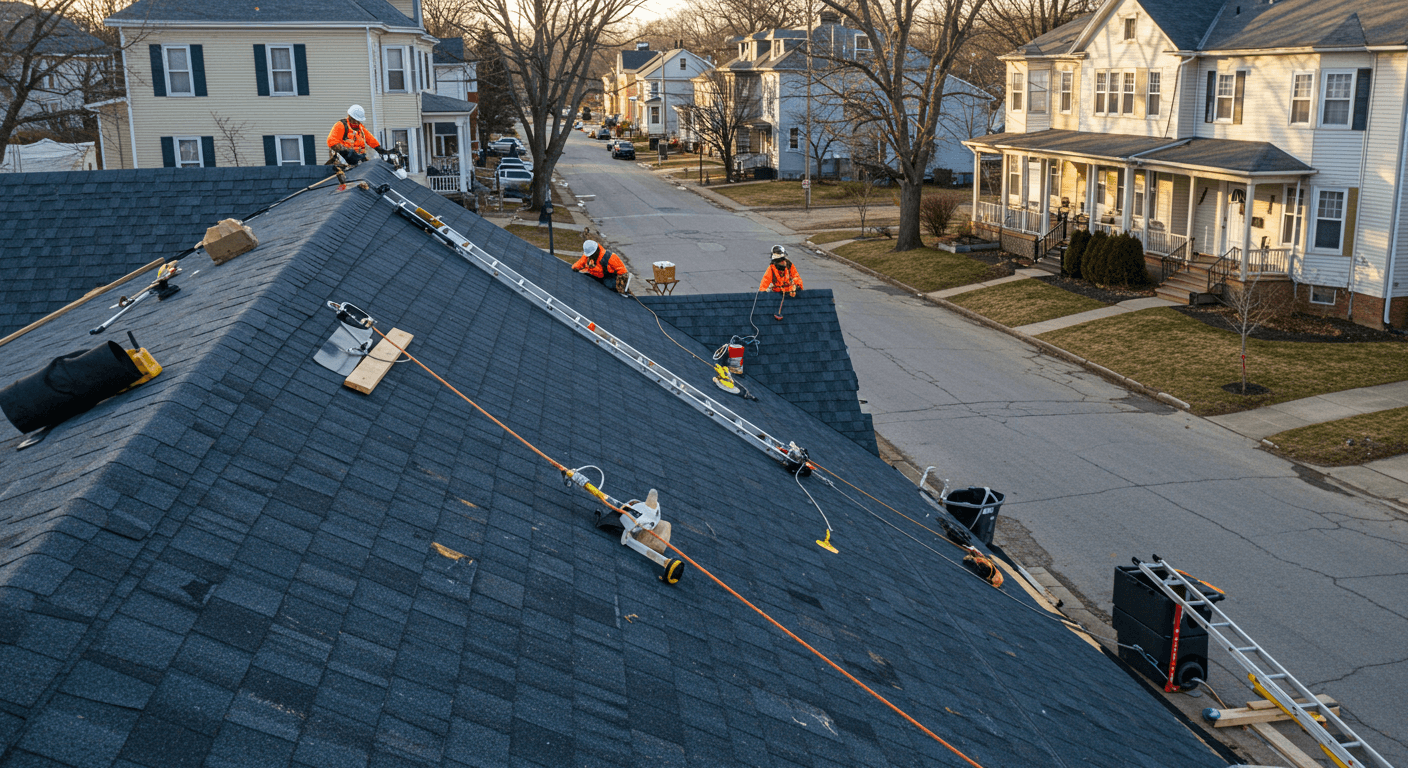
Safety gear is not a tax on productivity, yet a lot of owners in the 616 treat it like dead weight. You see the invoice for new fall protection kits or a $4,820 anchor update and you mentally convert it into squares you need to tear off just to feel whole again. That reflex is a big reason West Michigan shops stall under a revenue ceiling. Safety reads like compliance, so it never gets built into how the work actually flows.
Six months back I walked a job near Reeds Lake in East Grand Rapids with an owner I will call Wesley. His crew was on a steep Victorian, the kind of pitch that punishes small mistakes. A lead installer was tied off to a chimney that looked like it had not seen fresh mortar in decades. When I said something, Wesley shrugged and told me safety was slowing his crew and eating his margin.
We went to the numbers next. His fast crews were burning 19.4% more material than his one crew that actually followed the written plan, and callbacks for minor leaks ran 23.6% higher. Sloppy habits on the deck showed up as sloppy details at the eave. Safety, done with intent, is one of the cleaner signals you have for overall operational discipline.
Table of Contents
Turnover is expensive in roofing. When safety is predictable and fair, installers stick around long enough to get fast without getting reckless.
The myth of the "slow" secure crew
Tie-off does not kill pace. Bad layout and late anchors kill pace.
The story usually goes like this: ownership buys gear late, tosses harnesses at the crew, and never changes the sequence. Lifelines snag, anchors land in awkward spots, and everyone blames the harness for the lost minutes. Of course the job feels slower. Nothing was engineered.
What actually moves the needle is staged safety. One shop on 28th Street now sends the site lead out roughly 25 minutes early to set primary anchors before tear-off touches a ladder. By the time the crew steps on, the protection is part of the house, not a fight with it.
The BLS occupational outlook for roofers spells out how physically brutal the trade is. When someone feels unstable, the body braces before the mind decides to. A worker who trusts the arrest system often moves smoother on a 10/12 than someone free-climbing and spending half the day fighting balance. On an Ada project we timed shingle install and the secured crew was 14.7% quicker because they were not constantly wedging against the slope with their ankles doing all the work.
Afterthought safety versus staged safety
| Factor | Reactive setup | Staged system |
|---|---|---|
| Anchor timing | Crew waits on the roof while anchors get figured out | Lead sets primary anchors before tear-off starts |
| Lifeline routing | Lines cut across work paths and snag bundles | Routes planned for tear-off, install, and detail work |
| Crew perception | Gear feels like a penalty from the office | Gear reads as part of the production standard |
| Pace on steep work | Lots of micro-stops to rebalance and reposition | More continuous motion with real fall protection |
Anchor timing
Lifeline routing
Crew perception
Pace on steep work
Safety as a profit lever
Insurance premium control: pushing your EMR below 1.0 can take a mid-sized Grand Rapids shop into the mid five figures of annual workers comp savings.
Talent magnet: the installers you want for eight-plus years want a shop that does not gamble with their knees or their lives.
Liability gaps: time-stamped documentation beats a glovebox manual when MIOSHA or a carrier asks what happened that morning.
Higher precision: crews that respect written safety steps tend to respect written install details at valleys, penetrations, and ventilation.
MIOSHA reality in West Michigan
Local enforcement is not theoretical if you run crews in Kent County.
Grand Rapids is not just federal OSHA on a map. You are also under MIOSHA, and enforcement around Kent County has felt sharper over the last few years. I have seen a single no-harness situation open around $6,240 before the conversation even gets to systemic issues.
The OSHA Stop Falls campaign is a solid reference frame, but the failure mode I see locally is implementation. The manual lives in the truck, not in the pocket of the foreman who is actually on the ladder.
One Wyoming-area contractor was staring down a bad inspection outcome. We rebuilt the program around proof, not lectures. Before tear-off, the foreman grabs three photos: ladder setup, anchor points, crew tied off. Those shots land in job software immediately. Inspectors got what they needed on follow-up, and the same packet started helping on sales calls when homeowners asked why the bid sits above the two-guys-and-a-truck price.
The pencil-whipping trap
Do not let foremen sign safety checks at the end of the day for work that happened in the morning. If someone falls at 10:15 and your sheet says everything was fine at 4:30 yesterday, you have paperwork that hurts more than it helps. Use time-stamped photos or digital logs tied to clock-in.
Normalization of deviance
Small shortcuts train the whole company to accept bigger ones.
In operations work we call it normalization of deviance. The crew skips eye protection on tear-off, nothing bad happens, so the skip becomes normal. Next it is skipping harness rules on a 4/12, then a 6/12. Because nobody got hurt yet, the shortcut feels smart.
That is brutal for the balance sheet even before a fall. It erodes standards everywhere. If the safety manual is optional, drip edge and ice-and-water details start feeling optional too.
When you use a verified lead flow with locked previews, you see roof height, pitch, and obstacles before you burn fuel. That matters for safety planning in the estimate, not after the crew is committed. A Heritage Hill Victorian with tight access belongs in the bid as extra rigging time. If it is not in the bid, you push people to choose between safe and on schedule, which is a choice you never want on your crew.
Rebuilding the morning huddle
Turn ten minutes into a systems check instead of vague be careful talk.
Most huddles are weather grunts and a reminder to watch your step. If you want a real lift in field efficiency, treat the huddle like a preflight.
- Weather and grip: Grand Rapids mornings bring dew and fast lake-effect shifts. Call out what the deck feels like before anyone loads the first bundle.
- Equipment rotation: Inspect one class of gear per day. Monday ropes, Tuesday buckles, and so on. The crew stays sharp without a full gear audit every morning.
- Near-miss log: Reward reporting a slip that did not become a fall. That is how you retire a bad ladder or a worn boot before a $50,000 claim shows up.
Shops that put safety first on the agenda tend to run tighter trucks. I have tracked roughly 28.7% fewer wasted rolls when checklists and staging are part of the same habit loop as harness checks.
Photo routine
"Pair your three safety photos with the job address in the file name. When a homeowner or adjuster asks what makes your crew different, you can show the same packet you would hand a regulator."
The math of the MOD score
Your experience mod is a quiet line item until it is not.
Experience modification starts at 1.0. Claims push it toward 1.2 or 1.5. A clean run pulls it toward 0.85 or lower. On $350,000 of workers comp premium, 1.2 costs you $420,000 while 0.85 costs $297,500. That $122,500 gap is not abstract. At a 10% net margin you would need another $1.22 million in sales to create the same dollars in profit.
A serious safety system is less work than finding an extra million in revenue in a crowded Grand Rapids market. If you are juggling this kind of operational rebuild while the phone stays quiet, talking with someone about lead flow and scheduling can buy the space to install standards instead of chasing every marginal bid.
Step-by-step implementation
Roll changes in phases so the crew buys in instead of mutinying.
Action Plan
Staggered safety rollout
A four-phase path I use with Michigan contractors who need proof before they overhaul the culture.
Weeks 1 to 2, audit only. Watch lifelines, ladders, and staging. Take notes, skip the speeches, and build an honest picture of the as-is job.
Weeks 3 to 4, anchor standard. Pick one non-negotiable anchor approach, buy quality hardware, and demo the install until it is boring.
Weeks 5 to 6, documentation. Add the three-photo rule and make upload easy. No photo means no paid setup for that day.
Quarterly incentives. Route a slice of premium savings into a safety and quality pool for crews with zero violations and zero callbacks.
Want to skip the manual work and get exclusive, verified leads instead?
Get $150 in Free CreditsMoving from a get-it-done shop to a get-it-done-right shop is uncomfortable. It is also how you build something another owner can buy someday. Safety belongs in the same bucket as payroll and material orders: a system, not a mood.