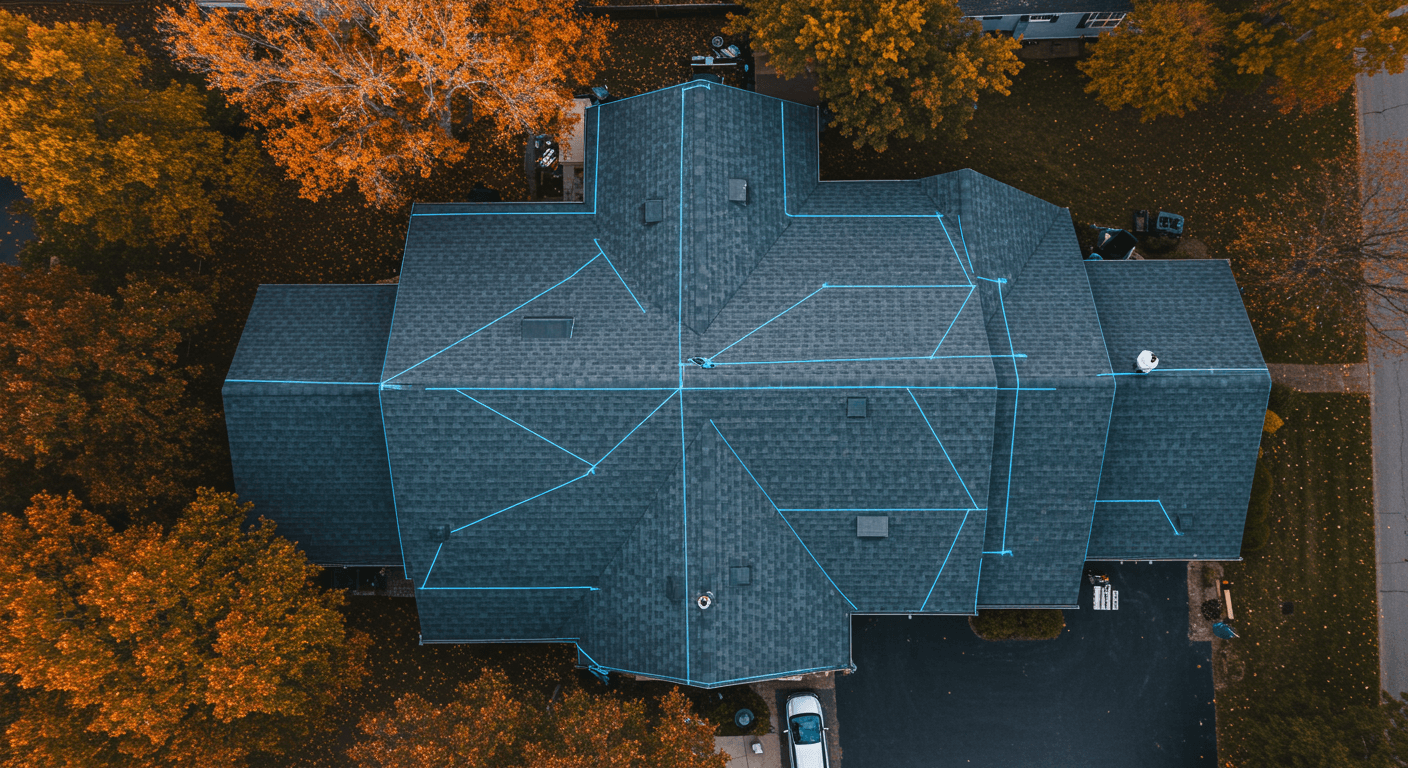
Roughly 19.4 hours per week vanish into the "estimating abyss" for the average mid-sized roofing company in the Midwest. I saw this firsthand last autumn in a cold warehouse just outside of Indianapolis. Xavier, a sharp owner with twelve years in the game, was hunched over a desk littered with chicken-scratch measurements and half-eaten sandwiches at 9:15 PM. He wasn't roofing, and he wasn't leading his team. He was doing manual math that a machine could have finished before his morning coffee was even poured.
Operational Gains from Automation
Reclaim approximately 14.7 hours of leadership time per week by removing manual measurement steps.
Reduce material waste by 7.4% through high-precision aerial data and automated waste-factor calculations.
Professionalize the sales presentation with instant, digital quotes that build homeowner trust faster than hand-written bids.
Stabilize overhead costs by allowing junior sales reps to produce expert-level estimates without senior oversight.
Watching Xavier struggle was a wake-up call. He was losing nearly three full workdays every month just to measurement discrepancies. In a region where the weather window can slam shut overnight, that kind of operational drag is more than just an inconvenience. It is a profit killer. When the first frost hits in places like Des Moines or Grand Rapids, you cannot afford to have your best people sitting in a truck with a calculator and a clipboard. You need them closing deals and moving crews.
Across a mid-sized Midwest shop, that time stacks up fast—often before a single shingle bundle hits the truck.
The Hidden Labor Cost of the Tape Measure
The math of manual estimating is grimmer than most owners realize. When you send a senior technician or a project manager out to walk a roof, you aren't just paying for their time. You are paying for the opportunity cost of what they could be doing instead. According to the Bureau of Labor Statistics (BLS), the mean hourly wage for roofers is $26.85, but for a skilled estimator or owner, that internal cost often doubles when you factor in taxes, insurance, and lost revenue potential.
If your senior lead is spending 45 minutes on a roof in Naperville measuring valleys and dormers, and another 30 minutes in the truck calculating squares, you've burned nearly $75 in labor before you've even sent a quote. Do that five times a week, and you are looking at $19,500 a year in "estimation overhead" per person. That is a massive leak in your bucket. Automated tools change this dynamic by shifting the heavy lifting to software.
In the Midwest, we also deal with "steep-slope fatigue." Sending a crew member up a 10/12 pitch in humid July weather just to get a measurement is a safety risk that doesn't need to exist anymore. Automation keeps your boots on the ground and your data in the cloud. This shift allows your team to focus on the verified leads that actually move the needle for your quarterly goals.
Why Accuracy Trumps Speed in the Midwest Market
I recently audited a shop in Columbus that was struggling with a 6.7% margin erosion. When we looked at the data, the culprit wasn't labor or fuel; it was "estimated vs. actual" material usage. The manual measurements were consistently off by just a few squares. In some cases, they over-ordered, leading to piles of shingles sitting in the warehouse taking up space. In other cases, they under-ordered, which meant a crew of six was sitting idle on a job site while a runner drove to the supply house.
Automated estimation tools use high-resolution aerial imagery and AI-driven CAD (Computer-Aided Design) to calculate every facet, ridge, and hip with a precision that a tape measure cannot match. When you have a digital twin of the roof, the software automatically applies your specific waste factors. This level of detail is what separates the companies that scale from the ones that just survive.
The 3% Buffer Rule
"Even with automated tools, always cross-reference your digital measurements with a quick ground-level photo. If the software flags a complex transition, a 3% manual buffer is safer than a generic 10% waste factor, which often hides deep inefficiencies in your ordering process."
Case Study: The Xavier Transformation
From overnight spreadsheets to same-day digital quotes—without sending salespeople up ladders first.
Let's go back to Xavier in Indianapolis. He decided to stop being the bottleneck. We implemented a system where every incoming inquiry was run through an automated measurement tool before a salesperson ever left the office.
The results were immediate. His speed to lead increased because he could send a preliminary estimate via text while his competitor was still looking for a ladder. By utilizing a mobile app to manage these digital bids, his sales team was able to visit 38% more properties per week. They weren't measuring; they were selling.
Xavier's material waste dropped by 8.2% in the first four months. More importantly, his stress levels cratered. He stopped being the "Math Guy" and started being the "CEO." He began using the extra 15 hours a week to refine his crew training, which led to a 12% increase in job site efficiency.
How to Roll Out Automation Without Breaking Your Workflow
Many owners fear that technology will complicate their lives. They think they need to be a computer whiz to make it work. The reality is that modern estimation software is designed for the field, not the office. Here is the framework I use when helping Midwest shops transition:
Action Plan
Midwest-Ready Automation Rollout
A practical sequence that keeps crews selling, keeps data clean, and avoids a Big Bang go-live that paralyzes the office.
Select a tool with aerial integration: prioritize platforms that pull high-resolution satellite or drone data instead of forcing you to trace every line by hand.
Standardize your price list: lock per-square labor and material costs in once so every report rolls up to a consistent total.
Train the front end first: office staff pulls the first-pass measurements so reps arrive with numbers, diagrams, and talk tracks ready.
Lead with the golden quote presentation: use labeled diagrams to show homeowners exactly why you are recommending a shingle or ventilation upgrade.
Manual vs. Automated Estimating
| Factor | Manual measurement | Automated measurement |
|---|---|---|
| Time per estimate | Often 60–90 minutes | Roughly 5–10 minutes |
| Typical error band | About 5–10% human variance | Often 1–2% with aerial + CAD |
| Safety exposure | More ladder and steep-slope time | Ground-based capture where possible |
| Data in your systems | Paper, re-keying, and spreadsheet drift | Instant digital sync into CRM and sales tools |
Time per estimate
Typical error band
Safety exposure
Data in your systems
Scaling for Future Growth
The Occupational Outlook Handbook projects about 6% job growth for roofers through 2034. That means competition for labor will only get tighter. If you want to attract the best talent, you can't ask them to work with outdated, slow processes. The best sales reps want to work for shops that give them the tools to win.
Automation isn't just about saving time; it is about creating a scalable engine. When your estimating process is standardized and digital, you can hire a new sales rep on Monday and have them sending accurate quotes by Friday. You've removed the expertise barrier that usually takes years to build.
If you find that your current systems are still holding you back, it might be time to look at how your lead intake is handled. If you are ready to stop chasing bad data and start focusing on growth, you can always reach out to our support team to discuss how to better manage your verified opportunities.