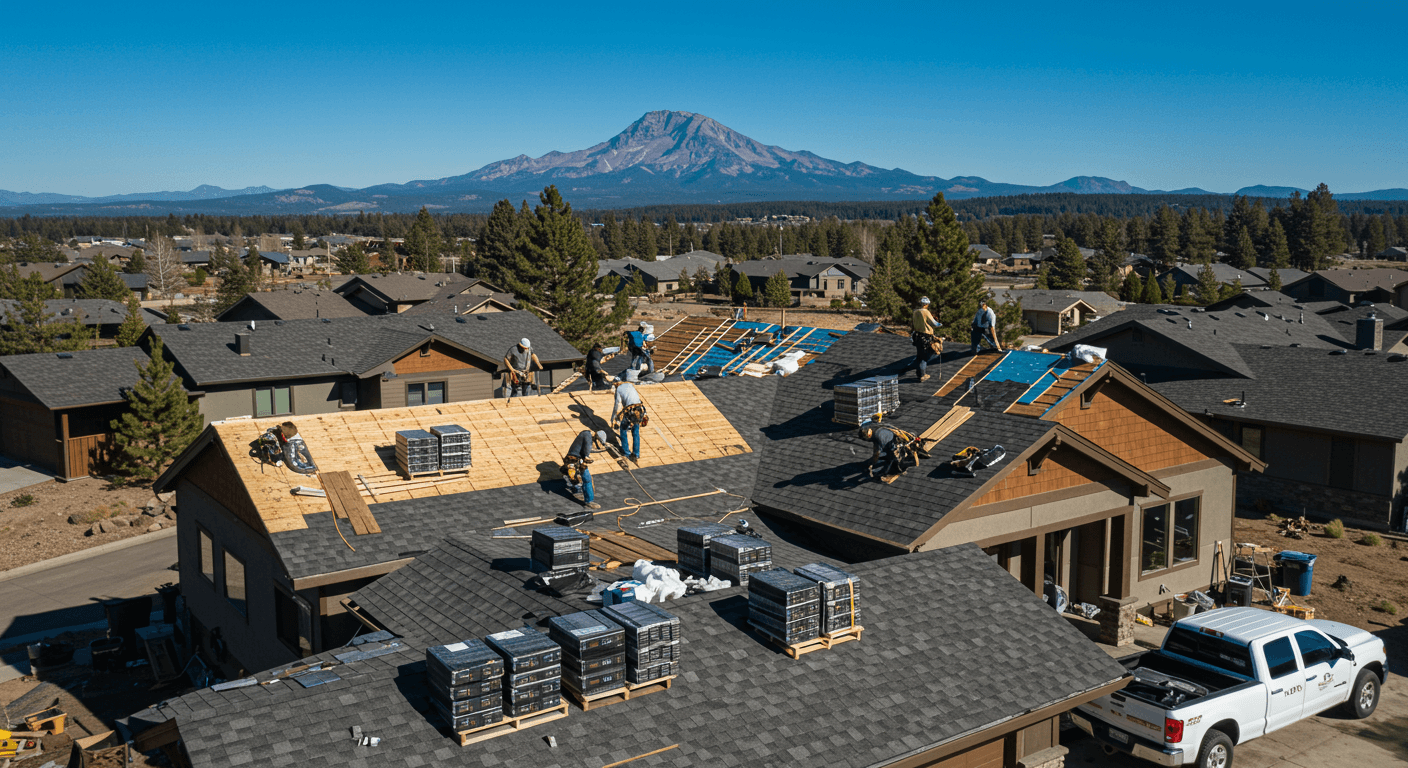
Reviewing a heat map of search rankings in the cab of a dually near the Old Mill District, Jaxon looked like he'd just seen a ghost. We were looking at a visualization of his shop's visibility for "roof repair Bend" and "new roof installation." On his own street near 3rd Street, he was number one. But just 4.2 miles away in Northwest Crossing, his business was invisible, buried on page four of Google. He was paying $184 per lead for Google LSA ads while his organic presence was failing to capture the massive influx of homeowners moving into the Tetherow area.
This is the proximity paradox that kills growth for roofing companies in Deschutes County. You think because your shop is physically located in Bend, you should naturally own the market. Reality is far more surgical. Local SEO is not about a single setting or a one-time optimization. It is a tactical battle for the "Map Pack" that determines whether your crew stays busy during the shoulder seasons or sits idle while a competitor from Redmond poaches your backyard.
At a Glance
Local SEO can reduce customer acquisition costs (CAC) by up to 38% compared to heavy reliance on paid search.
Google Business Profile (GBP) signals account for roughly 32% of your ranking weight in the local 3-pack.
Hyper-local content focusing on regional issues like ice damming or snow loads builds superior authority over generic national brands.
Review velocity and response time are now critical ranking factors that mirror real-world customer service.
The Economics of the Local 3-Pack
When a homeowner in Sunriver searches for a roofing contractor, they aren't scrolling past the map. Data from actual campaigns I have managed shows that the top three spots in the map pack capture nearly 47.3% of all clicks. For a roofing business owner, this is the difference between a self-sustaining lead machine and a business that lives and dies by the next $5,000 ad spend.
I recently analyzed a client's 18-month growth trajectory where we shifted focus from broad keywords to hyper-local "neighborhood" optimization. We saw their cost per lead drop from $212 to a sustainable $74. The reason is simple. When you rank organically, the trust factor is higher. Homeowners view the top organic results as vetted authorities, whereas they view the "Sponsored" tags with a degree of skepticism.
According to the National Roofing Contractors Association (NRCA), local reputation remains the primary driver for high-ticket residential contracts. If your digital footprint doesn't reflect that local authority, you are fighting an uphill battle.
Auditing Your Google Business Profile for Central Oregon
Most contractors treat their Google Business Profile like a digital yellow pages listing. They set it, forget it, and wonder why the phone stops ringing. To dominate Bend, you need to treat your GBP as a live feed of your operations.
I once worked with a shop that had 4.8-star ratings but hadn't posted a photo in 13 months. We started uploading "Work in Progress" shots of metal roof installations in Brasada Ranch and shingle replacements in Larkspur. Within 65 days, their "Discovery" searches (people finding them by category rather than name) spiked by 28.7%.
Google's algorithm rewards activity. If you are out on a job site, take a photo of the tear-off. Take a photo of the finished ridge cap. Uploading these with local metadata tells Google that you are an active, boots-on-the-ground operator in the 97701, 97702, and 97703 zip codes. If your team isn't equipped to handle these updates on the fly, using a mobile app to manage your lead flow and business presence becomes a necessity rather than a luxury.
The Geotagging Edge
"Before uploading job site photos to your Google Business Profile, ensure your crew has location services turned on. Google reads the EXIF data (metadata) of the image. A photo taken and uploaded directly from a job site in Sisters or Tumalo provides a stronger "location signal" than a stock photo uploaded from your office."
Localized Content: Beyond "Roofing 101"
Stop writing blog posts about "How to choose a shingle." Every roofer in the country has that content. If you want to rank in Bend, you need to write about things that actually happen here.
Talk about how the heavy snow loads in the Cascades impact gutter brackets. Write about why the high UV exposure in Central Oregon's high desert climate causes premature granular loss on certain asphalt shingles. This type of content does two things. First, it signals to Google that you are a local expert. Second, it builds immediate trust with the homeowner. They see that you understand the specific environmental stressors their home faces.
Roofing Contractor Magazine frequently highlights that specialized knowledge is what allows local firms to compete with national franchises. By focusing on regional specificities, you create a "content moat" that is very difficult for an out-of-state SEO agency to replicate for a competitor.
Action Plan
A Tactical 90-Day Roadmap to Increase Local Search Visibility
A tactical 90-day roadmap to increase local search visibility and lead quality.
The GBP Cleanup: Claim all variations of your business name, verify your primary phone number, and ensure your address matches exactly across the web (NAP consistency).
Neighborhood Landing Pages: Create dedicated pages on your site for 'Roofing Services in Redmond,' 'Sisters Roof Repair,' and 'Sunriver New Roofs.'
Review Velocity Program: Implement a system where crews ask for a Google review before leaving the driveway, aiming for at least 3-5 new reviews per week.
Local Backlink Building: Sponsor a local high school sports team or contribute to a Central Oregon building trade blog to earn high-authority '.org' or local '.com' links.
Conversion Optimization: Audit your mobile site speed. If your site takes longer than 2.8 seconds to load on a 4G connection, you are losing 19% of your traffic.
Want to skip the manual work and get exclusive, verified leads instead?
Get $150 in Free CreditsThe Review Velocity Trap
Many owners think that having 100 reviews is enough. It isn't. Google prioritizes "review velocity"—the frequency and recency of your feedback. If your last review was from four months ago, the algorithm assumes your business might be stagnating.
I watched a company in the Aubrey Butte area lose its top spot to a much smaller outfit simply because the smaller shop was generating 8 reviews a month while the leader was coasting on old glory. You need a consistent stream of fresh, detailed reviews. Encourage your customers to mention the specific service and the neighborhood. A review that says, "Great job on our metal roof in Broken Top!" is worth five reviews that just say, "Good work."
When these leads do start coming in from your SEO efforts, the quality can vary. This is why we focus so heavily on ensuring that the homeowners you talk to are actually ready to sign. Our verification process filters out the tire-kickers so your sales team isn't wasting time on "just looking" inquiries.
The P.O. Box Kiss of Death
Never use a P.O. Box or a virtual office (like a Regus suite) as your primary business address on Google. Google's anti-spam filters are aggressive. Using a non-physical location can result in an immediate suspension of your profile, which can take 14-21 days to resolve, costing you thousands in lost lead opportunities.
Technical SEO: The "Behind the Scenes" Work
While the "front end" of SEO is photos and reviews, the "back end" is what allows Google to index your site efficiently. For a roofing company, this means Schema Markup.
LocalBusiness Schema is a snippet of code that tells search engines exactly who you are, what you do, and where you do it. It's like giving Google a business card in its own language. I have seen sites implement proper ServiceArea Schema and see an immediate 14% lift in impressions within 19 days. It's a technical task, but the ROI is undeniable because it removes any ambiguity about your service boundaries.
If you are struggling to keep up with the technical demands of your digital presence, don't hesitate to reach out to a professional who understands the roofing vertical specifically. You can contact our team if you need guidance on how to align your lead generation strategy with your organic growth goals.
Measuring What Matters: ROI vs. Ego Metrics
Ranking #1 for a keyword is an "ego metric" if it doesn't result in a signed contract. As a Lead Generation Expert, I track "Cost Per Signed Contract" above all else.
If your SEO agency is sending you reports about "keyword improvements" but your crews aren't on roofs, the strategy is failing. You need to track the source of every call. Use unique tracking numbers for your GBP and your organic site.
In one recent audit, we found that a client was getting 62% of their organic leads from a "Service Area" page they didn't even know was ranking. We doubled down on that page's content, added a clearer CTA, and increased that page's conversion rate from 3.2% to 7.1% in a single month. That is tactical SEO that impacts the bottom line.