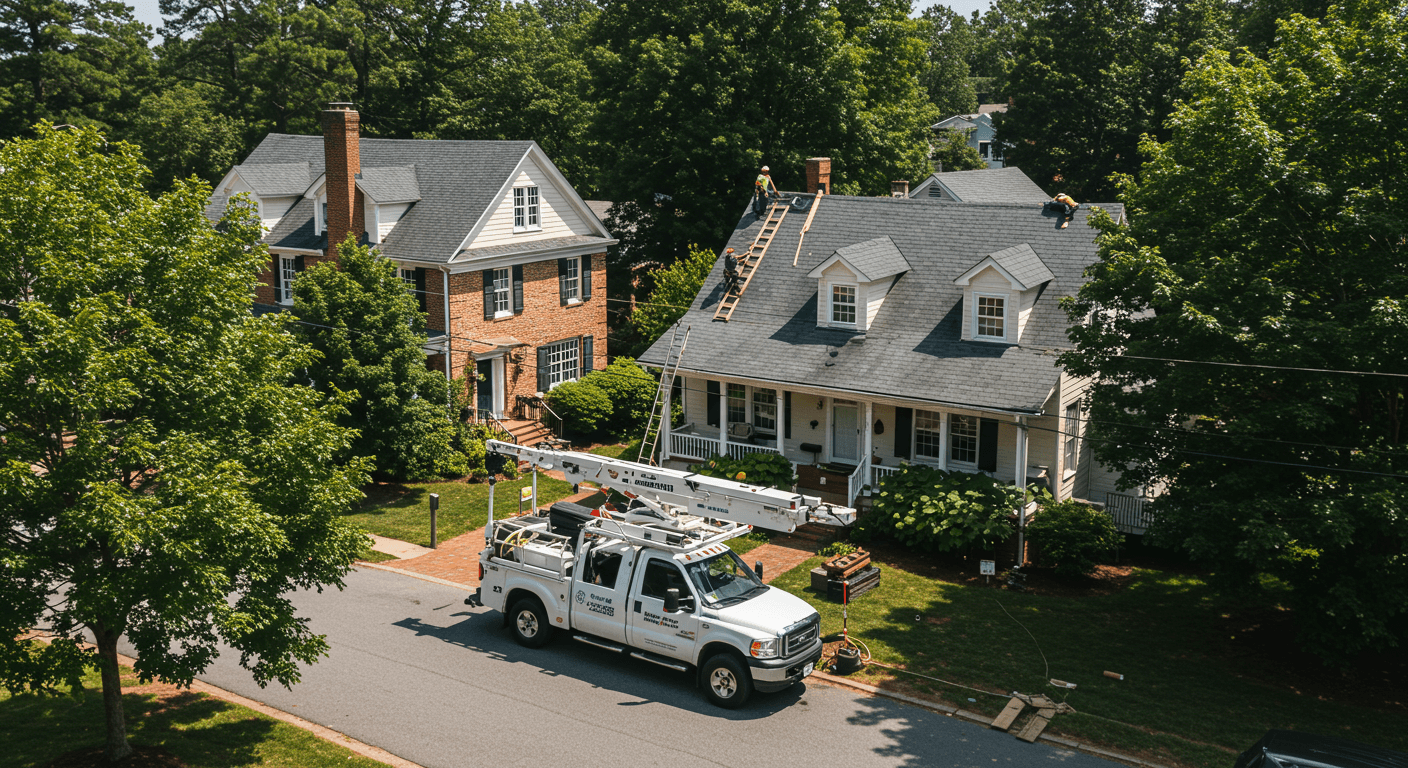
Before we overhauled the digital spend for a mid-sized outfit near the Brightleaf District, they were shelling out $192.40 per lead for shared, bottom-of-the-barrel inquiries that rarely closed. Today, that same team, led by a sharp owner named Wyatt, is pulling in high-intent homeowners for $64.15 apiece by shifting their focus from volume to verified intent. This transformation did not happen because of a bigger budget. It happened because we stopped treating every lead like a lottery ticket and started treating our marketing spend like a precise construction estimate.
In the Durham market, where competition from both national franchises and local "storm chasers" is fierce, maintaining a healthy Cost Per Lead (CPL) is the difference between scaling your crew or laying off your best foreman. I spent three days last month looking at the books of a shop in Southpoint, and the data was staggering. They were losing 24.7% of their potential profit simply by chasing leads that had already been sold to six other contractors. When we tightened their geographic targeting to specific zip codes like 27707 and 27713, their conversion rates climbed while their waste plummeted.
At a Glance
Focus on Intent over Volume: High CPL is often a symptom of broad, unvetted traffic rather than high market prices.
Geographic Precision: In Durham, targeting specific historic districts versus new developments changes the lead profile and cost structure.
Verification is Profit: Moving from shared leads to exclusive, verified opportunities can reduce your total Customer Acquisition Cost (CAC) by 38.2% even if the initial CPL is higher.
Speed-to-Lead Metrics: Reducing response time from 45 minutes to 4.2 minutes can effectively double your lead-to-appointment ratio.
The Durham Market: Why Your CPL is Different Here
The Research Triangle Park (RTP) influence creates a unique demographic for roofing contractors. You are dealing with highly educated homeowners who do their research. They aren't just looking for a "roofing guy," they are looking for technical expertise. According to Construction Dive, the industry is seeing a massive shift toward specialized materials and sustainability, and Durham is at the forefront of this trend.
When you run ads or buy leads in a place like North Durham compared to a rapidly developing area like East Durham, your CPL will fluctuate based on the neighborhood's home value and the age of the housing stock. I recently analyzed a campaign where the CPL for minor repairs in Trinity Park was 19% higher than for full replacements in the newer subdivisions near Brier Creek. If you aren't segmenting your lead sources by these micro-markets, you are likely overpaying for low-margin work.
The roofing industry statistics from ConsumerAffairs highlight a $56B market, and a significant portion of that growth is concentrated in high-migration areas like the Triangle. However, that growth brings noise. To optimize your CPL, you have to cut through the noise of "free estimate" hunters who have no intention of signing a contract this season.
The "Cheap Lead" Trap
Many Durham contractors fall for the $25 lead scam. These are almost always shared with 5 to 10 other companies. If you pay $25 but only close 1 in 20 because you're in a race to the bottom on price, your actual cost to acquire that customer is $500 in lead fees alone, not counting your sales team's time. A $110 exclusive, verified lead with a 1 in 4 close rate results in a $440 acquisition cost and a much higher profit margin.
The Math of Lead Waste in the Triangle
I often tell owners that if you can't tell me your CPL by lead source to the penny, you don't have a marketing plan, you have a gambling habit. Let's look at a real scenario I saw with a contractor named Elara who operates near Duke Park. She was running a Google Ads campaign that looked "successful" on the surface: $4,230 spent, 48 leads generated, resulting in a $88.12 CPL.
When we looked closer, 19 of those leads were for gutter cleanings (which she doesn't do) and 7 were outside her service area in Chapel Hill. Her "True CPL" for viable roofing jobs was actually $192.27. By refining her negative keyword list and tightening her radius to 12.5 miles around downtown Durham, we cut her waste by 41.6% in less than three weeks.
If your current lead flow isn't keeping your crews busy with high-margin replacements, you might be overlooking how many "trash" leads are inflating your metrics. You can see how other contractors are solving this by reading more on our blog.
Durham contractors lose significant profit margins when competing for shared leads instead of focusing on exclusive opportunities.
Conversion Rate Optimization (CRO) for Contractors
Optimization isn't just about the top of the funnel. It is about what happens once the lead hits your CRM. I've watched shops in the Research Triangle lose thousands because their intake person takes 2.5 hours to call a fresh lead back. In that time, the homeowner has already clicked on three other ads and booked two inspections.
Speed-to-lead data shows that if you call within 5 minutes, your chances of qualifying the lead are 21 times higher than if you wait 30 minutes. We implemented a simple automated SMS follow-up for a crew in Hope Valley, and their appointment set rate jumped from 32.8% to 54.1% without spending an extra dime on marketing. This effectively slashed their CPL in half because they were making twice as much out of the same bucket of leads.
The Speed Premium
"In Durham's competitive market, the first contractor to respond often wins. Set up automated alerts that ping your phone the moment a new lead comes in, and make it a non-negotiable rule that every lead gets a call within 5 minutes during business hours."
A 90-Day Roadmap to Reducing Your CPL
Reducing your cost per lead isn't about cutting corners—it's about cutting waste. Here's a systematic approach that has worked for multiple Durham contractors over the past year.
Action Plan
A 90-Day Roadmap to Reducing Your CPL
A tactical plan to reduce cost per lead and increase lead quality in the Durham metro area through systematic optimization.
Phase 1: The 14-Day Audit - Analyze Lead Sources: Export your last 90 days of leads from Jobber or AccuLynx. Calculate Source ROI: Don't just look at CPL, look at the revenue generated per lead source. Identify the 'Dead Zones': Mark zip codes or job types that consistently fail to close.
Phase 2: Refinement (Days 15-45) - Tighten Targeting: Adjust your digital spend to focus on high-intent neighborhoods like Forest Hills or American Village. Implement Lead Vetting: Use a service that provides locked previews or verification to ensure the homeowner is actually ready to buy. Update Your Intake Script: Ensure your team is asking qualifying questions (e.g., "Is this an insurance claim?" or "How old is the current roof?") immediately.
Phase 3: Scaling and Automation (Days 46-90) - Automate Follow-ups: Set up instant SMS and email responses for every new inquiry. Reinvest Savings: Take the money saved from eliminated waste and put it into exclusive lead channels. Monthly Metric Review: Hold a 20-minute meeting every four weeks to review CPL and adjust for seasonal shifts in the Durham market.
Want to skip the manual work and get exclusive, verified leads instead?
Get $150 in Free CreditsWhy Intent Verification Changes the Game
The biggest leak in most roofing budgets is the "curiosity seeker." These are people who saw a Facebook ad and clicked it because they were bored. They aren't ready for a $14,832 roof replacement; they just want to know if their leak is a "big deal."
When you use a platform like LeadZik, you are dealing with verified intent. We provide exclusive, verified leads with locked previews, so you know exactly what you are buying before you spend a cent. This is a massive shift from the traditional model where you buy a "lead" that might just be a wrong number or a renter. If you have questions about how our refund policy works for the occasional bad data point, our faq covers the specifics.
I recently worked with a Durham-based project manager who switched from a broad-market aggregator to verified leads. His "raw" CPL went up from $45 to $115, but his sales team's closing ratio went from 8.2% to 29.6%. His cost to acquire a customer dropped significantly, and his sales reps were much happier because they weren't driving to dead-end appointments in Creedmoor or Mebane.
Shared Leads vs. Verified Exclusive Leads
| Metric | Shared Leads | Verified Exclusive |
|---|---|---|
| Average CPL | $45 | $115 |
| Closing Rate | 8.2% | 29.6% |
| Cost Per Acquisition | $549 | $388 |
| Sales Team Satisfaction | Low (dead-end appointments) | High (qualified opportunities) |
Average CPL
Closing Rate
Cost Per Acquisition
Sales Team Satisfaction
Leveraging Local Nuances for Better ROI
Durham is a city of neighborhoods. The strategies that work for a bungalow in Old West Durham won't necessarily translate to a colonial in Woodcroft. Optimization requires understanding these nuances. For instance, historic district regulations in Durham can complicate roof replacements. If you are a specialist in slate or specific metal roofing required by local architectural boards, your CPL for those high-margin leads will be naturally higher, but your profit per job can be 3 to 4 times the city average.
By positioning your marketing to speak directly to these local pain points, your CPL actually becomes a secondary metric. The primary metric becomes your net profit per lead. If you are struggling to bridge that gap, you can always reach out to our support team at contact for a direct line on how to better align your lead acquisition with your specific crew capabilities.
The data backs up what I've seen in the field: contractors who obsess over lead quality rather than lead quantity are the ones who survive the off-season. In Durham, where the weather can swing from humid summers to unexpected ice storms, having a predictable, optimized lead pipeline is the only way to maintain consistent cash flow.
Durham contractors who shift from volume-based to intent-focused lead acquisition see significant cost reductions.