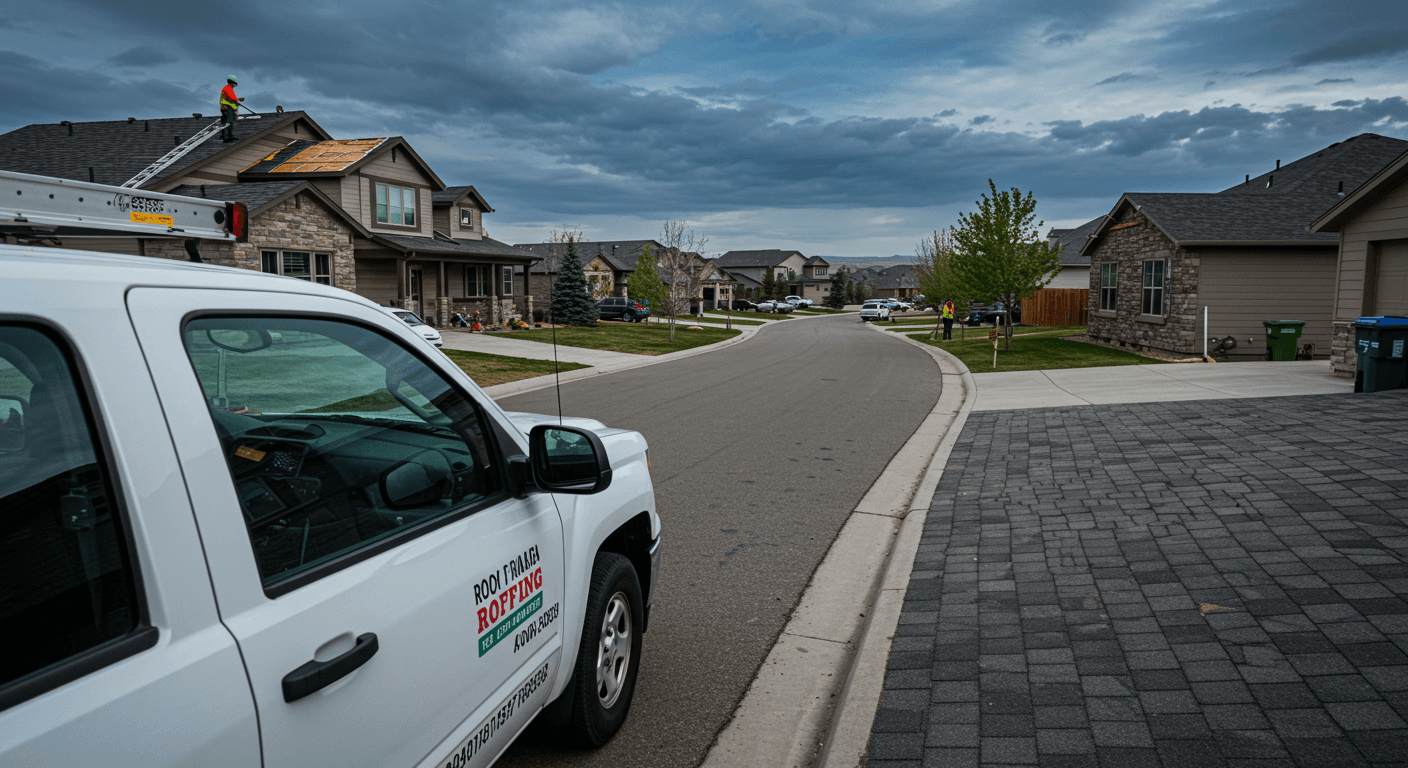
Elena was staring at a digital hail map on her tablet, tracing the path where a cell dropped 1.25-inch stones across the Northside Boulevard corridor yesterday afternoon. She wasn't celebrating the influx of calls. Instead, she was trying to figure out why her three best estimators were currently stuck in traffic near the Karcher Interchange, heading toward "leads" that hadn't even been qualified for insurance coverage. Her phone was buzzing every 9 seconds, but her production schedule for the next month looked like a disorganized mess of low-margin repairs and tire-kickers.
I've seen this exact scenario play out in Nampa shops more times than I can count. When the wind picks up across Canyon County, contractors tend to flip into a reactive mode that eats their profit alive. They throw bodies at every ringing phone, burning fuel and man-hours on jobs that don't actually move the needle.
At a Glance
Shift from reactive chasing to data-driven territory targeting to save 14.3% in fuel and labor costs
Implement a mandatory 6-point intake script to filter out non-insured 'lookers' before dispatching estimators
Use localized weather data to prioritize high-margin replacement opportunities over small-scale repairs
Maintain a verified lead pipeline to keep crews running at 94% capacity during the post-storm lag
The High Cost of the "Nampa Shuffle"
In the Treasure Valley, storm damage is a double-edged sword. On one hand, you have a concentrated volume of work. On the other, you have a massive spike in Customer Acquisition Cost (CAC) because every "trunk and a ladder" outfit from three states away descends on the region.
Last year, I worked with a mid-sized firm in Nampa that was pulling in $1.1M in storm revenue but barely seeing a 9% net profit. When we looked at the data, the leak was obvious. They were spending $462 on average just to get an estimator to a front door. Between the Nampa-Caldwell traffic, the time spent on "damage" that was actually just old age, and the follow-up calls for uncommitted homeowners, they were bleeding cash before the first shingle was ever pulled.
Unqualified leads consume valuable estimator time and fuel costs without generating revenue.
The reality is that storm leads are only valuable if they are filtered. If you're sending a $60,000-a-year employee to look at a roof that just needs a $400 flashing fix, you're losing money. You have to treat your estimators' time like the finite, high-value resource it is.
Building a Systematic Intake Filter
To stop the bleed, you need a workflow that prioritizes high-probability jobs. According to the National Roofing Contractors Association (NRCA), operational efficiency in high-demand periods is the primary differentiator between firms that scale and those that plateau. In Nampa, this means knowing the difference between a homeowner in a 20-year-old subdivision near Lake Lowell and a new build that likely has a high deductible and impact-resistant shingles.
I helped a local shop implement a "Storm Intake Matrix." Instead of just taking a name and number, their office staff started asking three specific questions:
- "Have you already filed a claim, and do you have the adjuster's summary?"
- "What is the approximate age of your roof? (Pre-2010 or post-2010)"
- "Are you looking for an immediate repair or a full replacement estimate for your insurance company?"
This simple shift allowed them to categorize leads into "Immediate Dispatch," "Desktop Review," and "Low Priority." They stopped wasting time on the "Low Priority" 30-minute drives to the outskirts of town for minor leaks.
Action Plan
The 4-Step Storm Lead Optimization
A systematic approach to filtering and closing high-value storm damage leads in the Nampa market.
Data Mapping: Overlay hail swaths with neighborhood age data to identify the highest probability for full replacements.
Tiered Intake: Use a 6-point qualification script to separate insurance-ready homeowners from general inquiries.
Route Optimization: Group site visits by ZIP code (83651, 83686, 83687) to reduce tech 'windshield time' by 22% or more.
Verified Lead Acquisition: Supplement organic leads with third-party verified sources to fill gaps in the production schedule.
Want to skip the manual work and get exclusive, verified leads instead?
Get $150 in Free CreditsThe "Zip Code Strategy" for Canyon County
Nampa is unique because of its rapid growth and varying building codes between the city and the surrounding county. If your crew is bouncing between a steep-slope Victorian near downtown Nampa and a sprawling ranch-style home out toward Melba, your setup and teardown times are going to vary wildly.
I've found that the most profitable shops during storm season are those that "cluster" their work. If you can get five roofs on one street in the Dallan subdivision, your overhead drops significantly. When the weather turns, the speed of your intake determines your margin, which is why I recommend accessing exclusive roofing leads that allow for upfront previews to avoid wasting your estimators' time on outliers.
Storm Response Strategy Comparison
| Factor | Reactive Approach | Systematic Approach |
|---|---|---|
| Lead Qualification | Chasing every storm call as it comes in, regardless of location or lead quality. | Targeting specific 'hail swaths' and using verified data to pre-qualify job size and insurance status. |
| Estimator Efficiency | Driving 30+ minutes between scattered job sites across Canyon County. | Clustering visits by ZIP code to reduce windshield time by 22%. |
| Close Rate | 12% average close rate on unqualified storm leads. | 21% close rate on verified leads with insurance claims in progress. |
Lead Qualification
Estimator Efficiency
Close Rate
Managing the "Post-Storm Slump"
There is a psychological trap in roofing where a big storm makes owners feel "fat and happy." They stop marketing because the phones are ringing. Then, four months later, the claims have all been processed, the easy fruit has been picked, and the crews are sitting idle.
Data from NOAA's Storm Prediction Center shows that while weather events are unpredictable, the "tail" of a storm—the period where work is actually performed—can last for 6.5 to 13.2 months depending on contractor capacity in the region. To avoid the slump, you need a consistent pipeline of leads that aren't just dependent on the last hail hit. According to research from Roofing Contractor Magazine, contractors who maintain diversified lead sources during peak seasons see 23% higher revenue stability year-over-year.
Reliability in your data pipeline is the only way to scale, and I've noticed that shops using a multi-point verification system tend to close at a rate 14.7% higher than those chasing raw canvassing lists. This is because they aren't fighting ten other contractors for the same "free estimate" seeker.
Nampa Permitting Hack
"Canyon County and City of Nampa have different turnaround times for roof permits. During storm peaks, designate one admin specifically to permit tracking to avoid 'dry runs' where a crew shows up but the paperwork isn't cleared."
Calculating the True ROI of a Storm Lead
Let's talk numbers. If a typical storm lead costs you $185 but has a 12% closing rate, your cost per acquisition is $1,541. If you can move that closing rate to 21% by only buying or chasing "verified" leads with insurance claims already in progress, your acquisition cost drops to $880. That's an extra $661 in profit per job that goes straight to your bottom line, not to an ad agency or a gas station.
In a recent study of Nampa-area roofing operations, we found that contractors who shifted to a "Verification First" model saw their crew utilization rates jump from 74% to 89% within the first 4.5 months. They weren't necessarily doing more jobs; they were doing better jobs with less downtime. This aligns with broader industry trends documented by Construction Dive, which reports that operational efficiency improvements can increase profit margins by 15-20% in competitive markets.
Conclusion: From Storm Chaser to Market Leader
Managing a roofing business in Nampa requires more than just knowing how to swing a hammer or price a square. It requires an obsession with operational waste. Whether it's the $9,342 you're losing annually to inefficient routing or the 18.3% of leads that never should have been booked, every inefficiency is a direct hit to your ability to grow.
By systemizing your storm response—filtering your intake, clustering your jobs, and using verified data—you stop being a "storm chaser" and start being a market leader. The difference between chaos and control comes down to having the right systems in place before the next cell rolls through the Treasure Valley.
Ready to transform your storm response? Start with $150 in free lead credits and see how verified, exclusive leads can change your operational efficiency.