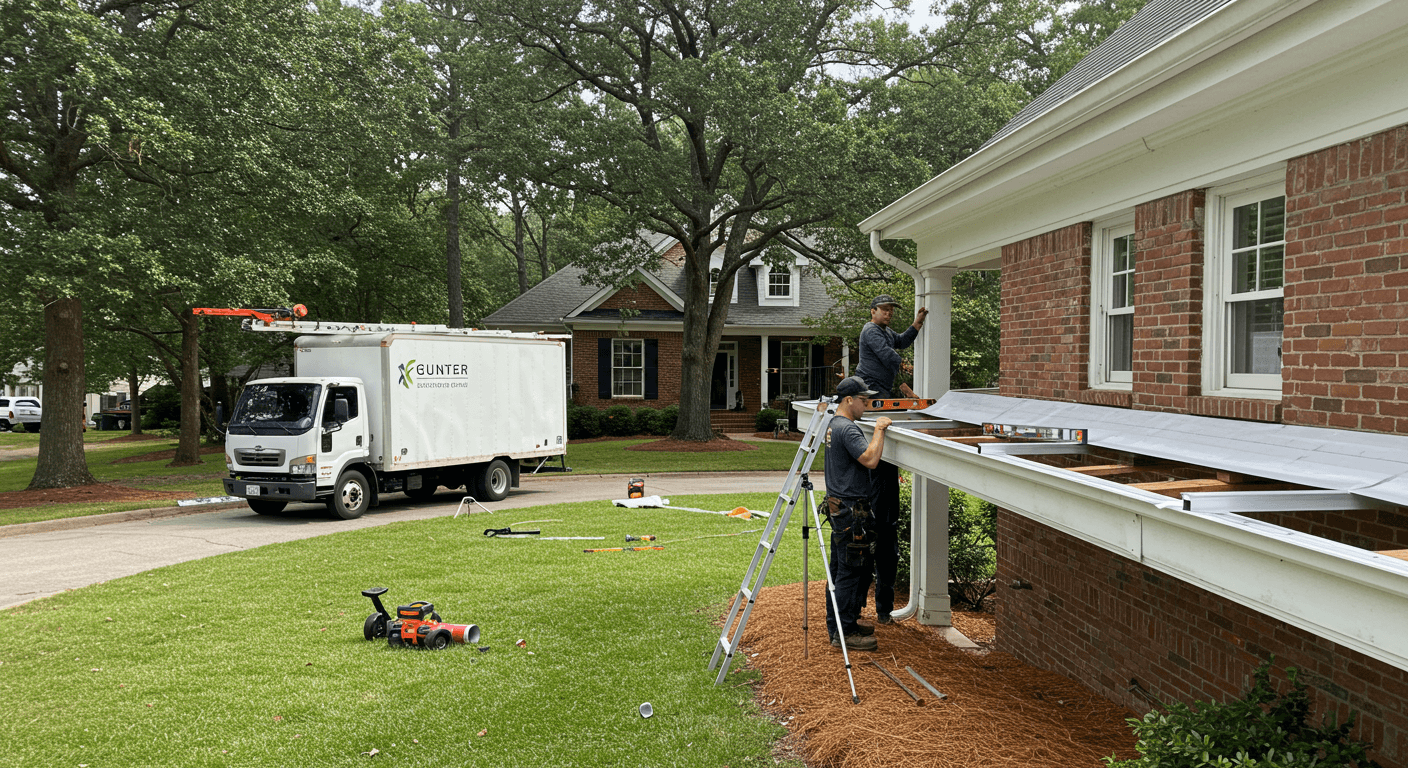
Jaxon was wiping sweat from his forehead in a driveway off Abercorn Street, watching his lead installer manhandle a 40 foot run of aluminum up the wall. It looked impressive, a seamless stretch of 6 inch K-style flying up in record time. When I looked at the fascia through my binoculars, the drip edge was not even engaging the gutter, and the wood behind it was already soft. That kind of miss is how you book about $1,248 in unbilled warranty work without noticing until the phone starts ringing.
Contrast that with a crew I watched in Marietta a few weeks earlier. They burned roughly 14 minutes more per side checking rafter tails and shimming brackets until the pitch read true on a sagging roofline. They were not racing footage. They were protecting the bottom line. Most Southeast owners still talk in feet per hour, but in a belt that sees 50 plus inches of rain a year, one soaked soffit wipes out whatever you saved by shaving ten minutes. Margin does not shrink politely. It leaves.
In humid, storm heavy Georgia, Florida, and the Carolinas, your install protocol is a financial lever. If you run a hang it and bang it shop, you are probably funding hidden costs in fuel, labor, and reputation. The shift is simple on paper: speed first becomes system first.
Warranty eats what production metrics never show on the whiteboard.
The fascia foundation: where profit bleeds out
Humidity turns small misses into expensive repairs faster than most P&Ls admit.
Southeast crews fight moisture that makes minor oversights look like structural failures inside 18 months. I still see owners skip the prep phase because the day's footage target is breathing down their neck. That is backward math.
If you hang 6 inch gutters on fascia holding 12% moisture or higher, those screws will back out. It is not if, it is when. I audited a Charleston shop seeing a 19% failure rate on heavy hangers. Crews were not checking for ghost rot, wood that reads fine under paint but handles like sponge.
Mandatory ice pick probing or a moisture meter at every corner and downspout location cut their callback rate 64% in one season. Time cost was small, about six minutes a job. Fuel, labor, and reputation savings were not. Builder guidance on drainage and green infrastructure barriers keeps pointing at the same truth: if the mounting surface fails, the gutter fails, no matter how clean the run looks from the street.
Operational pillars for gutter margins
Run a mandatory fascia integrity check with moisture meters so screw-out failures do not surprise you in year two.
Standardize 1/8 inch pitch for every 10 feet so flash-flood rain has somewhere to go.
Move crew incentives from total feet installed toward zero-callback bonuses so speed and profit stop fighting.
Require a photo of drip edge engagement before the ladder leaves the wall.
Pitching for profit: beyond the level
August storms do not grade on a curve.
Production meetings love to argue string line versus 4 foot level. In the Southeast, when three inches of rain lands in twenty minutes, close enough is a liability. Pitch that misses by even 1/16 inch over a long run leaves standing water. Here, standing water means silt, mosquitoes, and eventual sag.
Kira, an owner I worked with, kept getting clogged gutter calls on brand-new installs. The pitch read fine for a drizzle, not for Georgia thunderstorm hydraulics. We steepened pitch on runs over 35 feet and made 3x4 downspouts standard, not an upsell. Peak loads stopped hammering the hangers, and the overflow calls that ate her Fridays slowed down. EPA guidance on managing stormwater runoff frames gutters as part of a system, not a static trough. Treat the line like a high-speed conduit and the math gets honest in a hurry.
Installation mindset versus margin protection
| Field choice | Speed-first habit | Margin-first system |
|---|---|---|
| Daily target | Chase footage quotas | Chase zero-defect closes |
| Fascia prep | Visual pass, keep moving | Moisture and rot testing at risk points |
| Downspouts | Default 2x3 outlets | Standard 3x4 high-flow outlets |
| QC proof | Verbal check from the ground | Photo checklist signed off in the app |
| Callback load | Often 12% or higher | Shops below 2% when the system sticks |
Daily target
Fascia prep
Downspouts
QC proof
Callback load
None of this requires you to move slower forever. It requires you to front-load the minutes that prevent unpaid returns.
Operationalizing QC without killing momentum
Process beats you standing in every driveway.
You cannot babysit every crew. Scaling a gutter company in this climate means Jaxon follows the same checklist whether you are on site or across town. I push a Closing Photo Pack: the lead cannot clock out until four shots hit your system.
Action Plan
Closing Photo Pack (non-negotiable)
A lightweight close-out sequence that creates a dated record if a homeowner claims failure six months later.
High point of the run showing drip edge engagement.
Low point showing the outlet and sealant work.
Level or string line proof of aggressive pitch.
Splash block or underground tie-in as specified on the work order.
That trail has ended disputes in the $500 to $900 range because the install met spec at completion. When you are ready to tighten how you scale crews and paperwork, that same data shows which teams need coaching and which ones are quietly carrying margin.
Shops with documented, low-callback processes also look sharper in an exit conversation. Buyers pay for predictability, not heroic field fixes.
The bucket test
"Instead of waiting on the next storm, dump a 2 gallon bucket through the high end of each new run. It takes under a minute and surfaces most pitch mistakes before the ladder is strapped down."
Managing Southeast overflow risk
Small outlets become big truck rolls.
2x3 downspouts in heavy rain markets
Northern installs often get away with 2x3 outlets. In the Southeast they bottleneck during peak events, which reads like a leak to the homeowner and sends your crew back for a free look that was never in the bid.
I have parsed costs for dozens of shops. The sneaky pattern is a return trip for gutters that did not leak, they just dumped more water than the outlet could move. When you can preview roof complexity before you price the job, you can spec 3x4 from the bid instead of apologizing after the first frog-strangler afternoon.
Larger outlets are cheap insurance. Material delta is usually under $42 a house versus a $215 service call later in the season when torque from backed-up water starts warping runs and stressing fasteners.
Why material selection is a margin game
Thin coil is a hidden tax in wind and heat.
When aluminum spikes, cheap .027 coil tempts every buyer. In high wind, high debris Southeast work, it is a margin trap. I standard on .032 for pro-grade installs.
Thicker stock resists oil-canning when a South Carolina July is cooking the truck. On long pulls it kinks less. One ruined 50 foot run is roughly $135 in coil plus an hour you cannot bill. The upgrade pays for itself in fewer scrap pulls and calmer crew handling.
Common Questions
The bottom line on gutter margins
Efficiency is what you keep after the storm passes.
Real efficiency is not how fast the machine runs. It is how much revenue survives once the weather tests your work. Slow the prep, spec high-flow outlets, and let photo QC do the arguing for you. The process becomes boring in a good way.
Jaxon's crew eventually saw that an extra 15 minutes on the wall beat four hours of Saturday rework. When the field team feels that trade, your job as the owner gets lighter. Build for the climate you actually have, not the pace you wish you had. The next rainy season will show it on the balance sheet.