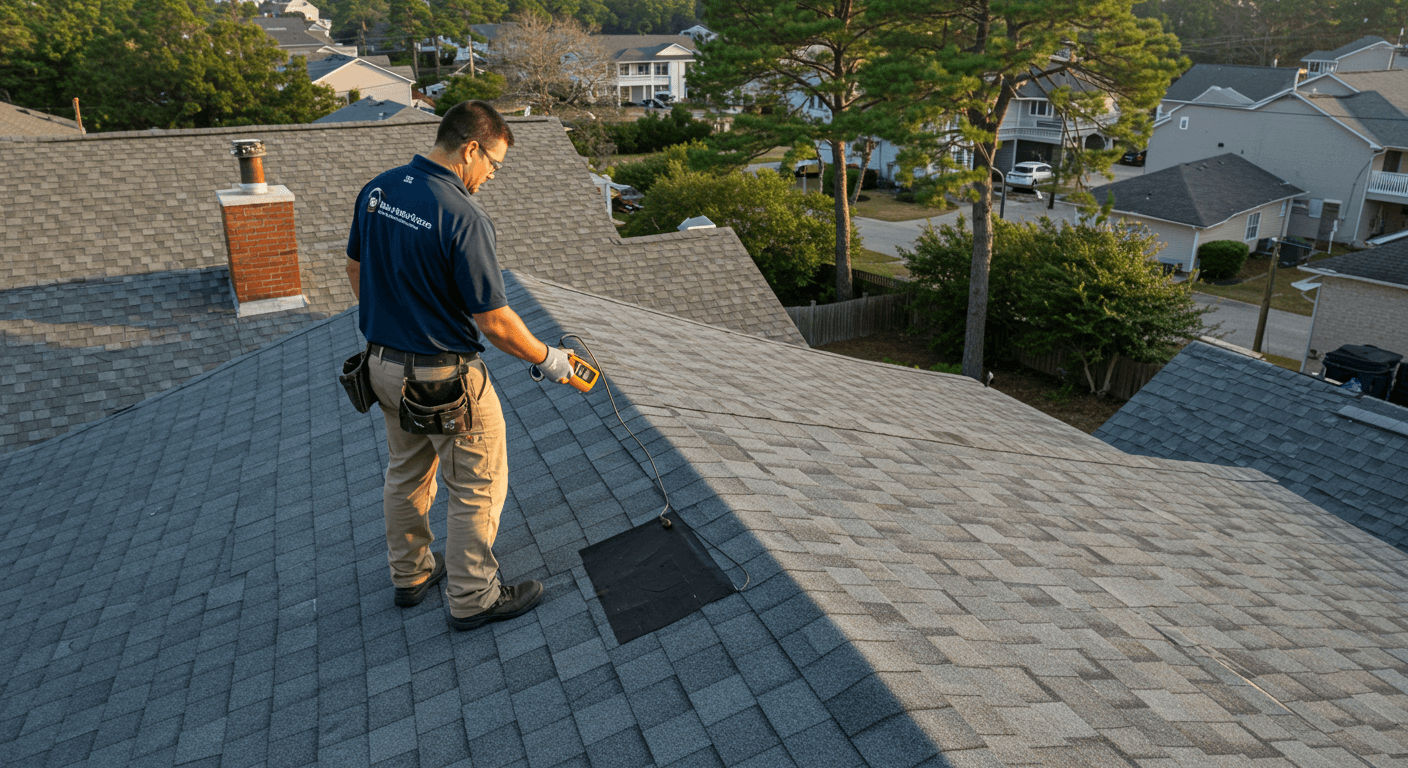
Something shifted in how I looked at job files when I saw three consecutive change orders from a project in Surfside Beach. Each one was for "unforeseen" decking rot. Looking at the inspection photos, it was clear that the inspector had missed the signs of failing transition flashing. We were not just missing rot; we were missing the opportunity to price the job accurately from day one. I realized that a fast inspection is often the most expensive thing a roofing company can do.
When I started working with Finn in his Myrtle Beach shop, he was seeing a callback rate of 8.6%, mostly due to drainage issues that were not addressed during the initial estimate. By shifting his team from a "look at the shingles" mindset to a "diagnose the system" routine, we did not just stop the bleeding. We increased the average contract value by $2,314 per roof because we were finding legitimate issues before the crew ever stepped on a ladder. In a market as competitive as Horry County, where every homeowner is looking at three different bids, being the one who actually knows what is happening under the shingles is a massive competitive advantage.
What Stronger Inspections Buy You
Catch decking delamination before tear-off so change orders do not erase margin or trust mid-job.
Bake drainage into every quote so average job size moves up without relying on vague allowances.
Document boots, vents, and wall transitions so full-system scopes feel obvious, not optional.
Standardize photos at high-risk transitions so callbacks fall and crews stay on schedule.
The Financial Drain of the "Unforeseen" Clause
Why vague decking language hurts closes in Carolina Forest living rooms and on your production calendar.
For many Myrtle Beach roofing owners, the "we will bill you for plywood if we find it" clause is a safety net. But in reality, it is a sales killer. I have watched Finn sit in living rooms in Carolina Forest where homeowners became visibly defensive the moment he mentioned potential extra costs. To them, it feels like a bait-and-switch. To a business owner, it is a scheduling nightmare. When a crew discovers 14 sheets of rotted OSB that were not on the work order, your 1.5-day job turns into a 3-day ordeal, throwing off your entire week's production calendar.
We calculated that every "unforeseen" decking discovery cost Finn's company approximately $485 in lost labor efficiency, separate from the material costs. This is because the crew stops, the lead man calls the office, the office calls the homeowner, and the project stalls while waiting for approval. By the time I arrived, Finn was losing nearly $9,400 a month in stopped-clock labor.
The solution was a 22-point diagnostic routine. We stopped calling them inspections and started calling them Structural Forensic Audits. This simple terminology shift allowed Finn to charge a premium or, more importantly, win the job because he was the only one pointing out that the chimney crickets were undersized for South Carolina's heavy seasonal downpours. According to the Western States Roofing Contractors Association, technical thoroughness in the early stages of a project is the primary driver of long-term profitability.
Stoppages, office calls, and homeowner approvals stack up before you ever order another bundle.
Diagnosing Decking Without the Tear-Off
Humidity, salt air, and hidden soft spots change what a walk-over actually tells you.
The humidity in Myrtle Beach is relentless. If a roof has been leaking for even six months, the salt air and moisture have likely compromised the fasteners or the plies of the decking. I taught Finn's inspectors to look for telegraphing. This is when you can see the slight humps of plywood seams through the shingles. In the afternoon sun on a North Myrtle Beach bungalow, these shadows tell a story.
We implemented a soft-spot walk. Instead of just walking the ridges, inspectors were required to walk the valleys and the areas around the HVAC curbs. If the deck felt spongy, it was an automatic attic entry requirement. If there was no attic access, we used moisture meters along the interior ceiling joists. This data-driven approach meant that 93% of Finn's quotes now included a specific, pre-calculated number of decking sheets, rather than a vague estimate.
This level of detail is especially important when dealing with OSHA roofing safety guidance. A compromised deck is not just a financial risk; it is a safety hazard for your crew. Knowing the deck is solid before the first shingle is pulled ensures that your fall protection anchors are going into something that will actually hold.
Inspection Method Comparison
| Factor | Standard Walk-Through | Structural Diagnostic Routine |
|---|---|---|
| Sales posture | Price-first quoting | Expert-first system diagnosis |
| Decking accuracy | Rough 40 to 50% guesswork | 90%+ sheet counts using telegraphing checks |
| Callbacks | Higher (drainage and accessories missed) | Lower (drainage and accessories priced in) |
| Typical contract band | $10k to $12k averages | $13k to $16k with scoped decking work |
Sales posture
Decking accuracy
Callbacks
Typical contract band
Drainage as a Revenue Center
Gutters stop being a nuisance trade when splash patterns tell you where water is attacking the building.
In the Myrtle Beach market, we get hit with intense, concentrated rain. If a roof is designed to shed water but the gutters are undersized or the downspouts are poorly placed, that water is going to end up behind the fascia or in the foundation. Finn was ignoring gutters, seeing them as a nuisance trade.
I showed him that by including a gutter audit, he could add an average of $1,840 to every contract. We looked at splash patterns on the siding and checked for granule dams in the troughs. If the gutters were clogged or failing, the roof replacement was only half the solution. By positioning his company as a water management specialist, Finn stopped competing on the price of shingles and started selling peace of mind.
This shift pairs well with how verification and preview work on LeadZik. When you know what a job requires before you purchase the lead, you can prioritize work where drainage or complex decking is a strength instead of a surprise.
The "Coastal Accessory" Audit
Salt spray and UV chew through boots and seals faster than many shingle lines suggest.
Myrtle Beach's proximity to the ocean means that standard plastic boots and vents have a shorter lifespan. The UV index and salt spray degrade the neoprene seals on pipe boots in about 7.5 years, often well before the shingles themselves fail.
Finn's new routine required inspectors to physically touch every accessory. We looked for cracked pipe boots (often hidden by a quick coat of spray paint from a previous repair), rusted step flashing (especially in older homes near the Marsh Walk in Murrells Inlet), and improper ventilation balance so intake at the soffits matched exhaust at the ridge.
We found that 64% of roof leaks Finn was called to investigate were actually accessory failures. By replacing these with high-quality, coastal-grade metal components, he was able to offer a leak-free guarantee that his competitors could not match. This was not about being more expensive; it was about being more thorough.
The "Attic-First" Rule
"Whenever possible, start your inspection in the attic. The underside of the decking shows water staining, mold, and daylight through gaps that are invisible from the roof surface. This adds about 15 minutes to your inspection but can save $1,500 in missed repairs."
Scaling the System Across the Team
Owners can eyeball problems; a 24-year-old rep needs guardrails that make thoroughness the default.
It is one thing for an owner to do a great inspection; it is another for a 24-year-old sales rep to do it. We built Finn a digital checklist that required a photo for every point. If there was not a photo of the chimney flashing and the gutter pitch, the estimate could not be submitted to the office.
This forced accountability changed the culture. The sales team started to take pride in finding the hidden issues. We even turned it into a game: the Golden Sheet award for the rep who caught the most rotted decking that would have otherwise been missed.
Action Plan
The 5-Step Myrtle Beach Diagnostic Protocol
A repeatable field sequence that keeps estimates aligned with what production will actually see on the roof.
Perimeter walk: note foundation splash-back, gutter sag, and obvious drainage failures.
Surface analysis: hunt for telegraphing, granule loss, and spongy decking points.
Accessory stress test: physically check boots, vents, and wall transitions.
Attic or interior survey: document stains, mold, and rusted nail heads when access allows.
Data integration: build the quote with fixed-cost decking and drainage solutions, not mystery allowances.
The Results: Beyond the Bottom Line
Margin recovered, crews off the job on time, and reputation that compounds in local groups.
Six months after implementing these routines, Finn's numbers were unrecognizable. His average profit margin per job climbed from 21.4% to 29.8%. Callbacks fell 14.7% compared with the prior rolling average once the photo gates and drainage line items were consistent. More importantly, his crew was happier. They were not getting stuck on jobs for an extra day, which meant they were getting home to their families on time.
In a city like Myrtle Beach, where word of mouth travels fast through local Facebook groups and neighborhood associations, Finn's reputation skyrocketed. He was not the cheap roofer; he was the roofer who found the things everyone else missed. That kind of positioning makes it easier to test LeadZik with real credits and hold a higher conversion rate than the shop quoting squares alone.
The Price-Match Trap
When a homeowner says another contractor did not mention decking rot, resist the urge to match a lower number. Walk them through your diagnostic photos and explain why your scope is accurate. Education turns the cheaper bid into a liability instead of a deal.
Long-term Growth and Efficiency
Fewer callbacks free project managers to chase new starts instead of playing defense on old jobs.
The final piece of the puzzle was the reduction in silent costs. When you have fewer callbacks, your project managers can spend more time on new job starts and less time playing defense on old ones. Finn's PM was able to handle 4.5 more jobs per month because he was not constantly driving back to Surfside Beach to look at a minor leak around a chimney that should have been flashed correctly the first time.
By treating the inspection as a critical operational step rather than just a sales hurdle, you build a foundation for a business that can scale without breaking. You stop being a shingle flipper and start being a construction professional.