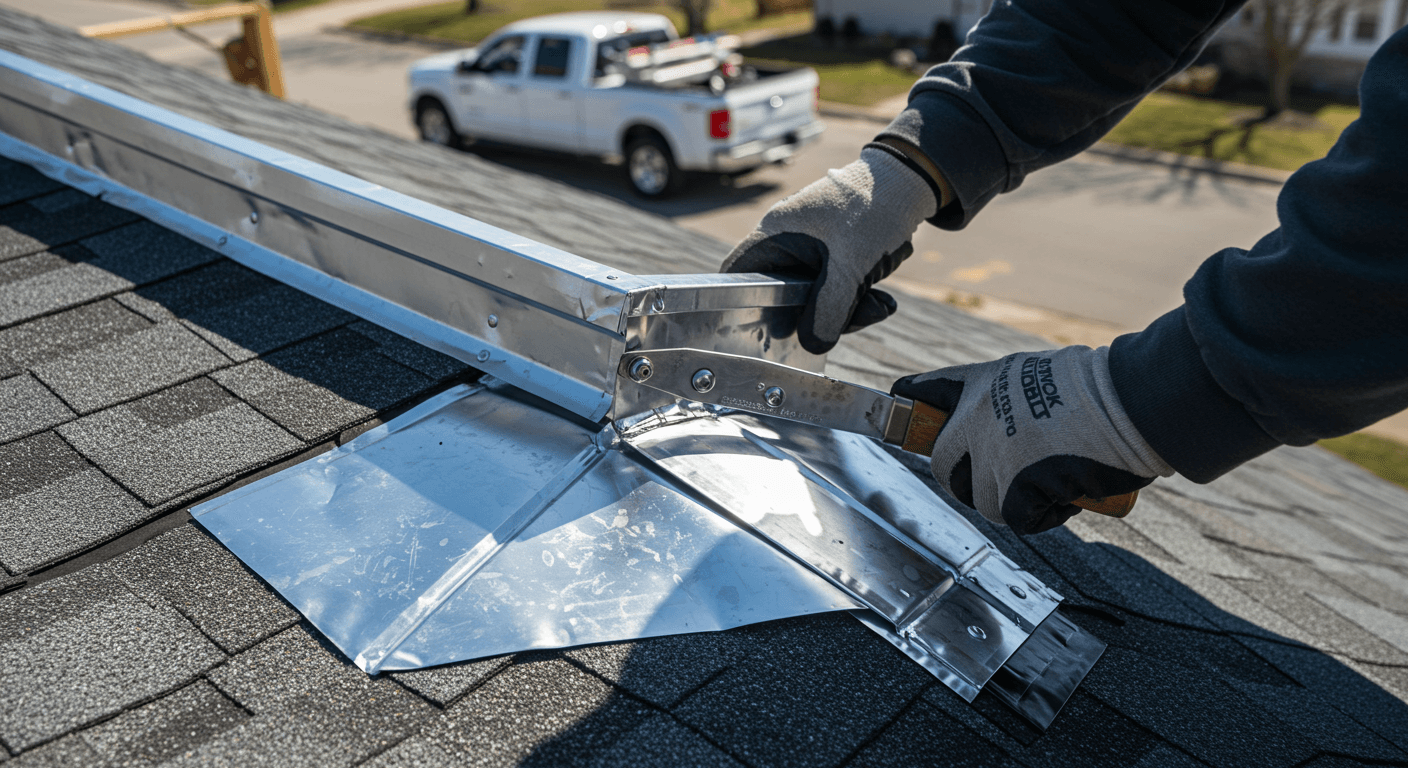
Most owners assume the hard part is moving a homeowner toward a $28,450 designer shingle package while keeping gross margin near 34%. The quieter problem is what happens six months after the final payment, when small water paths open and your net margin gets eaten from underneath. Underlayment and a name-brand laminate matter, but the unglamorous metal transitions are what separate a stable P&L from a shop that keeps paying to install the same roof twice.
When flashing choices live with a rushed sub crew instead of a written field standard, you are not buying quality. You are buying variance. Have you priced a single "minor" leak after you count drive time, labor, materials, reputation damage, and the install revenue you did not capture because your repair tech was tied up at an old address?
That slice is often enough to drag net margin from the high teens down toward 12%. Flashing discipline is one of the few levers that attacks the problem at the source.
Table of Contents
The line item that does not print on the estimate
Callbacks show up as goodwill, not as a SKU.
When I sit with owners on their numbers, we often find a slow bleed that never gets a clean label. It is not always lead cost or lumber spikes. It is the stack of return visits inside the first year and a half. In roofing, the gap between a 12% net and a 19% net is frequently the difference between paying for production once versus funding a second pass on the same street.
A chimney flashing repair is rarely just $400 in labor and tin. You also burn trust that would have become referrals, you load your production manager with firefighting, and you forfeit the revenue from the roof your tech could have been closing instead. The SBA Grow Your Business Guide frames growth as a sequence of predictable operations. If flashing quality swings job to job, your profit line will swing with it.
I recently coached an owner, Jaxon, who ran six crews across three counties. Revenue on the dashboard looked strong. Cash felt flat. When we traced his last 47 callbacks, 39 tied back to wall-to-roof transitions and valley terminations. Each trip was costing him about $2,145 all in. Tightening specs on those two families of details recovered roughly $83,000 in annual profit that had been walking out the side door.
Where margin lives on a steep-slope job
| Detail | Minimum habit | Margin habit |
|---|---|---|
| Step flashing at sidewalls | Layered shortcuts | Woven laps, visible before cover |
| Valley metal at the eave | Loose cut, caulk finish | Hemmed termination, positive drip path |
| Chimney cricket | Skipped on tight schedules | Sized cricket when width exceeds 29 inches |
| Photo proof before shingle cover | Optional | Required for payout |
Step flashing at sidewalls
Valley metal at the eave
Chimney cricket
Photo proof before shingle cover
The right column reads slower on site. It also reads cleaner on your bank statement.
What actually protects the $8,420 band
Treat about $8,420 per quarter as a realistic margin leak when you stack soft costs on flashing callbacks across a midsize shop.
Wall-to-roof and valley exits belong on a short list of non-negotiable details with photo checkpoints.
Sales should narrate metal as risk removal, not as a hidden upcharge, so premium bids stay defensible.
Move reserves from warranty guesswork toward engineered transitions so net margin stops bouncing with weather.
Why premium shingles still lose without premium metal
Warranty language is unforgiving on accessory work.
Selling a lifetime-rated laminate while sourcing the thinnest step stock you can find is how you build a legal file, not a brand. Many owners believe the shingle warranty is a backstop. In practice, a large share of denials I review cite improper installation of accessory components, and flashing is the usual headline.
Side-wall diverter detail
"Do not terminate a side-wall run without a dedicated diverter flashing. The part is inexpensive relative to the callback it prevents, and it gives your estimator a clean line item for controlled water off the wall plane."
Training drift is the second half of the problem. A strong lead installer may have learned in a market where sealant was treated as a primary defense. If that habit lands on your premium installs, you are underwriting someone else's old shortcut. The shift you want is mechanical: water leaves on metal and gravity, not on a bead that ages out in a few seasons of sun cycles.
Training reps to sell integrated flashing
Fear of price is usually fear of language.
Reps get nervous about adding roughly $1,200 for custom metal because they assume it kills close rate. In the field, the opposite often holds when the story is framed as risk removal instead of upsell theater.
I call the talk track the Invisible Shield. In plain terms, you contrast a full metal reset with competitors who leave old, work-hardened pieces hidden behind siding, then you anchor the price to avoided interior damage. When homeowners hear geometry and replacement logic instead of a mystery line item, premium closes tick up. That mirrors what you read in Harvard Business Review Small Business coverage on value-based pricing: compete on clarity of outcome, not on who can shave visible squares the hardest.
"Most proposals you receive will price the laminate you want, but they will leave the old counter flashing in place to keep the bid soft. That metal already lived through years of expansion cycles. We replace it as part of a full metal reset on premium installs so you are not funding a ceiling repair two winters from now. The upfront delta is small compared with the interior bill when old tin finally gives."
Swap dollar bands and neighborhood language so the story matches your market. The structure stays the same: contrast, consequence, then a choice that feels obvious.
Stacking drip edge
Installing new drip edge over old, bent drip edge saves a few minutes and invites a capillary gap that pulls water back toward fascia and soffit. You keep the labor, you inherit the rot call.
Five transition zones that quietly erase margin
If you cannot photograph it, you cannot defend it.
Give production a checklist that is tied to pay. A simple rule works: no photo of integrated flashing before cover, no completion. Subs and in-house crews should face the same bar.
- Chimney cricket: when the masonry span crosses about 29 inches, fabricate a cricket instead of relying on sealant mass alone. Insurance-grade scopes still get rejected when the diverter geometry is wrong.
- Step flashing weave: each course should engage the shingle above, not sit as a stacked shim.
- Pipe boots: a quality boot helps, and a secondary ice-and-water patch under the field keeps long-term sweating from becoming a mystery stain.
- Valley termination: hem the metal at the eave so water cannot jump the track and run behind fascia metal.
- Headwall overlap: plan at least four and a half inches of vertical coverage, especially where wind-driven rain is common.
A simple owner-led flashing audit
Random files, honest photos, one afternoon of math.
Action Plan
Four-step flashing audit for owners
You do not need a third-party firm to start. You need random jobs, honest photos, and a calculator.
Pull three completed jobs from the last ninety days using a random rule, not cherry-picked winners.
Walk chimneys with a light touch on counter flashing. Loose pieces forecast future stains.
Open the photo set and hunt for woven step laps and valley exits before shingle cover, not pretty ridge caps after the fact.
Divide unbilled repair labor on those files by collected revenue to see if silent rework is eating the quarter you thought you won.
Culture beats slogans
Speed without repeat visits is the only speed that counts.
Efficiency is not how fast a crew can lay bundles. It is how rarely they return to the same mailbox. When you protect twenty-five extra minutes to bend a clean aluminum or copper piece, you buy fewer emergency texts on Saturday night. Morale follows, because crews know hidden work counts in your shop.
Referrals rise when neighbors stop hearing drip stories about your sign in the yard. Once production is steady, scaling is less frightening. A platform that scores demand, locks turf, and pushes alerts into the tools you already use is easier to justify when your install standard is repeatable. You are not trying to outrun leaks with volume.
The owners I respect do not hope water stays out. They build assemblies where normal rain and melt leave on purpose-built paths. Metal is the quiet half of that promise. If your team is exhausted from defending cheap competitor bids, it is worth pairing technical standards with intake that respects your time. Read how LeadZik built a lead marketplace around exclusivity and verification so sales stops chasing people who were never buying craft in the first place.