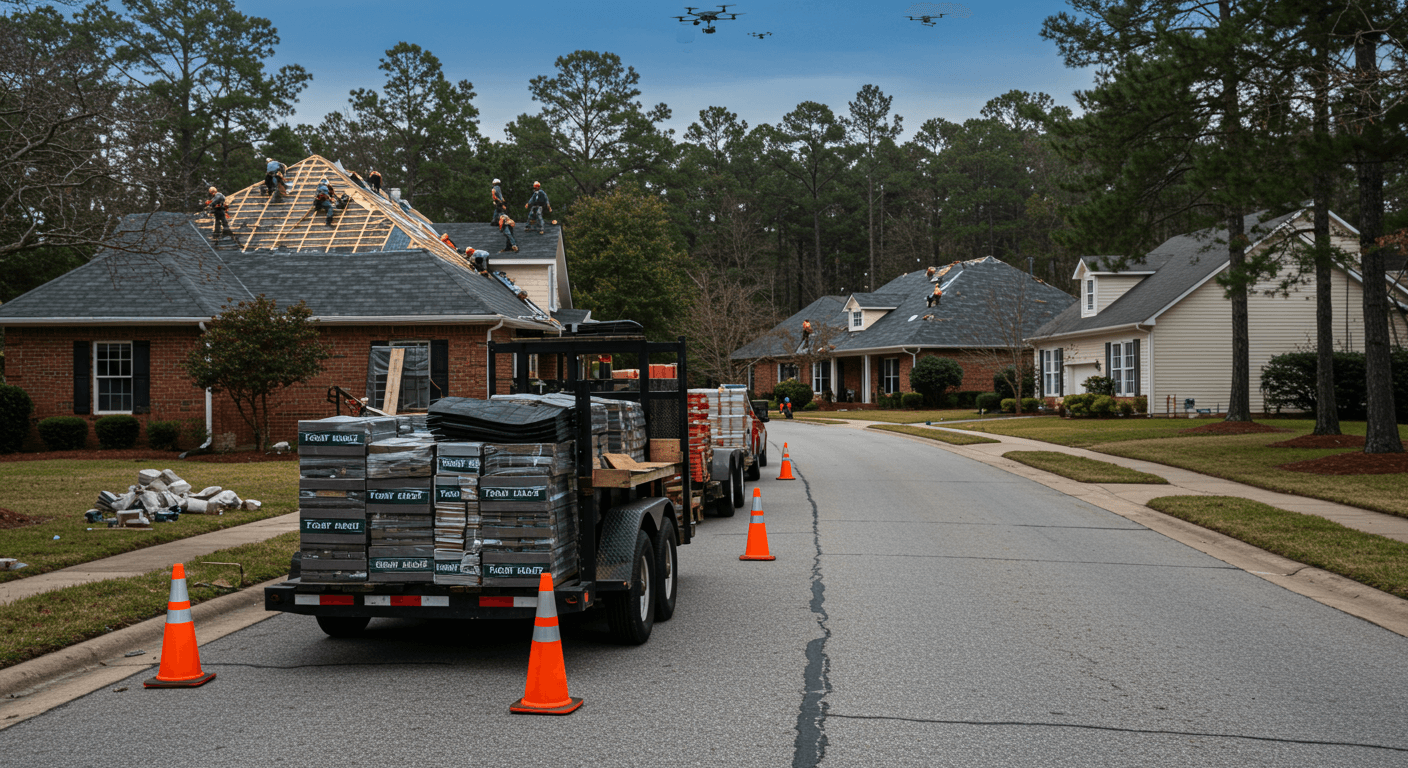
Before the 2023 hailstorms ripped through the Lexington and Irmo corridors, Wesley was running a respectable three-crew operation out of a small yard near Cayce. He was pulling in roughly $2.4 million annually, but his net margins hovered at a stressful 12.4% because he was constantly reactive. Contrast that with his performance six months after the storms: his revenue didn't just double—his net profit jumped to 19.8% while his competitors were drowning in supplement backlogs and labor disputes. While most Columbia shop owners were frantically chasing every "roof for free" sign in Forest Acres, Wesley treated the disaster as a logistics puzzle rather than a sales lottery.
I spent a week in Wesley's office during the peak of that recovery. The difference between his shop and the dozen others I've coached in the Midlands came down to one thing: friction reduction. Most guys think a storm is a license to print money, but without a specific system for high-volume intake and safety compliance, it's actually a license to go broke faster. You're paying more for labor, materials are on backorder at the local distributors, and your sales reps start making promises the production team can't keep.
We looked at the data from 147 of his local projects. The shops that "chased" the storm with door-knockers alone saw a closing rate of about 14% on cold leads. Wesley, by focusing on verified homeowner data, maintained a closing rate of 41.3%. He wasn't wasting gas driving out to Lake Murray for "leads" that turned out to be renters or people who had already signed three contingency agreements. He was playing a different game entirely.
At a Glance
Infrastructure must precede the storm; scaling mid-disaster leads to a 15-20% "chaos tax" on margins.
Transitioning from "storm chaser" to "recovery consultant" increases average job value by approximately $2,840 through proper supplement management.
Safety isn't a cost center; implementing rigorous fall protection standards reduces insurance premiums and prevents work stoppages during peak revenue months.
Localized targeting in specific Columbia ZIP codes (like 29206 or 29063) reduces drive-time waste by 22% for production crews.
The Infrastructure of a High-Margin Recovery
Winning in the Columbia market after a disaster isn't about who has the loudest megaphone; it's about who has the cleanest pipeline. I remember sitting with Wesley's lead salesperson, a guy named Bryce, who was staring at a stack of folders. "I can't tell which of these are real jobs and which are just tire-kickers," Bryce told me. That's the "Midlands Trap." You see a sea of blue tarps and assume it's all profit.
The reality is that post-storm environments are high-noise. Homeowners are stressed, insurance adjusters are overworked, and the City of Columbia permitting office gets backed up for weeks. To thrive, you have to eliminate the guesswork. Wesley stopped buying "raw" storm data and started focusing on exclusive, verified opportunities. This allowed his team to pre-vet every roof before a ladder ever touched a gutter.
If you're wondering how the math on that works, look at the overhead. A sales rep in a wrapped truck costs you roughly $115 per hour when you factor in salary, fuel, and opportunity cost. If they spend four hours a day chasing bad leads, you're burning $460 daily per rep. Over a 22-day work month, that's $10,120 in wasted payroll. Wesley's shift to a vetted intake process saved him nearly $32,000 in monthly sales waste during the 2023 season.
Action Plan
The 4-Step Precision Recovery Framework for Columbia Contractors
A systematic approach to scaling operations during post-storm recovery while maintaining margins and safety compliance.
Step 1: Neighborhood Saturation. Identify specific storm paths using radar overlay (e.g., the 2023 path through Chapin and Ballentine) rather than "shotgunning" the whole county.
Step 2: Resource Staging. Secure material allotments with local suppliers before the surge pricing hits, ensuring a 4-5% material cost advantage.
Step 3: Administrative Pre-Loading. Hire temporary local "adjuster liaisons" to handle the Xactimate supplements, freeing up sales reps to stay in the field.
Step 4: Safety Synchronization. Deploy site supervisors specifically to audit OSHA fall protection compliance daily to avoid the $15,000+ fines that often follow increased local inspections after disasters.
Want to skip the manual work and get exclusive, verified leads instead?
Get $150 in Free CreditsFor comprehensive guidance on fall protection standards, refer to OSHA's Stop Falls campaign, which provides the Plan, Provide, Train framework essential for construction site safety.
Sales Psychology: From Vendor to Consultant
One of the biggest mistakes I see in the Midlands is the "we'll pay your deductible" pitch. Not only is it a legal gray area in South Carolina, but it also devalues your brand. Wesley and I reworked his entire sales script. Instead of talking about "free roofs," we talked about "asset protection" and "insurance navigation."
I listened to one of his reps, Jordan, handle a tough call in Shandon. The homeowner was skeptical because three other guys had already knocked on her door that morning. Jordan didn't talk about shingles. He talked about the specific South Carolina LLR requirements for contractors and why an "out of state" crew wouldn't understand the local wind-load codes. He moved the conversation from price to expertise.
This psychological shift allowed Wesley to maintain a 38% gross margin even when competitors were slashing prices to win bids. When you're dealing with disaster recovery, the homeowner's primary emotion is fear—fear of being scammed, fear of a leaky roof, and fear of insurance denials. If you can solve the fear, price becomes secondary.
Production Velocity and the Safety Multiplier
Speed is the enemy of safety, and in a post-storm environment, speed is usually what contractors optimize for. But here's the kicker: one major accident on a job site in West Columbia can wipe out your entire season's profit. I've seen it happen. A crew gets hurried, a harness isn't clipped, and suddenly you're facing a six-figure lawsuit and an OSHA investigation.
Wesley took a different approach. He implemented a "Safety First, Speed Second" bonus for his sub-crews. If a crew completed a week with zero safety infractions and 100% cleanup, they got a $650 bonus. To the average roofer, that sounds like a lot of "lost" money. To Wesley, it was an investment. His EMR (Experience Modification Rate) dropped, his insurance premiums followed suit, and he didn't lose a single man-day to injury during the busiest four months of the year.
This production stability allowed him to accurately predict his completion dates. In a market where every other roofer is saying "we'll get to you in 6 weeks," Wesley could say "We will be there on Tuesday at 7:30 AM." That reliability is worth more than any marketing campaign.
The 'Adjuster Packet' Secret
"Equip your reps with a physical 'Adjuster Packet' for every job. Include high-res photos of the damage, a pre-written Xactimate estimate, and local code requirements. When you make the adjuster's job 50% easier, they are 80% more likely to approve your supplements without a fight."
Managing the Post-Storm Cash Flow Gap
The silent killer of roofing companies after a disaster isn't a lack of work—it's the cash flow gap. You're paying for materials and labor today, but the insurance checks might not clear for 45 or 60 days. Wesley almost went under in 2019 because he had $480,000 tied up in accounts receivable while his suppliers were breathing down his neck.
To fix this, we implemented a strict progress-payment system. He also became much more selective about which jobs he took. He stopped taking "long-shot" insurance claims and focused only on leads with high probability of approval. If you're struggling with the financial side of scaling, it's often because your "verified" leads aren't actually verified.
I told Wesley what I tell all my coaching clients: revenue is vanity, profit is sanity, but cash is king. If you don't have a plan for how to float $250,000 in material costs for 8 weeks, you shouldn't be scaling your crew count. You need to understand the pricing and refund structures of your lead sources so you aren't throwing good money after bad.
Conclusion: The Long Game in the Midlands
By the time the 2023 season wound down, Wesley wasn't just another roofer in Columbia. He had become the go-to guy for high-end residential work. He didn't do it by being the cheapest or the fastest. He did it by building a system that could handle the pressure of a disaster without cracking.
If you're tired of the "boom and bust" cycle of South Carolina weather, it's time to stop acting like a hunter and start acting like an architect. Build the systems, verify your data, and protect your margins. The next storm is coming—the only question is whether you'll be the guy chasing it or the guy managing it. If you need help tightening up your own sales pipeline or have questions about how we vet our data, feel free to reach out to our support team. We've helped dozens of shops in the Southeast transition from reactive to proactive.