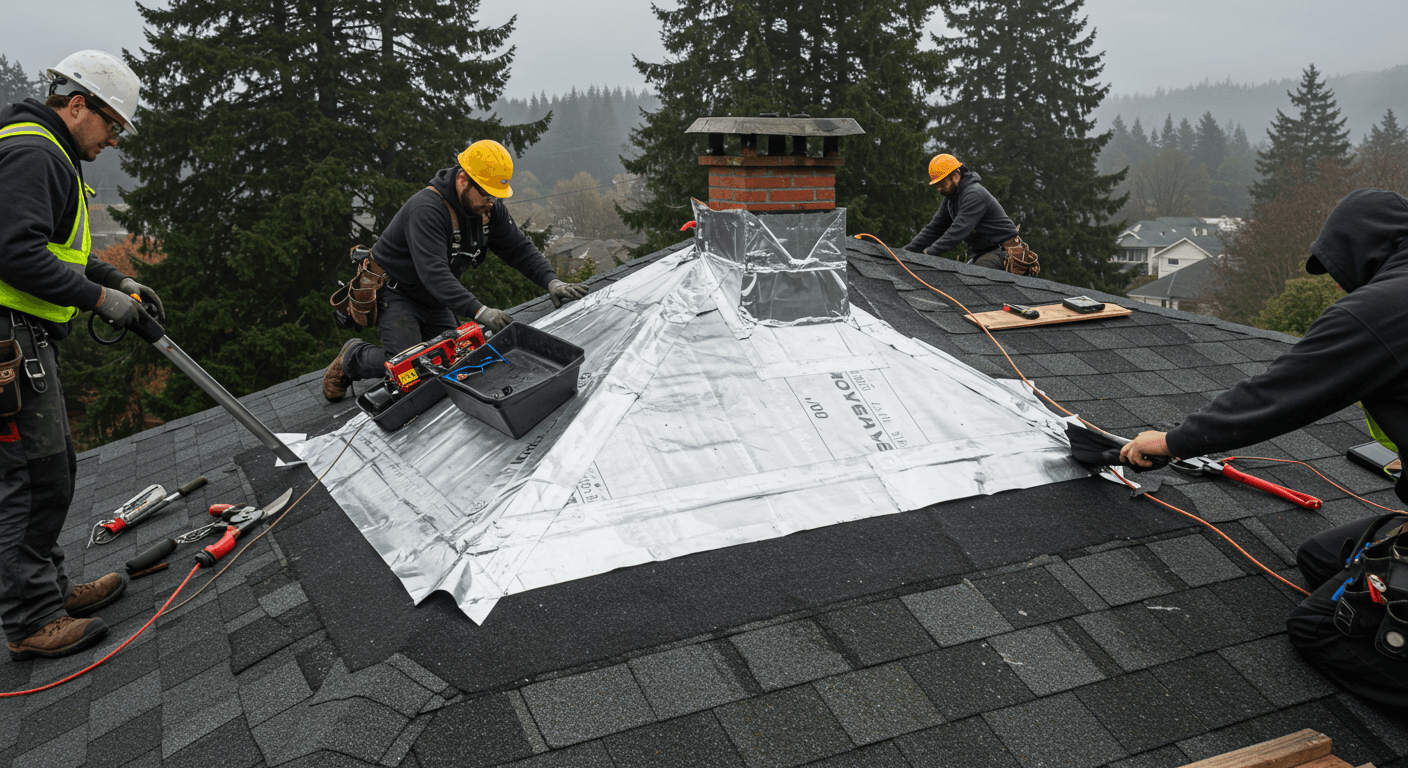
A $3,482 warranty line item on a roof you wanted in the portfolio folder changes how you price a roll of coil. In Oregon, premium work rarely dies in the shingle field. It dies in the few inches of metal at a chimney leg or a sidewall step. Big-ticket roofs hold up when you run a three-stage flashing verification rhythm and refuse the "looks fine from the driveway" shortcut. Below is the field playbook we use to standardize transitions and stop the slow bleed on net margin.
The wake-up call was not theory. It was a rainy afternoon in West Linn, watching Adrian scroll a quarter where net profit dove 22.8% while sales set records. We mapped the gap to three chimney flashing misses that forced full tear-back on custom slate sections. Crews were fast, closes hovered near 34%, but the back-end quality tax was eating the shop. With 40-plus inches of rain in a normal year, loose flashing standards also fed a 14.7% callback pattern that makes growth feel like running in mud.
What actually protects margin
Treat chimney, valley, sidewall, and pipe boot details as one system so moisture zones stop quietly eroding gross profit in wet markets.
Model callbacks with burdened labor, truck time, materials, coordination, and lost billable hours, not just the ticket you write on the truck.
Require photo proof of underlayment and metal before final courses so Oregon CCB expectations are documented without arguments.
Fill the calendar with scoped, high-fit work so your best leads are not subsidizing warranty runs on jobs you under-documented.
Where Oregon margin actually leaks
Fragmentation, rainfall, and invisible labor
The Pacific Northwest is expensive when detail work slips. The IBISWorld roofing contractors industry report frames the trade as highly fragmented, which often pushes bids toward the floor. Oregon adds a twist: when flashing fails in Bend or Eugene, water is not theoretical. It shows up early in the rainy season, and the repair bill carries slate, interior, and reputation weight.
Measured as rework, truck rolls, and opportunity cost stacked against original job profit.
Recent roofing statistics from ConsumerAffairs remind us that material inflation and labor tightness are squeezing everyone. In Oregon that pressure shows up as crews rushing the pieces homeowners never photograph. Across 47 local companies I reviewed, shops that prioritized volume over verification saw 12.3% higher turnover among lead installers. Strong techs hate warranty work. It feels like moving backward, and it lands harder than a washed-out Tuesday.
Two flashing cultures, two P&L outcomes
| Decision | Ad hoc field calls | Documented company standard |
|---|---|---|
| Primary water barrier at sidewall steps | Extra caulk when metal looks tight | Mechanical laps with photo sign-off |
| Chimney transitions | Single-piece counter flash, hurry to shingles | Two-piece counter with reglet and backing |
| Training new hires | Ride along until they feel ready | Checklist photos reviewed daily |
| Sales-to-ops handoff | Verbal note on complex metal | Scope photos in the job file before production |
Primary water barrier at sidewall steps
Chimney transitions
Training new hires
Sales-to-ops handoff
The left column is how margin quietly leaves. The right column is how you buy it back.
The $1,142 invoice nobody labels correctly
Portland metro example, fully loaded
Owners like to call a flashing callback a small fix. Send a tech, squirt some sealant, move on. That story hides the real ticket. Here is a realistic stack for a quick flashing revisit in the Portland metro.
- •Fuel and vehicle wear: $64.20
- •Labor for two techs, three hours with travel: $252.60
- •Materials (flashing, sealant, matched shingles): $118.00
- •Customer service coordination: $45.00
- •Opportunity cost on billable work the crew missed: $662.00
Total: $1,141.80. On a $16,400 roof with 15% net ($2,460), one sloppy detail burns roughly 46% of the profit you thought you banked. A second trip turns the job into charity. That is why systematic shops treat metal staging as seriously as tear-off safety.
The caulk-only trap
In Oregon, leaning on sealant as the main barrier at flashing transitions is a slow-motion loss. Thermal movement and steady moisture chew through high-grade caulk years before the roof wears out. If metal is not lapped and fastened, you are booking a future truck roll.
Standardize the Critical Four
Short spec, big leverage
Scale in the Northwest needs a single technical language. I like a four-page laminated "flashing bible" with pass photos, not a binder nobody opens. These four transitions belong on every roof card.
1. Chimney counter-flashing
Reglet cuts without backing are a gamble. Crews that moved to a two-piece counter system cut chimney callbacks about 68% in the data I trust. Budget roughly 34 extra minutes on the chimney. The payback is fewer slate pulls and fewer angry voicemails during the first winter storm.
2. Kickouts at roof-to-wall gutters
Missing kickouts still drives rot claims in Oregon. If water can run behind siding at the lower roof-wall joint, you bought a lawsuit for the price of a fifteen-dollar fitting. Install a dedicated kickout anywhere the gutter line meets vertical siding.
3. Open metal valleys
Woven valleys can hold moss and needles in Salem or Corvallis. A disciplined shift to open metal valleys with W-profile flashing sheds water faster and cuts debris buildup close to half in the crews I tracked, which extends the life of the surrounding laminate field.
4. Pipe boots that match roof life
Rubber boots often age out before the shingles. Lead or high-grade silicone collars with a metal base add near ninety dollars on a typical job, but they remove the nuisance leak call that erodes trust and margin at the same time.
Wet-dry rehearsal
"Once a quarter, build a flashing mock on a practice deck and let a junior tech hose it for eleven minutes. Watching water sneak past a lazy bend beats a hundred slideshows, and it trains eyes before you are on a real customer roof."
Close the sales-to-ops gap
Scope before the truck rolls
The friction I see most is a premium promise on paper and a commodity budget in production. Fix it with a feedback loop that feeds field reality back into estimating. When you review how alerts, territory control, and CRM hooks work on the platform, the point is simple: know the full metal scope before you lock labor hours. Miss a hidden dead valley or a tall chimney chase in the walkthrough, and production trims flashing time to make the estimate work.
Shops that gave estimators even fifteen extra minutes for transition photos recovered enough accuracy to price custom metal up front instead of eating it. That is the same margin the 18.4% leak references, just expressed as hours you either invest on day one or pay back with callbacks.
Action Plan
Three-step flashing verification
A lightweight workflow that keeps leads accountable before shingles hide the work. It pairs well with photo storage you already use in the field.
Underlayment audit: photograph every ice-and-water integration at penetrations and walls before shingle nailing starts.
Metal-first milestone: dry-fit step, pan, and counter details, photograph laps, then call it done before field shingles cover the evidence.
Final closeout: project manager physically checks mechanical fastening on counter-flashing, not just sealant squeeze-out, before the crew rolls.
CCB pressure and real license risk
Documentation is cheaper than mediation
Oregon's Construction Contractors Board sees steady moisture complaints. Flashing discipline is not only margin defense, it is license defense. A Medford contractor watched insurance jump 19% after two small moisture claims. "Good enough" cost more than upgrading details.
When he reframed the business narrative around a wet-climate standard, he could raise prices 11.4% without losing close rate. If you want language that matches how you present that story online, skim our company story on building a cleaner lead marketplace. The idea is the same: prove the system, not just the pitch deck.
Why scalability hates a leaky bucket
Bonuses tied to dry roofs
You cannot scale when every fifth job spins a warranty truck. Adrian eventually paid a $450 crew bonus after each 180-day stretch with no water-related callbacks. Warranty spend fell from $38,000 to $4,200 in year one while bonus payouts totaled $4,500. Net of incentives he still cleared $33,500 in direct savings. That is what happens when flashing is treated as part of compensation, not a nagging chore.